
Related videos:
Almost three years after the tragic fire that devastated the Supertankers Base in Matanzas, one of the most important energy infrastructures in Cuba, the reconstruction efforts are progressing, albeit slowly, thanks to a collaboration between Cuban forces and Chinese workers.
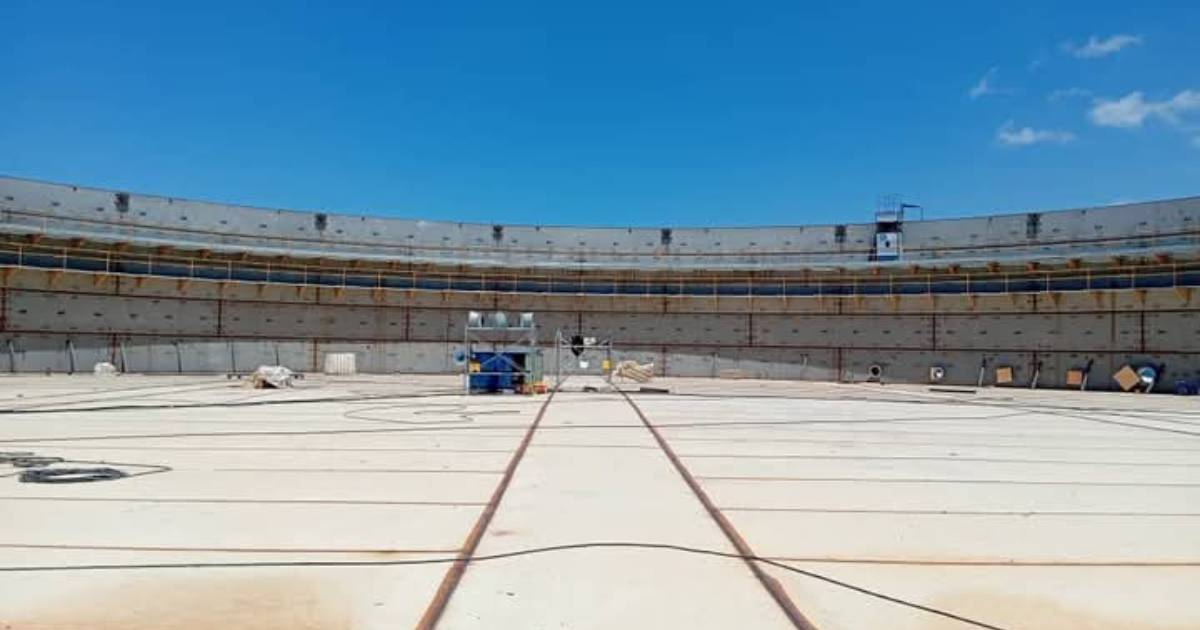
According to reports from the local newspaper Girón, four new storage tanks have begun to be constructed, identified as tanks 88, 49-1, 86, and 87. Tank 88, built by Cuban workers, is 60% complete, while the other three are the responsibility of Chinese brigades, who are making progress on structures spread over two platforms, unlike the original tanks which were located together.
“The work is progressing... we are in the mechanical finishing phase before moving on to the painting phase,” explained engineer Richard Daniel Martínez Sánchez, who is leading the Integrated Project Management.
The Fuel Marketing Company (CUPET) leads the investment, which includes seven kilometers of asphalt access, two kilometers of perimeter fencing, greater distance between the tanks, and modern lightning protection systems. The goal: to build a safer terminal, less vulnerable, and with a renewed image.
Pain, loss, and a country in mourning
On August 5, 2022, a lightning strike hit a tank full of crude oil, causing a series of explosions that destroyed four of the eight storage tanks at the Matanzas base.
The flames, which burned for more than a week, claimed the lives of at least 17 people, including young firefighters and rescue personnel, as well as leaving dozens injured and causing severe environmental damage that has not yet been fully quantified.
Entire families lived through days of anguish, with no news of their missing loved ones disappeared amid the toxic smoke that enveloped the sky of Matanzas. Social media was filled with photos, prayers, and desperate calls for help. The tragedy profoundly impacted the collective memory of the nation.
Logistically, the incident severely compromised the storage and distribution capacity of fuel on the island, at a time already marked by an energy crisis. The loss of 200,000 cubic meters of storage capacity impacted not only the electricity supply but also transportation and the daily lives of millions of Cubans.
Reconstruction without clear deadlines
Despite the current progress, there are no official dates for the completion of the work. In February of this year, a brief update on social media from CUPET reflected the slow pace of the work, affected by the economic crisis, the shortage of materials, and the technological dependence on foreign allies such as China.
In April 2024, other images published by CUPET showed only the constructed base of tank 88. The vertical welding work and the installation of firewalls continued to be the "bottleneck" of the project.
Although officials from the Ministry of Energy and Mines had announced that only two new tanks would be constructed for safety reasons, the recent local report now mentions four tanks being built. All of them will have retention basins and greater distances between each other to prevent another disaster of a similar magnitude.
Memory, fire, and future
The fire in Matanzas is, for many Cubans, a deep wound. A tragedy that exposed structural vulnerabilities, official improvisations, and a crisis management that raised more questions than answers.
Today, the new tanks rise among scaffolding, cranes, and workers dressed in protective suits. But beyond the steel and cement, the country continues to seek certainties: when will the construction be completed? What guarantees exist to prevent another disaster? How much has this tragedy cost in lives, resources, and collective memory?
The reconstruction of the Supertankers Base is making progress, yes, but is still far from closing a chapter that deeply marked Cuba. And whose flame, symbolically, is still not extinguished.
Filed under: