
Related videos:
The Cuban sports journalist Raúl Rodríguez shared on his social media a post that rawly portrays the contradictions of contemporary life in Havana.
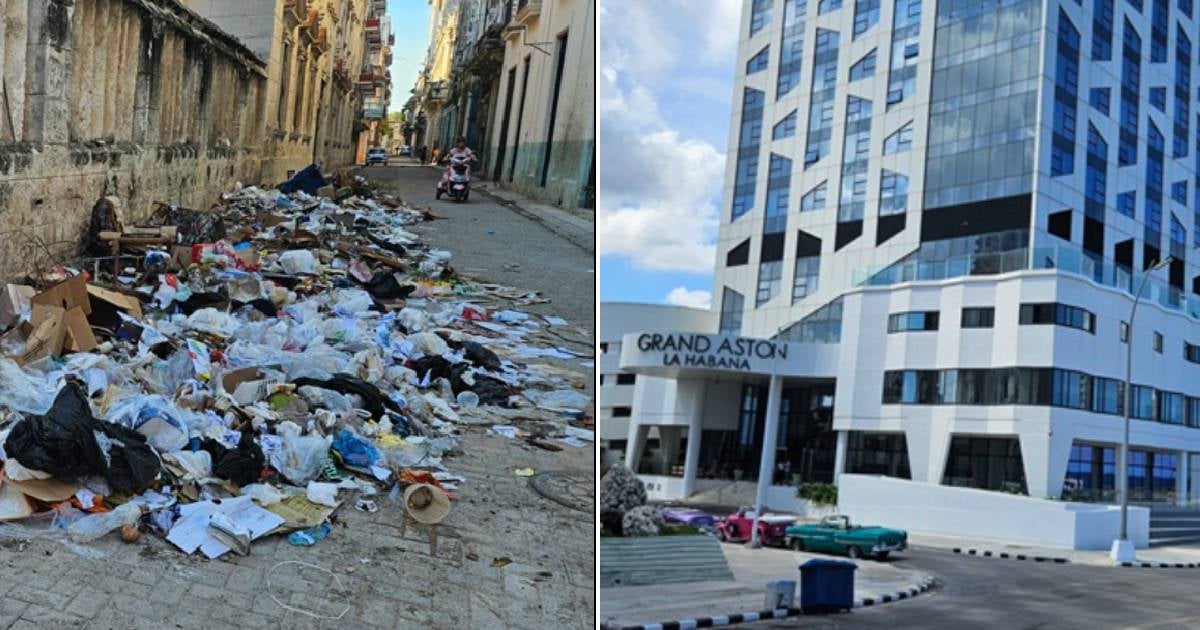
Through a series of images, Rodríguez, an experienced and prominent radio communicator, contrasted the majestic hotels built by the regime with the everyday scenes of overflowing garbage dumps on the corners of Havana.
"The two Havanas. One remarkable, that endures, is occasionally made up to keep it going; the other is gasping, painful, and cries out for some relief," he wrote, referring to what he himself describes as "images from any day in the suffocating August of 2025."
As explained, some of the photos were taken from a tourist bus, while others capture the visible deterioration in the depths of the 15 municipalities of Havana.
Painful contrast
The publication illustrates the dual nature of a city where the regime invests millions in hotel infrastructure, while its citizens grapple with garbage accumulation, lack of basic services, blackouts and a life marked by misery.
Rodríguez's graphic testimony adds to the increasingly frequent complaints circulating on social media, where Cubans document the deterioration of entire neighborhoods in the face of a government that insists on presenting to the outside world a system of "achievements," while the internal reality reveals a landscape of neglect and shortages.
Havana... a reflection of contemporary Cuba
In Cuba, poverty is felt on every corner. Families survive with the bare minimum amidst blackouts, food shortages, and salaries that don't even cover basic necessities.
The population is caught in an endless crisis that is worsened by inflation and the mass exodus of young people fleeing misery in search of a dignified future beyond the island.
The architecture, which was once the pride of Havana and many cities in the country, is now in ruins.
Colonial buildings and 20th-century constructions are collapsing due to a lack of maintenance, leaving dozens of families homeless. The collapses have become frequent, while the regime barely offers real solutions and blames the "blockade" for its own negligence and poor management.
Paradigmatically, the communist government invests millions in building and promoting luxury hotels aimed at foreign tourism, while hospitals lack medicines, medical equipment is outdated, and patients must bring everything from syringes to antibiotics in order to receive care.
This contradiction illustrates the regime's priority: to attract foreign currency to sustain its power apparatus, even though the Cuban people continue to be mired in deep precariousness.
Frequently Asked Questions about Social Contrast in Havana, Cuba
How do inequalities manifest in Havana?
Inequalities in Havana are evident in the contrast between luxurious hotels aimed at tourism and the daily misery faced by Cubans. While the government invests in hotel infrastructure, many neighborhoods face garbage accumulation, lack of basic services, and constant blackouts. This contrast highlights the regime's priorities, which focus on attracting foreign currency while neglecting the basic needs of the population.
What is the current state of infrastructure in Havana?
The infrastructure in Havana is in a lamentable state, with colonial buildings and 20th-century constructions in ruins due to a lack of maintenance. This deterioration has left many families homeless due to frequent collapses, while the government prioritizes the construction of luxury hotels for foreign tourism.
How does the energy crisis affect Cubans in Havana?
The energy crisis in Cuba is severe, with blackouts that can last up to 20 hours a day in several provinces, including Havana. These extended blackouts impact the daily lives of Cubans, who suffer from the loss of refrigerated food and lack of ventilation in a stifling climate. Paradoxically, while entire neighborhoods remain in darkness, luxury hotels like Torre K-23 are fully lit.
Why do luxury hotels continue to operate while there are blackouts in Cuba?
The Cuban government prioritizes the operation of luxury hotels to attract tourism and foreign currency, even amid an energy crisis that impacts the majority of the population. While citizens face prolonged blackouts, these hotels remain lit and operational, reflecting a clear inequality in the distribution of resources. This situation has generated outrage among Cubans, who see how tourism is favored over their basic needs.
What impact does the tourism economy have on the daily lives of Cubans?
The tourism economy in Cuba is focused on generating revenue through services for foreigners, which puts the local population at a disadvantage. While the government invests in attracting tourists, Cubans are facing shortages of basic goods, insufficient wages, and a deteriorating urban environment. The local population does not have access to the same services and products as tourists, which increases the feeling of inequality and neglect.
Filed under: