
Related videos:
The head of Mission at the United States Embassy in Cuba, Mike Hammer, reaffirmed on Friday the commitment of Washington to the Cuban people while commemorating the tenth anniversary of the reopening of the diplomatic mission in Havana.
In a message shared on their X account, Hammer emphasized the importance of maintaining direct contact with the public.
"Today we commemorate 10 years since we reopened our Embassy. We continue with our mission to support the Cuban people in their aspirations for a better future," stated the diplomat
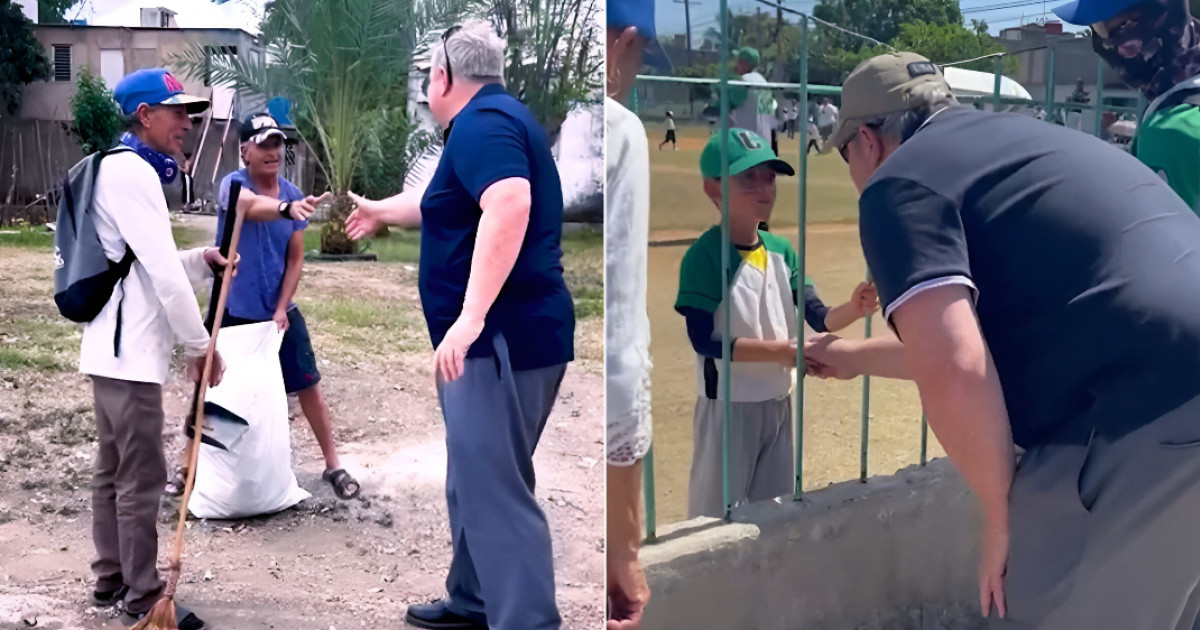
"We are committed to continuing to engage with everyday Cubans across the country to understand their priorities and concerns, and to amplify their voices," he said in a video where he is seen walking through the streets of Holguín, Cienfuegos, Bayamo, and Güines, greeting and chatting with the elderly, young people, women, and children.
In another post, she shared images from her visit to Cienfuegos, where she accompanied a family at a children's baseball game.
"The Cubans I have met during my travels across the island deserve a better future," he stated.
In a relaxed tone, Hammer appeared wearing a cap from the local baseball team, assuring that he always cheers "for those who fight hard and have suffered, but are determined to achieve victory."
"We'll see each other in the streets; if you see me, invite me to play a game of dominoes or maybe we can have a little coffee," she added cheerfully.
A direct contact strategy
Since his arrival in Cuba in November 2024, succeeding Benjamin G. Ziff, Hammer has advocated for a direct and open diplomacy.
Her travels through various cities in the country have not been limited to official meetings; they have also included gatherings with artists, activists, and ordinary citizens—something unusual in a context where the regime restricts diplomats' contact with the population.
In August, during a visit to Matanzas, he was closely followed by State Security agents, although no incidents occurred.
In July, while walking with his family in Varadero, a group of alleged "revolutionaries" confronted him with criticisms of the embargo. The episode, filmed and shared by profiles linked to MININT, was part of the harassment campaign against his work on the Island.
Far from stopping, Hammer has insisted on appearing in public spaces and engaging in dialogue with the people, a symbolic gesture that contrasts with the secrecy of the Cuban government.
Criticism of the regime and support from Washington
Hammer's style has not gone unnoticed in Havana.
In May, the official program "Con Filo" dedicated a segment to attacking him, labeling him as "cynical" and accusing him of being an emissary of Washington's "suffocation" policy.
However, his appointment was precisely a sign of the United States' commitment to human rights in Cuba.
With over 35 years of diplomatic experience, Hammer has held high-level positions, including that of Special Envoy for the Horn of Africa.
Its current management seeks to reinforce not only bilateral relations in areas of regional security but also the promotion of fundamental freedoms on the island.
In recent weeks, Hammer has also held significant meetings outside of Cuba.
In Doral, Florida, he met with the commander of the U.S. Southern Command, Admiral Alvin Holsey, to discuss the internal situation in Cuba and its repercussions in the region.
SOUTHCOM has described the Cuban regime as a "corrosive element in Latin America," emphasizing its destabilizing role.
Later, in Washington, he discussed with Deputy Secretary of State Chris Landau about the energy crisis and the situation of political prisoners on the island.
"It is necessary for the regime to free all political prisoners and respect human rights. The United States supports the Cuban people and their right to live in freedom and decide their future," they reiterated on that occasion.
A contrast with the official narrative
While the regime's propaganda insists on blaming the U.S. embargo for the country's ills, Hammer's tours reveal another side: that of a diplomat who sits down with ordinary Cubans, listens to their everyday problems, and acknowledges their aspirations for change.
During a trip to Miami, he stated that public discontent on the Island is widespread and that "the vast majority" of Cubans believe that "the revolution has failed."
Hammer, who has visited all the provinces of the country since his appointment, described a bleak outlook during a press conference before U.S. media after his tours of the island, where he met with representatives of civil society and activists.
"There is no electricity; you can see the blackouts; there is a shortage of fuel, food, and medicine. And people recognize that the ones responsible are from the Cuban regime. It has nothing to do with any U.S. policy," he detailed.
Their message is clear: the Cuban people deserve to decide their own destiny without oversight or repression.
And it is precisely that idea, amplified with every direct contact, that deeply unsettles a weakened government, clinging to a discourse that increasingly resonates less within the island.
Filed under: