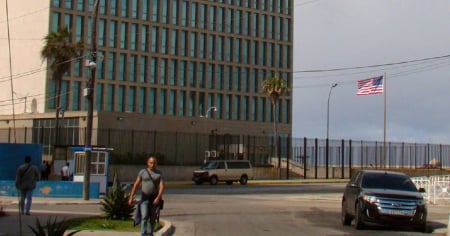
The United States Embassy in Cuba commemorated this Thursday the tenth anniversary of its reopening in Havana with a message of commitment to the Cuban people and a video that reviews the visits of the current Chief of Mission, Mike Hammer, to various provinces of the island.
"We continue with our mission to support the Cuban people in their aspirations for a better future," stated the diplomatic mission on the social network X, accompanied by a video that reviews Hammer's visits to Güines, San Antonio de los Baños, Santiago de Cuba, Guantánamo, Varadero, Bejucal, and Cienfuegos, among other places.
In these visits, the diplomat has played dominoes with young people in Camagüey, talked with residents in neighborhoods affected by blackouts, visited artists like Abel Lescay and interacted with religious leaders and volunteers.
This direct approach has provoked an angry reaction from the Cuban regime, which has responded with organized acts of repudiation, such as the one he faced in the Lanchita de Regla, discrediting campaigns in official media, accusations of interference, and summons to the Ministry of Foreign Affairs. Hammer has reported constant surveillance and recordings during each of his visits.
The anniversary commemorates a key moment in the recent history of Cuba and the United States. On July 20, 2015, after more than half a century without diplomatic relations, Washington and Havana reopened their embassies.
It was the result of the historic thaw announced in December 2014 by Barack Obama and Raúl Castro, which included the removal of Cuba from the list of state sponsors of terrorism and the re-establishment of ferry travel.
Obama described the reopening as "a historic step forward" and urged Congress to lift the embargo, although complete normalization was conditioned on issues such as the return of the Naval Base at Guantanamo and respect for human rights.
However, a decade after the announcement, the then Under Secretary of State Brian Nichols, during the Joe Biden administration, expressed regret that "the reforms we would have liked to see in Cuba did not happen".
Repressive policies remained in place, and the approach was largely reversed by the sanctions imposed by the previous Trump administration, which are now reinforced under the current administration, including the reinstatement of the island on the list of state sponsors of terrorism.
In this context, marked by renewed tensions and economic crisis on the island, the message from the embassy and Hammer's visits aim to keep alive that spirit of dialogue with the Cuban people.
"What is promised is a debt," said the diplomat, reaffirming his intention to continue traveling across the island and speaking with ordinary citizens, away from official halls, in a gesture that combines political symbolism with human connection.
Frequently Asked Questions about the U.S. Embassy in Cuba and its Chief of Mission, Mike Hammer
What is the main objective of the U.S. Embassy in Cuba and its Head of Mission?
The primary objective of the U.S. Embassy in Cuba is to support the Cuban people in their aspirations for a better future. The Head of Mission, Mike Hammer, has committed to maintaining direct dialogue with Cuban citizens, away from official halls, and to listening to their opinions and concerns. This stance aims to keep the spirit of dialogue and engagement with Cuban civil society alive, despite tensions with the Cuban regime.
Why have tensions emerged between the Cuban regime and Mike Hammer?
Tensions have arisen due to Mike Hammer's actions in maintaining direct contact with Cuban civil society. The Cuban regime has responded with organized acts of repudiation and smear campaigns, accusing Hammer of adopting an interventionist and disrespectful attitude towards the Cuban people. However, Hammer continues with his visits and meetings, reaffirming his commitment to human rights and freedom in Cuba.
What actions has Mike Hammer taken in Cuba to connect with the population?
Mike Hammer has taken various actions to connect with the Cuban population, including visits to provinces, meetings with religious leaders, activists, and ordinary citizens. He has played dominoes with young people, talked with neighbors in neighborhoods affected by blackouts, and visited artists such as Abel Lescay. These actions aim to strengthen direct dialogue with the Cuban people and highlight their realities and concerns.
How has the United States reacted to the Cuban regime's accusations against Mike Hammer?
The United States has expressed its full support for Mike Hammer in the face of accusations from the Cuban regime. U.S. authorities have highlighted his work in favor of human rights and freedom on the island and have rejected claims of interference. The Trump administration has reaffirmed its support for the diplomat and its commitment to the Cuban people, emphasizing that it is not the United States that has turned the Cuban people against the regime, but rather its own failed policies.
Filed under: