
Related videos:
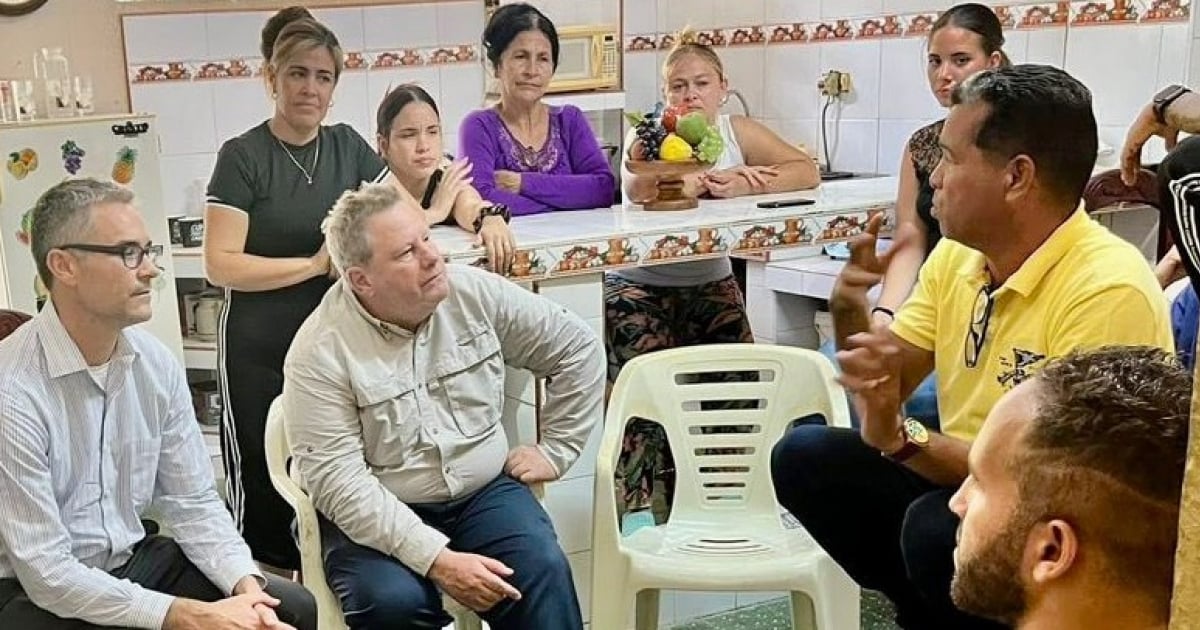
The head of the U.S. Mission in Havana, Mike Hammer, reaffirmed his country's commitment to human rights in Cuba during a meeting with activists, opposition figures, and relatives of political prisoners at his residence in the capital.
The event also served for the official presentation of the new Deputy Chief of Mission, Roy Perrin, who will take on the role of second-in-command at the embassy.
"Let us hope that justice, freedom, and democracy for the Cubans will come soon," Hammer said in a speech where he highlighted the bravery of the families of the more than one thousand political prisoners who remain incarcerated on the Island.
"We always have to remember them. I know it's very difficult for them, but know that we are always here to support you," he emphasized.
According to CubaNet, the diplomat stated that the purpose of the meeting was to get to know everyone better.
"To remain committed, to work together and determinedly to make the dreams and aspirations of the Cuban people a reality: freedom, respect for human rights, and the ability to express themselves without fear," he detailed.
An event marked by civil society and dissent
The reception brought together a wide representation of independent civil society.
Present were the leader of the Ladies in White, Berta Soler, along with her husband and former political prisoner Ángel Moya; independent journalists Henry Constantín and Reinaldo Escobar; and the parents of protesters jailed after the protests of July 11th, Jenny Taboada and Wilber Aguilar.
The meeting was also attended by private business leaders, artists, religious leaders, representatives of accredited foreign press, and diplomats from other nations.
Hammer pointed out the presence of "so many friends," recalling that, unlike in previous occasions, State Security did not prevent guests from entering, as had happened during the celebration on July 4th.
In the vicinity of the residence, the presence of plainclothes agents was noted, though there was no harassment. Inside the premises, U.S. security reinforced the usual measures.
The arrival of Roy Perrin in Havana
The main purpose of the meeting was to welcome the new Deputy Chief of Mission, Roy Perrin, who arrives from Honduras, where he served as Minister Counselor and Chargé d'Affaires at the U.S. Embassy in Tegucigalpa.
Perrin, originally from New Orleans, Louisiana, shared cultural references with the attendees to highlight the historical closeness between his city and Cuba.
"Cuban music helped to create jazz, which was born in my city. We also share food: in New Orleans, we eat red beans with rice every Monday, although I know you prefer black beans. Our cities have a similar rhythm; we know how to celebrate life and face difficult times, like hurricanes," he commented.
"I am very excited to be here. They say that Cubans have big hearts and a strong desire for a better future. That is why I look forward to meeting all of you," he concluded.
With more than two decades of experience in the Foreign Service, Perrin has held positions in Turkey, Costa Rica, Iraq, Venezuela, China, and in the Office of Central American Affairs in Washington. An engineer and lawyer by training, he is married and has one daughter.
Commitment to democracy in Cuba
Hammer, who took over the leadership of the mission in November 2024, has maintained an active agenda supporting Cuban civil society.
The official reiterated that the United States' policy will continue to focus on the defense of human rights, freedom of expression, and solidarity with the families of political prisoners.
"The Cuban people deserve to live in democracy as we do in the United States," he stated, making it clear that Washington will continue to pressure for the release of those imprisoned for political reasons and supporting the aspirations for change on the Island.
Frequently Asked Questions about the Political Situation in Cuba and the Role of the U.S.
What is the stance of the United States regarding human rights in Cuba?
The United States has reaffirmed its commitment to the defense of human rights in Cuba. Mike Hammer, head of the U.S. Mission in Havana, has maintained an active agenda in support of Cuban civil society, emphasizing that his country will continue to push for the release of political prisoners and support the aspirations for freedom and democracy on the island.
What actions has Mike Hammer taken in support of Cuban dissent?
Mike Hammer has organized meetings with dissidents, independent journalists, and families of political prisoners. He has participated in symbolic events to show support for Cuban civil society and has denounced the human rights violations committed by the Cuban regime. These meetings are part of the U.S. policy of dialogue with all sectors of Cuban society.
What is the message from the United States to the families of political prisoners in Cuba?
The message from the United States to the families of political prisoners is that "they are not alone." The U.S. Embassy in Havana has reaffirmed its commitment to freedom, human rights, and the democratic future of Cuba, assuring families that they will continue to advocate for the release of those unjustly imprisoned.
How has the Cuban regime responded to Mike Hammer's actions?
The Cuban regime has accused Mike Hammer of "interference" in the country's internal matters. Cuban authorities have criticized his meetings with opposition figures and members of civil society, and they have escalated repression against dissenting voices. However, Hammer has reaffirmed his support for the Cuban people and his commitment to human rights.
Filed under: