
Related videos:
The recent report by CiberCuba on the crisis of “combined arboviral diseases” in Cuba sparked a wave of reactions on social media, where hundreds of citizens highlighted a reality far more severe than what the regime officially acknowledges.
On the Facebook wall of the media outlet, comments reflected the healthcare collapse, collective despair, and a complete loss of trust in public institutions.
"What we are living through is a hell", wrote a user, in a phrase that captured the general sentiment.
Cubans not only complained about mosquito-borne viruses—such as dengue, chikungunya, and Oropouche—but also about the conditions that exacerbate them: endless blackouts, lack of water, mountains of garbage, collapsing hospitals, and a shortage of medicines.
From Old Havana, a reader sarcastically remarked: “There are more mosquitoes than food”. Others added that the city “is a dump”, that “there is no fumigation”, that “blackouts give life to the mosquitoes”, and that the government “looks the other way while people get sick and die”.
A sick country with no response
A significant portion of the comments pointed to a shared conclusion: environmental degradation and governmental inaction are the perfect breeding ground for epidemics. Several users described that “there is no cleanliness in the streets, the water arrives murky like mud, and hospitals lack reagents and electricity”.
From various provinces, others stated that “there is no fuel for fumigation or medications to care for anyone”, that the health centers “are overwhelmed” and that “the doctors are doing what they can without resources”.
A pregnant woman recounted that she fell ill in recent weeks: "It's the most horrible thing that exists. The hospitals are overwhelmed, and there's nothing to take care of us. Pregnant women are suffering through this alone."
Several testimonies agreed that the authorities are concealing deaths and downplaying the magnitude of the crisis. In Matanzas, many asserted that “they are denying deaths from chikungunya, just as they did with coronavirus”, and that “there are dozens of unrecognized official fatalities”.
"They are killing us little by little."
A particularly shared post went viral by encapsulating the general feeling of frustration:
“How much longer are we going to keep enduring… There is no health, no education, no electricity, no water, no food. They have taken everything from us, even our smiles. We almost look like zombies because we can't even sleep with the blackouts and the mosquitoes.”
The post gathered hundreds of reactions and responses in just a few hours. Most agreed on a diagnosis of total collapse. “They are slowly killing us, with no medicine, no food, no water, and with inadequate hospitals”, wrote an internet user.
Other comments expressed desperation and resignation: “Better to die than to continue with this agony,” said one; “In Cuba, it's a miracle to be alive... it's as if we are dead, because we are not really living,” wrote another.
Trash, mosquitoes, and blackouts: The deadly combination
A large part of the testimonies linked the current epidemic to the collapse of basic services. "Between arbovirosis and hunger, we are all going to die here," stated a reader.
In neighborhoods of Havana, such as Vista Alegre and Juanelo, residents claimed that "in each block there are several people sick with the Oropouche virus". "In my block, all the houses have sick people, and public health neither fumigates nor does anything. The garbage is on fire", described another person.
Others described scenes of complete abandonment: "I have a sewage ditch in front of my house for a year now. I went with a letter and they never came,” said a neighbor.
Between rage and mockery
Although most reactions were of distress, many also expressed anger or sarcasm in response to the official statement insisting that “everything is under control”.
"The medical power", several Cubans wrote with irony, accompanied by yawning emojis. Others added: "They made us believe we were a medical power, but COVID proved that there is no power of anything here."
Some users took the criticism into the political realm with dark humor, saying that “the real arboviruses are the leaders, parasites that have drained the life out of the people”.
"This is a war."
The comments from elderly individuals, many of whom are ill or caring for infected family members, revealed a harsher dimension of the problem.
"This is a war, a cold war", wrote a woman. "I never thought we would live like this, without food, without electricity, without medicine. It is not easy to survive."
Others mixed their complaints with religious invocations: "God have mercy on the Cubans", dozens of messages echoed. "Only a miracle can save us", some asserted. "What is happening is strange and very difficult. All of us who have gone through this have suffered greatly".
"They are letting us die."
In recent hours, numerous comments have agreed that deaths from fever, vomiting, and hemorrhaging are on the rise, although authorities do not officially attribute them to any virus.
“They do not recognize it because they have no means to confront it”, wrote a user. Others added: “In the hospitals, there are no reagents or medications, and they do not acknowledge that people have died. It is a disaster of incompetent rulers”.
A woman summed up the popular sentiment bluntly: “They would have to get infected themselves or have their family members infected to acknowledge what is happening. People are dying, and they shamelessly deny it.”
A weary country
The messages also depicted a broader social crisis, where illness is just a symptom. "Lack of everything: food, medicine, transportation, cleanliness, and shame", wrote one user. "This is the complete package".
Others pointed to political despair: "They are letting us die. The government knows what is happening, but it doesn't care.", read one message. "Cuba is slowly dying.", several others echoed.
Some blamed the collective fear: "Cuba is not being killed; we are the ones letting ourselves be killed. Fear has become a terminal illness."
Silence has a cost
Between anger, mockery, and prayer, the voices converged on a shared perception: the country is sick and the State has neither the will nor the resources to heal it.
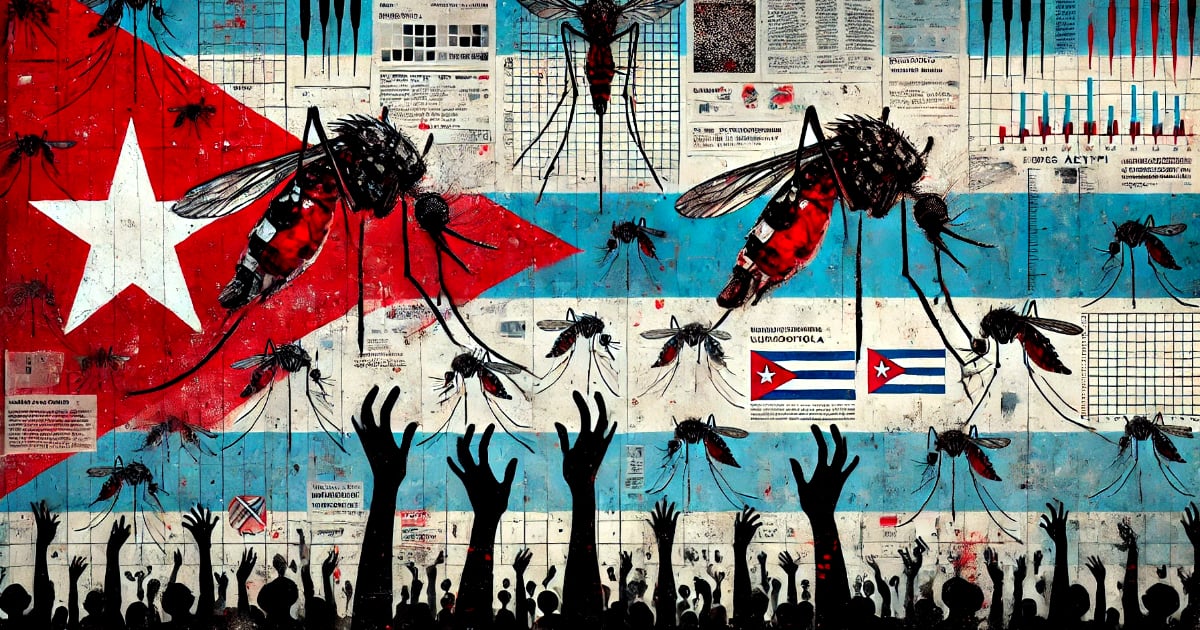
While power outages leave households without fans, hospitals without light, and neighborhoods without fumigation, the mosquito—now a symbol of a nation in crisis—continues its unchecked course.
"Every street is a garbage dump", summarized one of the most frequently repeated comments. "The mosquitoes lift you up. People are getting sick and dying, and no one does a thing...".
Cuba, voices on social media say, is experiencing its most dangerous epidemic: abandonment. And as a reader concluded, somewhere between resignation and hope: “When a people falls ill and its government remains silent, silence also kills.”
Filed under: