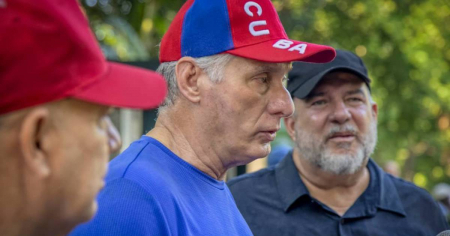
Miguel Díaz-Canel published a video this weekend on Facebook where he was seen sweeping leaves in the gardens of the Palace of the Revolution, accompanied by several ministers and officials, as part of a new "cleaning campaign" called in Havana.
In his message, the leader asserted that “there are people who believe that others should solve their problems”, referring to the lack of citizen participation in the campaign. Displaying his political cynicism, the occupant of the Palace blamed the “people” for his failure as the head of an executive that is leading the country to the abyss.
The video showed Díaz-Canel and the "not first lady" Lis Cuesta Peraza, broom in hand, alongside Prime Minister Manuel Marrero Cruz and other leaders, in an action intended to project institutional commitment in the face of the deep sanitation crisis affecting the Cuban capital.
"There is a call from the country, and the population has joined in, and I believe that people have also acted with a sense of responsibility," said the leader who has been trying for years to revitalize the "red Sundays" on the Island.
Díaz-Canel acknowledged that the current conditions are critical, but insisted that the problems can be resolved with "daily work and a sense of belonging."
"There are things that, if we clean them with less effort every day, do not accumulate, and with that systematic approach, problems are resolved," she stated, while emphasizing that "now everyone is very happy because we are seeing clean things that we haven't seen in a long time."
However, the leader acknowledged that not everyone responded to the call. "A large portion of people has mobilized, and there are those who haven't shown up, believing that others should solve the problem for them," he stated critically. "We must be clear, because it makes no sense to acknowledge what is done well without criticizing what is not achieved," he added.
Structural crisis and improvised responses
The call from Díaz-Canel comes after weeks of images of streets filled with garbage, makeshift landfills, and neighborhood protests due to the lack of waste collection.
Havana, along with other cities in the country, is facing a collapse in communal services due to shortages of trucks, fuel, and personnel, as well as a lack of efficient management.
In recent months, the government has attempted to involve various state and private actors in waste collection.
A year ago, in October 2024, Díaz-Canel himself ordered that “each ministry address one municipality”, while in several provinces mipymes have been contracted to assist with urban cleaning. In practice, however, the results have been minimal and the problems have worsened.
During the weekend, military recruits, police officers, and state workers were mobilized, in an effort that some neighbors described on social media as “Sunday theater.”
“They started cleaning the Palace, but the trash is you,” commented a user on X, reflecting the growing social discontent.
Official cynicism and evasion of responsibilities
Díaz-Canel's words, in which he criticized citizens for "believing that others should solve their problems," have been interpreted by many as a display of political cynicism.
In a country where waste collection, waste management, and urban sanitation are direct responsibilities of the State and its local administrations, blaming the people for the accumulation of waste is akin to shifting the responsibility for governmental failure onto the victims of the administrative collapse itself.
The message, rather than inspiring civic responsibility, reveals a profound disconnect between the ruling elite and the daily lives of Cubans, who, lacking resources and institutional support, face the problems accumulated by governmental inefficiency, such as dengue outbreaks and other viruses, paralysis in sanitation and fumigation efforts, and lack of drinking water, among others.
As a viral comment on social media summed up: "The garbage is not only in the streets, but also in the power that produces it."
"Operations" without sustainability
In his remarks, Díaz-Canel assured that the sanitation efforts must be repeated periodically to maintain urban order.
"We will need to continue this week. We won't resolve everything in just one weekend," he said. He even suggested holding "cleaning marathons or exercises" periodically as a way to maintain the initiative.
The president linked the campaign to other government issues, such as the electricity crisis and the shortage of drinking water. “Efforts are being made to significantly improve the water supply for the population in the city,” he stated, without providing concrete details on timelines or structural solutions.
Red Sundays: The Propaganda of "Voluntary Work" as a Universal Remedy
The "cleaning" campaign in which Díaz-Canel is shown sweeping leaves at the Palace of the Revolution is not an isolated event.
It is part of a broader strategy of the Cuban regime to revive the so-called “red Sundays”—voluntary work days that combine moral discourse, political mobilization, and media propaganda.
For years, the ruling leader has led or promoted cleanup and agricultural work initiatives, urging Cubans to "contribute with their own effort" in light of the State's inability to guarantee basic services.
These activities, which aim to evoke the revolutionary epic of the past, are often presented as "exemplary actions" of collective commitment, although in practice they do not address the structural causes of national deterioration.
In April 2024, Díaz-Canel participated in voluntary agricultural work alongside Party members. While state media highlighted his “spirit of sacrifice,” Cubans referred to it as "a circus." During this time, he labeled those who did not participate in these activities as "lazy."
A few months later, in November, he ordered that “each ministry sponsor a municipality” to assist with garbage collection in Havana, another “sanitation operation” broadcast live on official television.
This kind of initiative resurfaces precisely when social discontent amplifies. In 2022 and 2023, calls for volunteer work coincided with prolonged blackouts and food crises, and in 2025 they returned to the forefront after the historic collapse of the sugar harvest, the worst in over a century.
A ritual without results
The pattern is recurring: in the face of every sectoral crisis—waste, agriculture, or energy—the government responds with calls for voluntary work, as if sweeping, weeding, or cleaning the pipes of thermoelectric plants could substitute for planning, investment, and efficient management.
These "red Sundays" function more as a ritual of ideological reaffirmation than as a public policy. Their aim is to maintain the narrative of collective sacrifice and divert attention from the administrative failures that have led to the collapse of basic services and strategic sectors.
Increasing criticism
Díaz-Canel's words have sparked new criticism among Cubans, who accuse him of blaming the people for the problems arising from state inefficiency. "The country is sinking under blackouts, garbage, and misery, and the government's response is to sweep leaves in front of the cameras," commented another user.
Meanwhile, neighborhoods across the country continue to report piles of garbage accumulating for weeks, pools of sewage, and a proliferation of mosquitoes. The so-called "cleaning campaign" seems, for many, like yet another attempt to mask the regime's inability to provide sustainable solutions with symbolic gestures.
Filed under: