
Related videos:
The latest call from the ruler Miguel Díaz-Canel to "get things in order in Havana" triggered a wave of criticism, irony, and expressions of frustration among Cubans both inside and outside the country, who interpreted his words as yet another attempt to shift responsibilities onto the population, rather than addressing the evident crisis of state management.
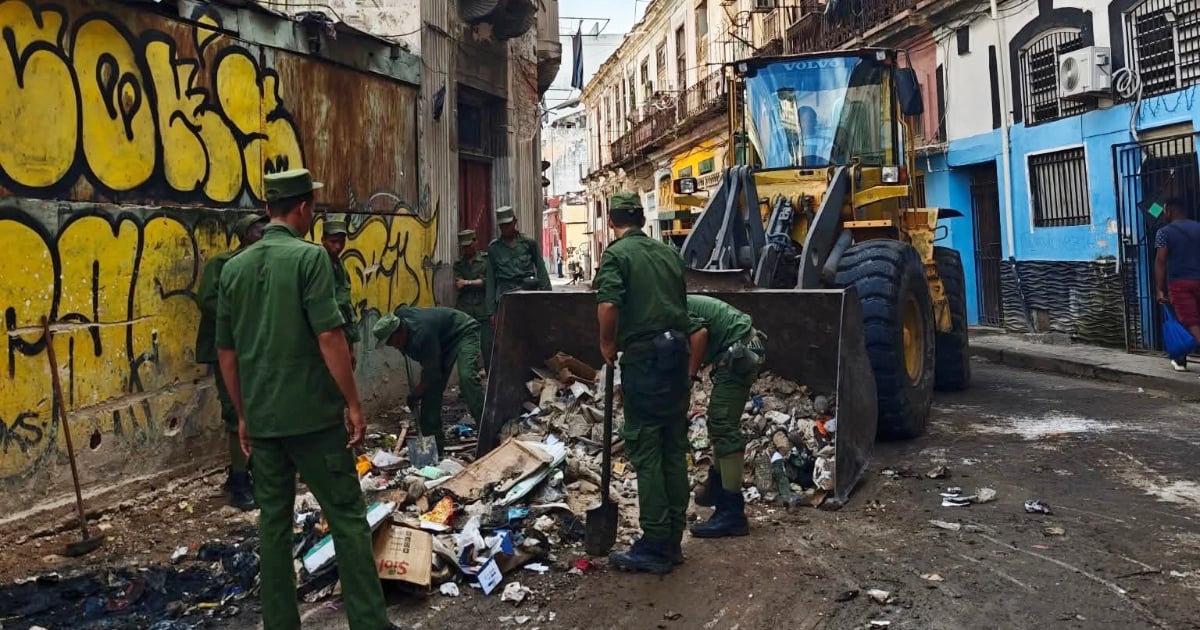
In a message published on his account, the First Secretary of the Communist Party of Cuba (PCC) acknowledged that the capital is facing a “complex” situation due to “acute problems generated by the blockade and negligence,” and urged all “forces committed to the people”—including the Revolutionary Armed Forces (FAR) and the Ministry of the Interior (MININT)—to engage in cleaning efforts, control, and “restoration of order”.
"Things need to be organized in Havana. There has been a lack of cooperation. Organizations, institutions, and party structures must be in the streets fighting for the restoration of cleanliness," wrote the president, also assuring that there is not enough "fuel available" to cover essential services such as garbage collection, water supply, or public transportation.
The message, which was intended to be seen as a call for volunteer work and social discipline, ended up sparking a wave of indignation and sarcasm among the citizens. Thousands of comments agreed on one central idea: the real disorder is not in the streets, but in the country's administration.
“If you want to clean up, start with the State Council”, wrote a user in response to the official message, while another sarcastically remarked: “After 66 years of disaster, now they remember order”.
Most of the comments accused the government of wanting to hold the people responsible for the urban collapse, while the leaders "live in comfortable houses and move around with escorts and official cars".
From waste to fatigue
The streets of Havana have become a visible symbol of national decay. The mounds of accumulated waste, the persistent stench, the endless blackouts, and the scarcity of drinking water are the daily portrait of a capital steeped in chaos.
This is combined with the recent protests and pot-banging demonstrations reported in neighborhoods like Centro Habana and Regla, where residents took to the streets to demand solutions to the ongoing lack of electricity and water for several consecutive days.
In that context, the presidential call was perceived as a provocation. "There is no fuel to collect the garbage, but there is to mobilize troops and political caravans", wrote an internet user.
Others questioned the invocation of the "will of the people" while threats of repressive measures against those who protest are made. "First, they militarize the neighborhoods, and now they ask for cooperation. You cannot command through fear and expect gratitude."
Several comments recalled that the regime itself acknowledged the seriousness of the health situation. The Minister of Science, Technology and Environment (CITMA), Armando Rodríguez Batista, recently admitted that “that garbage is not contained: it is scattered all over Havana”, while the official journalist Ana Teresa Badía recognized that “Havana smells like garbage”.
"They admit it and nothing happens. No resignations, no sanctions, no changes. Just speeches and more slogans.", wrote a citizen, reflecting the widespread frustration.
"It’s not the blockade, it’s the neglect."
Among the most recurrent criticisms, a phrase that has circulated on social media as a popular slogan stood out: "It's not the blockade, it's the apathy." Users accused Díaz-Canel's government of hiding its inefficiency behind the U.S. embargo, while corruption and state neglect continue to grow.
"They ask us to clean the streets, but they don't clean the system. They ask for order, but they govern with the greatest institutional disorder in Latin America," pointed out another comment. "If the people have to do what the State doesn't do, what is the purpose of ministries, delegates, and state enterprises?", another questioned.
Many criticized that the call for social discipline was accompanied by warnings against those who “block roads or disrupt public services” during protests, which was interpreted as a criminalization of citizen discontent.
“First they leave us without water, electricity, or food, and when we protest, they accuse us of disorder. The real disorder is the one they have created,” a user commented on the post by the ruler.
A collapsed capital
Living conditions in Havana have deteriorated drastically in recent months. Power outages lasting more than 12 hours a day, water shortages, and overflowing garbage have turned several municipalities into centers of unsanitary conditions.
The recent rains worsened the crisis: flooded streets, floating containers, contaminated waters invading doorways and homes.
"There are neighborhoods where children play among flies and waste,” commented a resident of Diez de Octubre. “The smell is unbearable, there hasn't been a cleanup in weeks, and diseases are on the rise. But all they say is that we should clean up and be aware.”
In social media, many compared the current situation to the worst moments of the so-called 'Special Period'. "It's like going back to the nineties, but without hope", reads another message. "No electricity, no water, no food, no medicine. Just promises and slogans".
"You can't live on speeches."
The call from Díaz-Canel was also criticized for its paternalistic tone. "He asks for empathy and sacrifice, but he doesn't know what it's like to go 24 hours without electricity or water to bathe," several users wrote.
Others pointed out the disconnect between official speeches and daily life: “They talk about revolutionary morality while the country sinks into misery”.
Some messages called for the government to abandon its rhetoric of resistance and acknowledge its failure. “The best way to restore order is by resigning. That would truly resolve the problem at its core”, commented one of the most shared users.
There were also mocking expressions: “They are going to create a ‘Revolutionary Garbage Brigade’ with the same people who used to form the ‘rapid response brigades’”. Another wrote: “Cuba does not need more cleaning speeches, it needs to clean up the discourse”.
Among the few voices that defended the presidential message, some argued that "with unity, anything can be achieved," but the majority responded with skepticism. "Unity yes, but not behind those who have brought us to this point", replied another commentator.
"The people no longer believe."
The overall tone of the reactions displayed a deep fatigue. The leader's words, instead of motivating, rekindled the perception of a disconnected power lacking solutions.
"We no longer believe in their calls or their justifications. Every time they speak, things get worse.", was echoed in dozens of responses.
For many, the phrase “things need to be put in order” was interpreted as an unintentional metaphor for a system that has lost control. “There is no order in the economy, nor in health, nor in education, nor on the streets. And now they want the people to save them from the chaos they themselves created.”
Díaz-Canel's call thus became a thermometer of national discontent. More than just a call for volunteer work, his words sparked a debate about the legitimacy of a regime that insists on heroic rhetoric in the face of a crumbling reality.
In the midst of power outages, garbage, and despair, the most repeated response summarizes the general sentiment: “One cannot live off speeches. If they want to make changes, they should start by arranging their exit from power.”
Filed under: