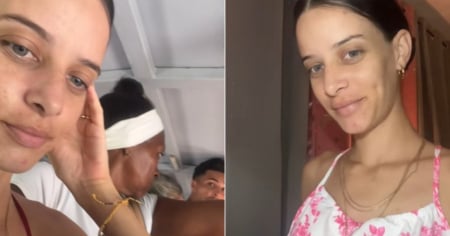
From Matanzas, a Cuban mother identified on TikTok as @ari_sarita25 requested support for her daughter Sara, who has cerebral palsy.
In a video shared online, the mother explained: "My daughter suffers from pediatric cerebral palsy, a spastic quadriplegia with brain lesions. Please, I am begging for your help to improve my daughter's quality of life."
The woman, who lives in Matanzas, said that she cannot work because she has to take care of her daughter. "She is a girl who does not walk, who does not talk... the only option I have left is to turn to you," she added.
In another post, she responded to a user who asked about the origin of her daughter's condition. She shared that Sara was born at 27 weeks of gestation, with low birth weight and in need of ventilation. "The girl suffered from hypoxia at birth," she explains, which led to brain damage. Doctors at the Institute of Neurology confirmed the diagnosis of "non-progressive encephalopathy due to prenatal, perinatal, and postnatal causes, with spastic quadriparesis and cerebral palsy."
"It was something that completely changed our lives, yet I still believe with all my heart that she can improve." He insists that his daily efforts are dedicated to ensuring his daughter has a better quality of life: "So that she can smile, so that she feels loved and happy," he added in his testimony, where he reiterated that his "greatest wish as a mother is to see my daughter walk" and expressed unwavering faith and determination to fight for her: "I will never give up, we will never surrender."
Her story has generated reactions of solidarity, supportive comments, and questions about how to help. When asked about the father's presence in the girl's life, she replied: "The father of my daughter is here and is the one who works outside; even so, it doesn't even cover the basics. A friend created this account to help me and enable me to move forward. And if there are people supporting me financially, it's because they genuinely want to help; my goal is to be able to monetize through social media."
In another recent video, he expressed his gratitude: "Thank you so much to everyone who is helping me from the heart. I know that the situation is not easy for anyone, yet you give not from what you have left over, but from what you have. That speaks volumes about the big hearts you have." In the accompanying text, he added: "Your gestures, no matter how small they may seem, mean a lot to me and to Sara. May God return to you multiplied everything you do with such love."
Cases like this have become frequent on Cuban social media. Other mothers have also turned to the Internet to share their situations and seek help. In Guantánamo, Yaimare Villafañe Romero reported that her house was flooded after a downpour, putting the lives of several children at risk, without receiving an effective response from the authorities. She recounted this in a Facebook group where she shared photos of her inundated home after the rains.
In Havana, a woman with three small children knocked on the door of the comedian Limay Blanco to ask for food. "I am in the same situation or worse than you," Blanco confessed before organizing a solidarity event to help her. The woman lives in Guanabacoa, with low income and without support from the father of her children, as the comedian recounted when sharing her case on social media.
Another mother, Niuvis Figueredo, is fighting to obtain a humanitarian visa for her daughter Meral, who has been diagnosed with leukemia and is in critical condition. Through her Facebook profiles, she has made a desperate plea to try to save her before it's too late.
Yaimara Ricardo Peña, for her part, reported from Holguín that her son, who underwent surgery for a brain tumor, needs a valve to begin his oncological treatment. She herself is a cancer patient and asserts that, although there are valves in the country, they are not being distributed to those who need them most. Her story has also been shared on social media.
These stories reflect a reality shared by many Cuban families: mothers who, faced with a lack of access to treatments, social support, or decent living conditions, turn to digital platforms to seek direct and urgent help. The story of Ari and her daughter Sara is part of this collective outcry.
Frequently Asked Questions about the Situation of Cuban Families in Crisis
Why does Sara's mother seek help on social media?
Sara's mother seeks support on social media to improve her daughter's quality of life, as she suffers from cerebral palsy. Due to economic limitations and a lack of resources in Cuba, many mothers turn to the Internet to ask for help and try to provide better conditions for their children. Sara's mother, unable to work as she dedicates herself to her care, sees social media as an opportunity to receive financial and emotional support.
What is Sara's medical condition and how did it originate?
Sara suffers from cerebral palsy, specifically spastic quadriplegia with brain injuries. Her condition originated due to hypoxia at birth, as she was born prematurely at 27 weeks of gestation, with low birth weight and a need for ventilation. This lack of oxygen at birth caused brain damage, which was diagnosed by the Neurology Institute as non-progressive encephalopathy.
How is the community responding to the situation of Sara and her mother?
The community has shown solidarity and support for Sara and her mother, both emotionally and financially. Through comments, likes, and sharing their story, many people have tried to help improve their situation. However, the mother has also expressed that, despite the father's work, their income is not sufficient even for the basics, which reflects the difficult economic situation they are facing.
What role do social networks play for Cuban mothers in similar situations?
Social media has become a crucial tool for Cuban mothers facing crisis situations. In a context where the healthcare system and social assistance are inadequate, these networks provide a platform to highlight their cases, receive economic and emotional support, and connect with goodwill individuals willing to help. Stories like those of Amanda, Dayma, and other mothers demonstrate the impact of these platforms on the lives of those fighting for the well-being of their children in Cuba.
Filed under: