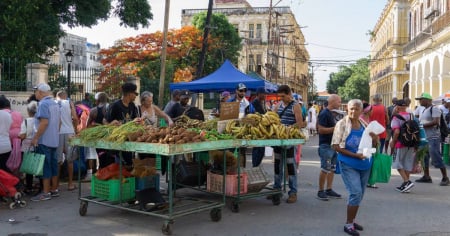
A Cuban mother, identified as @gelylaflaki on TikTok, went viral after posting a video showcasing the clothes she bought to celebrate her birthday and her daughter's, along with the prices she paid in national currency. The content, with its relatable and everyday tone, has generated thousands of reactions for highlighting the high costs of clothing and footwear on the island.
"My love, stay here because I'm going to show you the little things I bought for my birthday and for the girl's," Gely says at the beginning of the video, where she details the items she purchased: a denim shorts for 2,500 Cuban pesos, a black sweater for the same price, handmade sandals for her daughter for 4,000 CUP, and a children's outfit for 6,500 CUP.
It also mentions a thread dress made by an elderly woman, which cost "2,000 pesos and something," and a pair of white shoes, the most expensive item, for 11,000 CUP. "Do the math, $1 is at 430 Cuban pesos," he says at the end of the video, highlighting the disparity with average incomes on the island: "Prices here... what they pay a worker is 2,500 Cuban pesos a month, and the better ones get 7,000."
The figures presented by the young woman sparked an avalanche of comments, both of support and outrage. “God bless them, and I’m glad they bought them for their birthday,” wrote one user, while another pointed out, “It’s crazy to spend what a person earns in over a month just on shoes.”
"With what they earn in a month, they can't even afford a pair of shoes," commented someone else. "So, the shorts cost the same as a full salary," pointed out another person. A woman from Argentina reacted, saying: "Those shorts cost 10 times less here... it's crazy!" Another user wrote: "You've spent the equivalent of a whole year's salary for a Cuban or more... just imagine what a blessing."
In addition to the criticism, many people expressed empathy and a desire to help from abroad: "Is there a way to send clothes to Cuba?" asked a woman from Washington, while others offered donations from Spain, Colombia, and Venezuela.
The video has not only been interpreted as a representation of personal celebration but also as a snapshot of the current price levels in Cuba, which continues to spark debate due to its disconnection from the purchasing power of the majority of the population.
This disconnection becomes evident when compared to official data: the average salary in Cuba rose in 2025 to 6,649 pesos, according to the National Office of Statistics and Information (ONEI). However, that amount, which in the business sector reaches 7,331 CUP and in the budget sector barely hits 5,922 CUP, effectively equates to around 16 dollars per month at the current informal exchange rate.
Meanwhile, currencies continue to soar: the dollar is trading today at 440 CUP and the euro at 500 CUP, unprecedented figures in the recent history of the country.
The testimony of this young mother adds to others previously shared on social media, like that of another young woman who denounced that dressing and buying footwear in Cuba has become a luxury, as she showed price tags ranging from 10,000 to 15,000 CUP in national stores last April, stating that a person with a state salary cannot afford those products.
A young man also showcased on TikTok footwear priced up to 25,000 pesos, describing them as "one of the most expensive items currently sold in Cuba," while discussing the impossibility of even replacing a pair of flip-flops.
Another video featured a Cuban woman who shared what she paid for clothing and accessories, including a pair of shoes costing 31,200 CUP and basic personal care products with prices deemed "criminal" by internet users both on and off the island.
The difficulty of getting dressed in Cuba is not new. Residents in Guantánamo reported that they must choose between buying food or clothing, and that many people turn to patched or secondhand clothes due to the lack of affordable stores and the disparity between prices and salaries.
The gap between income and prices of basic goods such as clothing and shoes remains one of the most visible reflections of the economic crisis in Cuba, a reality that numerous content creators continue to document through their social media.
Frequently Asked Questions about the Cost of Living in Cuba and Its Economic Impact on Families
How much do clothing and footwear cost in Cuba according to the testimony of a Cuban mother?
A Cuban mother demonstrated that she bought a pair of denim shorts and a sweater for 2,500 Cuban pesos each, sandals for 4,000 CUP, a children's outfit for 6,500 CUP, a dress for just over 2,000 CUP, and a pair of white shoes for 11,000 CUP. These prices have generated outrage as they represent amounts that are difficult for most Cubans to afford, considering that the average monthly salary in Cuba is approximately 6,649 pesos in 2025.
How does the average salary in Cuba compare to the cost of basic products?
In 2025, the average salary in Cuba is about 6,649 Cuban pesos per month, which is equivalent to approximately 16 dollars at the unofficial exchange rate. This income is insufficient to cover the high costs of products such as clothing and food, which often exceed a worker's monthly salary. The disconnection between prices and income reflects the severe economic crisis facing the island.
What do Cubans think about the price of basic necessities on the island?
Many Cubans express indignation and frustration over the high prices of essential items, such as clothing, footwear, and hygiene products. On social media, users describe these costs as "criminal" and emphasize the impossibility of affording them with current salaries. Furthermore, some suggest that dressing and equipping oneself in Cuba has become a luxury that not everyone can afford.
What alternatives do Cuban families consider in light of high prices?
Amidst high prices, many Cuban families resort to saving for months to be able to buy basic items or prioritize needs such as food over other expenses. It is also common for families to choose patched or second-hand clothing. Furthermore, support from relatives abroad and solidarity networks have emerged as alternatives to alleviate the economic burden.
Filed under: