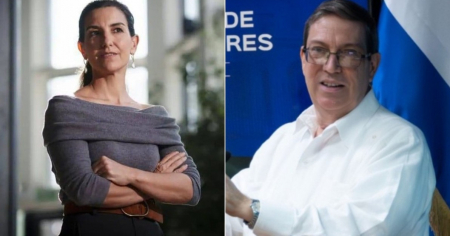
For the first time since his dramatic downfall, Miguel Díaz-Canel publicly addressed the former Minister of Economy, Alejandro Gil Fernández, who has been sentenced to life imprisonment on charges of espionage, bribery, and corruption.
He did it with an ideological tone, wrapped in the words of Fidel Castro, and with a speech that aimed more to discipline the ruling elite than to provide explanations to the citizens.
During the XI Plenary of the Central Committee of the Communist Party of Cuba (PCC), Díaz-Canel turned Gil into the paradigmatic example of what is defined as betrayal to the Revolution.
To achieve this, he did not rely on data or judicial evidence, but rather on a rhetorical arsenal borrowed directly from the most orthodox fidelism.
"These days, I recalled Fidel, and I quote: 'The enemy knows very well the weaknesses of human beings in their search for spies and traitors, but they are unaware of the other side of the coin: the enormous capacity of human beings for conscious sacrifice and heroism,'" thus began his analysis.
Díaz-Canel framed his speech as a warning. He distanced himself from the technocratic language he promoted years ago—with Gil as a key figure—and returned to the epic tone of the ideological struggle, where there are patriots or traitors, martyrs or sellouts.
In his speech, he referenced a passage from the Metallurgical Congress of 1960, delivered by Fidel Castro, to emphasize that the Revolution, by its very nature, exposes the impostors:
"A revolution teaches us who are the men and women who are of service, and who are not; [...] who are made of selfishness, ambition, disloyalty, betrayal, or cowardice."
“In a revolution, everyone must remove their mask; the altars collapse [...] that is what the Revolution teaches us: who the true patriots are and where the great traitors come from,” he also said, echoing Fidel's words and tightening the noose around Gil.
In addition to those words, Díaz-Canel added other reflections from the same Fidelista speech, aimed at defining the moral value of commitment to the revolutionary project:
"It teaches us who has the courage to sacrifice themselves for the people, and who only wants to take advantage of them; who stands with the cause, and who only stands for themselves"; and he added at another moment: "Those who are not willing to die for the homeland are also not fit to live off it."
Before directly mentioning Gil, Díaz-Canel established a general accusatory framework:
"Those who profit from needs and shortcomings appear, those who obstruct the path and delay progress, and others capable of betraying the nation that once exalted them to the highest ranks."
That phrase was the preamble to explicitly naming him, marking his first direct mention of the former minister since his dismissal in February 2024.
“I don't think there are more precise phrases to describe Alejandro Gil's performance, from which we must draw experiences and lessons, making it clear, first of all, that the Revolution has zero tolerance for such behaviors,” he concluded.
The phrase "denigrating case" made clear the tone chosen by the leader: one of moral condemnation, cloaked in revolutionary epic, with no room for nuance or doubt.
Díaz-Canel, who was Gil's doctoral thesis advisor and defended his economic reforms for years, did not hold back on adjectives: he described him as a "traitor," "sellout," "selfish," "ambitious," and "disloyal."
It is a fall from grace as steep as the loyalty that once seemed to be professed.
A trial without public evidence, an official narrative without cracks
The sentence against Gil Fernández was announced on December 8, but the trial was held behind closed doors, with no press, no visible defense, and no procedural transparency.
The official information refers to a life sentence for: espionage, bribery, theft of documents, and violations of regulations regarding classified information.
However, the evidence was never made public, and the file remains sealed, which has led independent media and international observers to question the legitimacy of the process.
More than a matter of justice, the case has been interpreted as an exemplary purge: a warning to the state's officials and a way to distract attention amid a deep economic crisis, characterized by daily blackouts, rampant inflation, food shortages, and rising social unrest.
In this context, the internal enemy serves a political function: to consolidate power through punishment, to reaffirm authority without acknowledging mistakes, and to shift public opinion towards a manufactured traitor.
Rewriting history: From star minister to official traitor
The shift has been drastic. Alejandro Gil was for years one of the most visible faces of economic power in Cuba.
He led the so-called "structural transformations" of the system, attended international forums, and was presented as a reformist under control.
Today, the regime erases him from the archive of the useful and records him in that of the traitors.
Díaz-Canel's speech at the XI Plenary makes it clear that in official Cuba, the setbacks are absolute, and the narrative is being rewritten according to the rhythm set by those in power.
The legacy of Fidel, evoked as doctrine, serves not only to condemn but also to shield the system against self-criticism.
In that logic, the altars collapse, as Castro said, but not those of the system: those of people like Gil, who were used until the last moment… and then sacrificed without any possibility of appeal.
Filed under: