
Related videos:
In his speech at the XI Plenary of the Communist Party (PCC), Miguel Díaz-Canel repeated one of the most common phrases in his repertoire: “Our greatest strength is unity, based on debate, criticism, and conscious discipline. The heroic people continue to be our greatest inspiration.”
At first glance, it sounds like a weary and cracked declaration of principles; in practice, it reveals the increasing gap between the power that speaks of the people and the real people who survive outside the discourse.
In the official narrative, the Cuban people are an abstraction: a heroic, grateful, and disciplined entity, always ready to resist, always convinced of the righteousness of the socialist project.
It is the people of slogans, the one that appears in murals, news broadcasts, and Party meetings. It is the people carried and brought forth by the nationalist populism of dictator Fidel Castro, covered in the dust and saliva of dispossession and propaganda. But that imaginary people no longer exists except in the language of power.
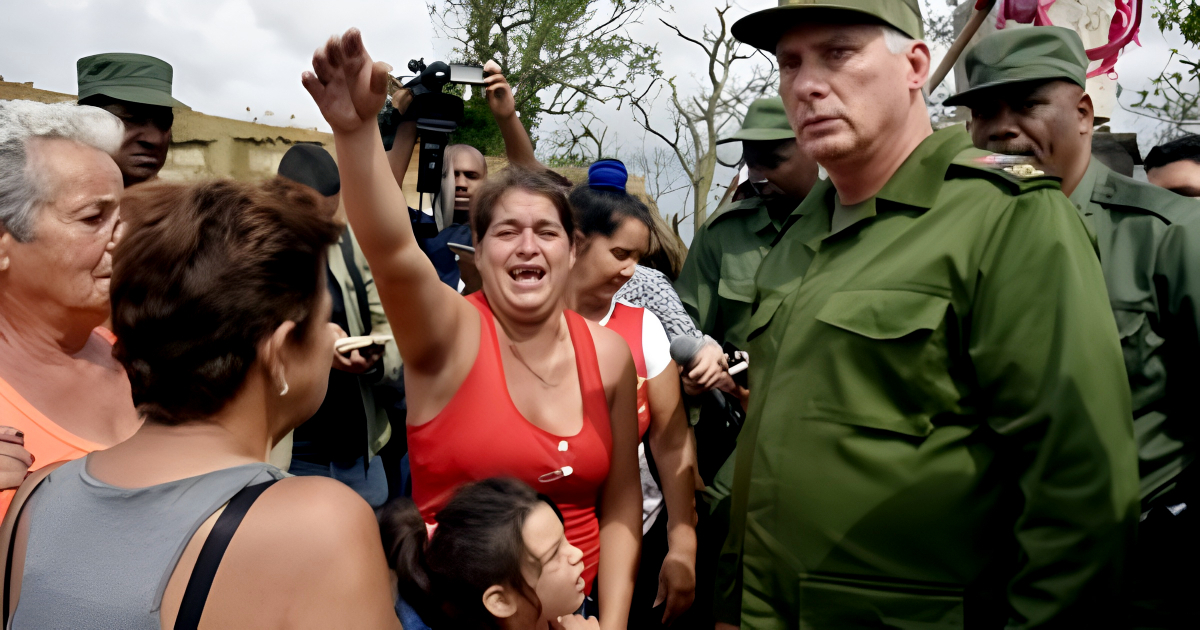
The true Cuban people —made up of generations of silenced and intimidated families, those who wait in endless lines and pay impossible prices, those who live between blackouts and search for food in the black market— do not feel represented by that rhetoric.
The word "people" has ceased to be a political category and has become a pretext for the system.
When Díaz-Canel says that “the people's trust in their institutions is built on actions,” he overlooks the fact that the country’s institutions do not hold themselves accountable or subject themselves to public scrutiny. There are no mechanisms for citizen oversight or spaces for genuine participation. What is presented as dialogue is, in reality, monologue.
For decades, the official discourse has attempted to replace social complexity with a moral unanimity. Being part of the people equates to being within the so-called "revolution"; dissent equates to stepping outside of it. Therefore, when the president speaks of the "heroic people," what he truly describes is a filtered and domesticated version of the citizenry, the one that applauds, nods, and remains silent.
In reality, the Cuban population is going through one of the most difficult moments in its recent history: loss of purchasing power, mass migration, precariousness in basic services, and a growing distrust towards institutions. However, the official discourse insists on portraying it as a unified and satisfied body, heroic in its resignation.
The gap between that ideal image and everyday reality is so vast that it has become unsustainable.
While the regime speaks of "resistance," millions of Cubans are leaving the country. While the PCC praises "popular creativity," citizens are improvising to survive without resources. While Díaz-Canel calls for "trust," the people respond with silence or sarcasm.
That disconnection is not just communicative: it is political. A power that does not fully acknowledge the social unrest and its political consequences ends up being unable to govern with legitimacy.
The rhetoric of heroism, which once served to unify, now acts as a mechanism of denial. By insisting on the image of the heroic people, the regime denies the real people—those who question, those who tire, those who leave.
In his speech, the president urged to "strengthen the relationship with the people, to be more transparent, and to hold the officials to higher standards." However, as long as there is no press freedom, citizen participation, or free and plural elections, these words are hollow promises. Transparency is not something that can be mandated; it must be practiced.
In Cuba, the term "people" has been used so many times that it has lost its meaning. It has been employed to justify censorship, impose an ideology, legitimize repression, endorse failed policies, and silence those who do not fit into the narrative.
Today, when the regime mentions it, the majority of Cubans no longer see themselves in it. The true people are not measured by the applause in a session, but by their ability to express themselves without fear in an open, free, and plural society.
And that people, the one that doesn't appear in speeches or in the news, is the one that has spoken most clearly: with their weariness, with their migration, with their protests, mockery, and even with their silence.
What Díaz-Canel said was that the people remain steadfast. What the people are truly saying, quietly, is that they no longer believe in the indoctrination and slogans of the dictatorship.
Filed under: