
Related videos:
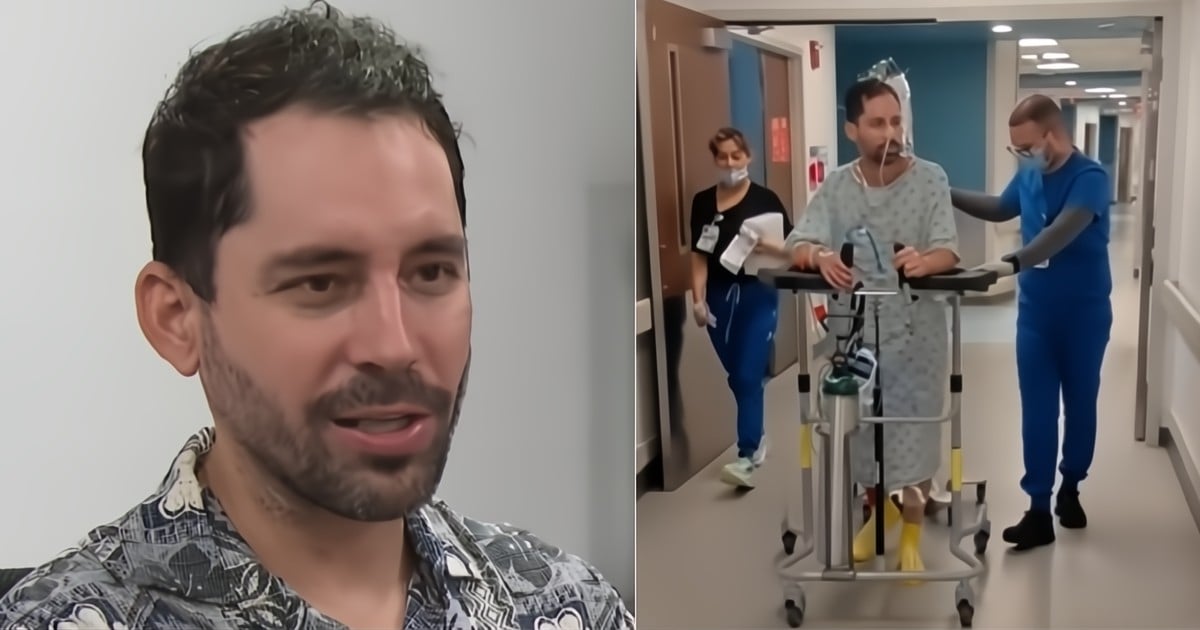
Alejandro Cuevas is 36 years old and carries a story in his body that seems impossible. Just four months ago, he received a multivisceral transplant in Miami that involved five of his organs—a highly complex surgery that is performed in only five hospitals in the United States. Today, he continues to fight to adapt to the donated organs while facing another fear that remains unspoken: the potential deportation of his wife, his only caregiver and support.
The case was reported by the network Univision, which closely followed the human drama of this Cuban couple who arrived in the United States in 2022, fleeing Cuba in search of medical care that never came on the island.
Alejandro had been diagnosed with a genetic mutation that caused three large tumors in his abdomen. In Cuba, they had already removed his colon, but his condition continued to worsen, bringing him to the brink of death, with constant bleeding and a guarded prognosis, as the patient himself recounted to Univision.
"I was told that I had a time bomb in my abdomen, and that I could lose my life at any moment," Alejandro told the American media.
The intervention at Jackson Memorial Hospital in Miami-Dade marked a turning point. "It's a miracle, first God and then the doctors who are taking care of me," he stated.
However, the battle for survival did not end in the operating room. Although Alejandro received humanitarian parole due to his critical condition, his wife Yaisely, a behavioral therapist with a work permit and responsible for paying both of their health insurance, remains under I-220A immigration status, which makes her vulnerable to possible detention or deportation.
"What I ask for is an opportunity to contribute to society and, right now, to take care of my husband, who needs it so much," Yaisely said. Alejandro was more direct: "We have no intention of going back to that dictatorship."
The uncertainty of migration weighs heavily on daily life. Going out to drive, attending medical appointments, or showing up at an immigration court has become a constant source of anxiety. "Sometimes you feel that fear of encountering the police or immigration at any moment," Yaisely confessed.
Last Friday, a hearing held in a federal court opened a light of hope, not only for them but for thousands of Cubans with I-220A. A favorable ruling could set a historic precedent, although lawyers are calling for caution.
"No quiero que nadie salga corriendo a aplicar para nada porque todavía no hay una decisión," warned immigration lawyer José Guerrero to Univision.
While the judges analyze the case, the recommendation remains the same: stay informed, avoid legal issues, and wait.
For Alejandro, every day matters. His recovery depends on continuous care and the presence of the woman who has been by his side since he left Cuba in search of a second chance at life.
Filed under: