
Related videos:
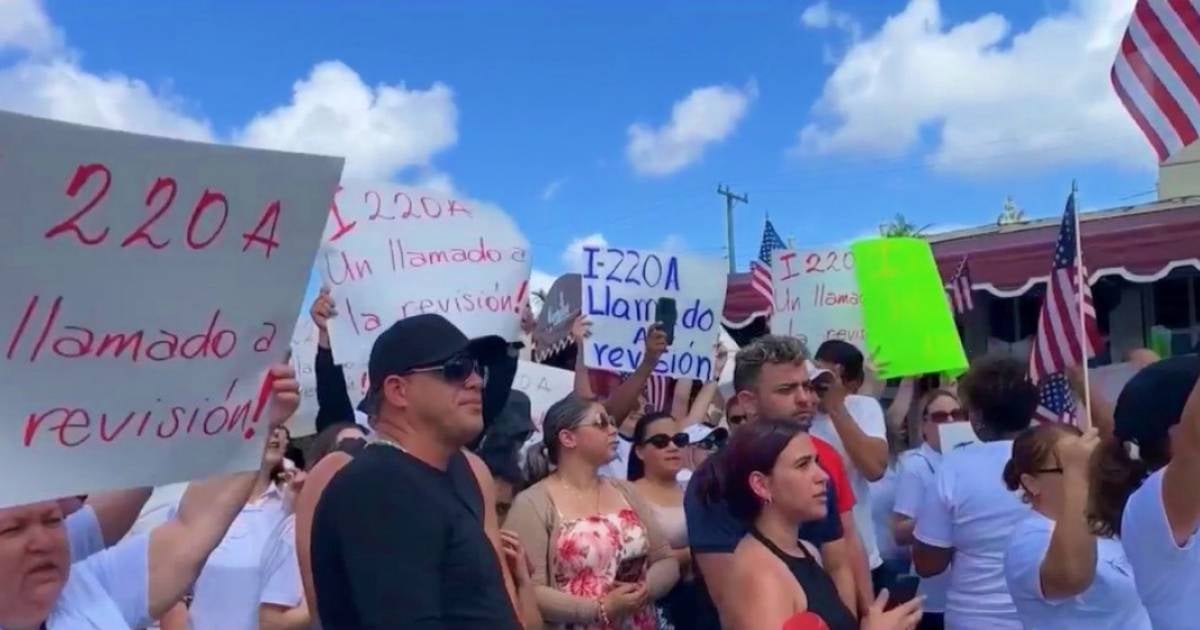
Cuban migrants who received an I-220A upon arriving in the United States are feeling fear and uncertainty about what will happen to their lives following the new measures adopted by the Trump administration.
The document grants them temporary residency in the country while they resolve their legal situation, but many are unsure if it will be enough to prevent deportation.
Yunior Luis Pino Pérez, a participant in the 11J protests, received an I-220A after crossing the border from Mexico. He resides in Miami, where he applied for political asylum. This year, he has a second hearing to defend his case before the immigration court, but until then, he fears being deported.
"My life is in danger in Cuba, after being blackmailed and forced into exile. I simply cannot return," he told Martí Noticias.
Another case is that of Dayvel Álvarez, who arrived in July 2022 and applied for asylum shortly thereafter. After a year and a day, he applied for residency under the Cuban Adjustment Act. He has yet to receive a response regarding any of his processes.
"I only received the work permit. I'm waiting; that is on hold. When I check the case, I still don't have a cutoff date," she said.
The story of Oscar Casanella is different. He is a political activist who, in Cuba, lived under harassment and threats from State Security, especially after the encampment of the San Isidro Movement in Old Havana in 2020.
In 2022, he crossed the border with his young son and his pregnant wife. He submitted all the documentation proving they were a family to avoid being separated. However, each of them was given independent documents and they did not have an interview.
"We wanted them to conduct the credible fear interview, we tried that, but they released us with the I-220A without being able to explain that we were political refugees," he lamented.
Casanella, a biochemical scientist, applied for political asylum and this year he is scheduled for his first court hearing.
Her greatest fear regarding the new immigration policy of the United States is that "general measures will be applied, cases will not be analyzed individually, and individuals with a strong political asylum may end up being lumped together with others."
For many, it is almost a mystery to understand the criteria that immigration officials at the border use to issue an I-220A form or a parole. There are families who entered together and their members received different treatment.
According to The Associated Press in 2022, the Border Patrol chose to grant parole because it was a quicker process and there were no conditions in the detention centers to accommodate the influx of migrants.
Some Cubans with the I-220A obtained residency by applying for the Cuban Adjustment Act. However, in 2023, the Board of Immigration Appeals (BIA) dismissing the option to consider the form as a pathway to legal residency, pushed Cubans to seek political asylum.
Thousands of them, who arrived between 2017 and 2024, are in a migratory limbo, waiting for their cases to be heard in an immigration court, and according to some lawyers, they could remain in this situation for years due to the increase in applications.
Frequently Asked Questions about Cubans with Form I-220A in the United States
What is the I-220A form and how does it affect Cubans in the U.S.?
The I-220A is a supervised release permit that allows Cubans to remain in the United States while their immigration situation is being resolved. However, it is not recognized as an official admission document, which leaves beneficiaries in a legal limbo without access to permanent residency.
What are the main risks for Cubans with I-220A in the event of a possible Trump administration?
A Trump administration could tighten immigration policies and increase deportations, posing a significant risk to Cubans with I-220A. Although this document provides some level of protection, it does not guarantee safety against more restrictive policies.
What legal options do Cubans with I-220A have to regularize their status in the U.S.?
Cubans with I-220A can attempt to take advantage of the Cuban Adjustment Act, which allows for residency applications after one year of stay in the U.S. However, due to the lack of official recognition of the I-220A as an admission document, the process can be complicated and is subject to changes in immigration policies.
Why are Cubans with I-220A protesting in Washington?
Cubans with I-220A protest to demand a solution to their uncertain immigration status. They seek the U.S. government to grant them permanent residency under the Cuban Adjustment Act, as they feel trapped in a legal limbo that affects their stability and future in the country.
What role does Congresswoman María Elvira Salazar play in this issue?
Congresswoman María Elvira Salazar has been actively working to ensure that Cubans with I-220A can apply for permanent residency through the Cuban Adjustment Act. She has promised to continue fighting for this cause and has urged Cubans to maintain hope while she seeks solutions with the government.
Filed under: