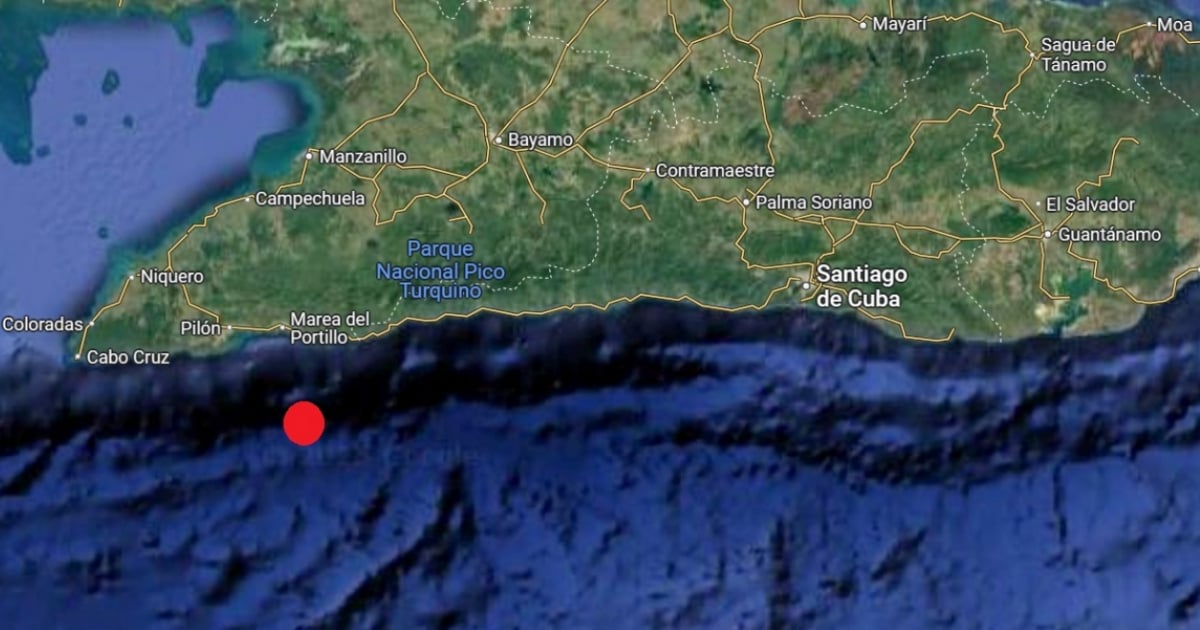
The head of the National Seismological Service of Cuba, Enrique Diego Arango Arias, reported that the network of seismological stations in the country registered a noticeable earthquake at 12:24 a.m. on February 25.
The seismic event had a magnitude of 3.3 degrees and was recorded at a depth of 10 kilometers.
The epicenter was located 24 kilometers from the municipality of Bartolomé Masó and 37 kilometers southeast of the town of Pilón, both of which are part of the province of Granma.
According to the provided data, the earthquake was located at coordinates 19.67° north latitude and -77.14° west longitude.
Arango Arias referred to reports on perceptibility from the areas of Marea de Portillo and Bartolomé Masó.
However, in the comments section, residents of the Granma municipalities of Media Luna, Campechuela, and Pilón reported feeling the tremor.
The official statement published by CENAIS on its website specifies that as a result of the minor earthquake recorded early this morning, "no material damages or loss of human life have been reported."
In a more recent post, Enrique Diego Arango Arias reported on a 5.4 magnitude earthquake that occurred in the northeast of the Dominican Republic at 1:48 a.m. today.
In that case, the phenomenon was recorded at a depth of 19.1 km, as revealed by the United States Geological Survey (USGS).
Head of CENAIS confirms seismic risk in Cuba but urges to avoid alarmism
In recent days, Enrique Diego Arango Arias addressed recent information that has caused alarm regarding the possibility of a major earthquake in the Caribbean that could impact Cuba.
Through a post on his Facebook profile, the specialist clarified that while there are areas with geological faults that accumulate significant energy and can generate substantial earthquakes, predicting such an event in the short term without concrete data is not possible.
"Both in the Dominican Republic and in Cuba, Japan, California, and many other places, a great earthquake could occur in the faults that have a significant amount of accumulated energy. This is no secret to anyone, but in the short term, it is very difficult to make a prediction without showing data to support it. The call for attention is valid, but in a less alarmist and sensationalist manner," wrote Arango Arias on Facebook.
The expert responded to an article titled "Director of the Seismological Institute warns that a major earthquake could occur at any moment", published on February 16 by the Dominican news portal Diario Libre.
That publication generated concern among many Cubans, which led the head of the National Seismological Service of Cuba to clarify the context of the situation.
Arango Arias emphasized that "based on the threat of each territory, the estimates of seismic hazard are established and included in the codes for earthquake-resistant construction."
In addition, he emphasized that authorities and the population must maintain adequate preparedness measures to reduce the risks associated with earthquakes.
The expert's clarification aimed to prevent the spread of alarmist information that could induce panic among the population.
Ten people were injured and at least 3,752 buildings were damaged as a result of the6 and 6.7 magnitude earthquakes that shook southeastern Cuba on November 10 of last year.
Since the earthquakes of magnitudes 6.0 and 6.7 that occurred on November 10, 2024, a total of 9,637 aftershocks have been recorded, of which 141 have been reported as presumably perceptible.
Regarding the 6.1 earthquake recorded on December 23, 2024, at 1:00 a.m., which was felt in the eastern half of the country, 573 aftershocks have been detected, of which only three have been felt by the population, according to the latest report from CENAIS.
Related videos:
Filed under: