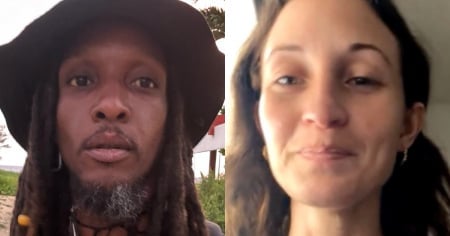
The repressor Eduardo Enríquez Blanco, who on July 11, 2021 (11J), took to the streets to "defend the revolution" during the mass protests, is now living in the United States, as revealed by the independent outlet Cubanet, based on information provided by an acquaintance of the young man.
The news was confirmed by that outlet on social media belonging to Enríquez Blanco, where at least two videos are said to have been recorded in Miami, and he has indicated that city as his place of residence.
Subsequently, the journalist Mario J. Pentón published in Martí Noticias that the Cuban arrived at the southern border of the United States in February 2023 and was welcomed in that country as a "refugee."
The young man, a former engineer at DATYS, a company dedicated to the development of applications, technologies, and systems belonging to MININT (the Ministry of the Interior), gained attention in the Cuban official media in 2021 following an interview in which he referred to his involvement in the repression against protesters from July 11, where he was allegedly "injured".
In his appearance before the state media, he recounted that, following Miguel Díaz-Canel's call to take to the streets to "defend the revolution", he decided to do so.
"No one called me, no one told me that I had to go out into the street," he stated in the interview.
In his speech, victimizing himself and reinforcing the narrative of the regime that labeled the participants in the protests as "criminals," he recounted that when he arrived at the demonstration, he positioned himself alongside the police, and the protesters threw stones, bottles, and assaulted them: "They started to say things to us, and above all to challenge that group of law enforcement officers who were there at that moment."
"The police began to advance, trying to disperse that crowd, and that's when I was injured, first with a stone on my thigh, then I was cut with a bottle on my back, I have an injury here on my leg that required seven stitches," he said.
However, the source that confirmed Enríquez resides in Miami informed Cubanet that the man, months before the events of July 11th, was part of a group of animal rights activists who at that time were protesting in front of state institutions "demanding an animal protection law in Cuba."
"I was surprised to see him on national television defending the regime and, worse still, supporting the repression of July 11; it was then that I questioned whether he was genuinely connected to the animal rights activists out of conviction or if he was an infiltrator, because in that video it is stated that he worked for MININT, so I have no doubt about it," he told the media.
So far, it has not been specified how the repressor managed to leave Cuba. The young man's profile on social media has been deleted.
This year, the Foundation for Human Rights in Cuba (FHRC) updated its "Cuban Repressors" project, adding new members to its list of individuals linked to serious human rights violations on the island, some of whom are already residing in the United States or are on their way to that country.
Since August 2024, the list has increased from 115 to 135 repressors who have entered U.S. territory through various means.
Some 1,130 repressors have been identified by the FHRC from its establishment in 2017 to February 2025.
The organization warned that these individuals pose a danger to the U.S., as most are connected to the repressive and military bodies of the Cuban dictatorship.
On the other hand, as argued by the FHRC, many of these repressors have entered the country under false statements to immigration authorities, which not only constitutes a federal crime but also compromises the integrity of the justice system and the protection of fundamental rights.
Frequently Asked Questions about Cuban Repressors of July 11th in the U.S.
Who is Eduardo Enríquez Blanco and why is his case relevant?
Eduardo Enríquez Blanco is a former engineer at DATYS, linked to MININT, who participated in the repression of the protests on July 11th in Cuba. His case is significant because, despite his role in the repression, he has been granted asylum in the United States, raising controversy over how some individuals associated with the Cuban regime manage to establish themselves in the northern country. His presence in Miami was confirmed by videos on his social media and journalist Mario J. Pentón.
How many Cuban repressors have entered the United States according to the FHRC?
As of August 2024, the Foundation for Human Rights in Cuba (FHRC) has increased its list of Cuban repressors in the United States from 115 to 135 individuals. In total, since 2017, 1,130 repressors have been identified by the FHRC, some of whom already reside in the United States. The organization warns about the danger they represent due to their connection with repressive bodies and military forces of the Cuban regime.
How do some Cuban repressors manage to enter the United States?
According to the FHRC, numerous Cuban repressors have entered the United States under false statements to immigration authorities. This not only constitutes a federal crime, but also undermines the integrity of the U.S. justice system. The case of Eduardo Enríquez Blanco, accepted as a refugee, is an example of how some individuals linked to the Cuban regime manage to settle in the U.S.
What actions have been taken to identify Cuban repressors in the U.S.?
The Foundation for Human Rights in Cuba has implemented the project "Cuban Repressors," which continuously updates its list of individuals linked to human rights violations on the island. The aim is to monitor these individuals and raise awareness about their presence in the United States. Through this project, the goal is to prevent repressors of the Cuban regime from settling in the country without facing the consequences of their actions in Cuba.
Filed under: