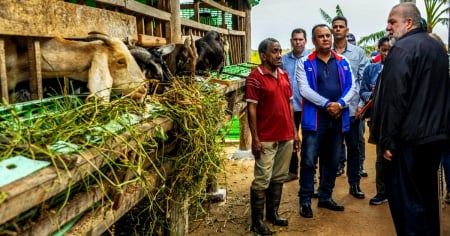
The Cuban regime plans to grant land in usufruct to foreign companies and individuals with permanent residency on the island as part of a new strategy to boost agricultural production amid the serious crisis facing the sector.
The Ministry of Agriculture (Minag) announced on Tuesday at a press conference that this measure is included in the draft Law on Property, Possession, and Use of Land.
The regulation aims to promote the "increase of agricultural production" and recognize "all economic actors," reported the news agency EFE.
The preliminary draft, consisting of 60 pages, will be subject to discussion until May 1 and will subsequently be presented to the National Assembly of People's Power for approval in December.
Although Cuba had already granted land in usufruct to foreign companies, this was done without a clear legal framework.
Mayra Cruz, legal director of Minag, explained that the fundamental change lies in the explicit recognition of this possibility in the agrarian legislation.
"The current decree law regarding the granting of land in usufruct does not mention foreign legal entities in any form (...) How has this been addressed so far? Based on the Constitution, but with a legal void," Cruz stated.
In January, the Cuban state media reported that a Vietnamese company became the first foreign firm to receive land for cultivation in Cuba since 1959.
The company obtained 308 hectares on a farm in the south of Pinar del Río province for rice cultivation.
Cruz emphasized that the new legislation also aims to address a common issue among foreign residents on the island who wish to access land for usufruct but have had to request it through Cuban relatives.
"We know many cases of foreigners living in the country who are interested in accessing this possibility. Until now, they have had to rely on their wives, children, or other Cuban relatives to obtain land. This proposal will allow them to acquire it directly in their name, just as is the case with other assets like cars and housing," the official explained.
The measure comes at a critical moment for the Cuban economy, which is facing a deep crisis exacerbated by the covid-19 pandemic, the tightening of U.S. sanctions, and failures in domestic economic policy.
The island is experiencing a severe shortage of food, medicine, fuel, and cash, along with uncontrolled inflation, prolonged blackouts, and a growing dollarization of the economy.
Frequently Asked Questions about the legalization of land in usufruct for foreigners in Cuba
What does the legalization of usufruct land for foreigners in Cuba imply?
The legalization of usufruct lands for foreigners in Cuba allows foreign companies and individuals with permanent residence on the island to legally access land for agricultural production. This measure aims to boost agricultural production amid the country's economic crisis. Previously, land grants to foreigners were made without a clear legal framework, creating a legal void that the new agrarian legislation now seeks to address.
How does this measure affect foreign residents in Cuba who wish to access land for usufruct?
The new measure allows foreign residents in Cuba to directly access land in usufruct without the need for Cuban intermediaries. Until now, many foreigners interested in this opportunity had to rely on Cuban relatives to obtain the land. With the new regulation, they will be able to acquire it directly in their name, just like with other assets such as cars and homes.
Why is the Cuban government implementing this measure now?
The Cuban government is implementing this measure in an attempt to reactivate agricultural production and mitigate the severe economic crisis the country is facing. The scarcity of food, medicine, and other essential resources has prompted the regime to seek new strategies to increase agricultural productivity and attract foreign investment, despite the structural and political challenges the island faces.
What is the potential impact of this measure on Cuba's national sovereignty?
The granting of land in usufruct to foreigners raises concerns about Cuba's national sovereignty, as it involves relinquishing some control over the use of state lands to foreign entities. While the government presents it as a solution to agricultural unproductivity, the measure also reflects Cuba's increasing dependence on foreign investment to address its internal economic issues.
Filed under: