
Related videos:
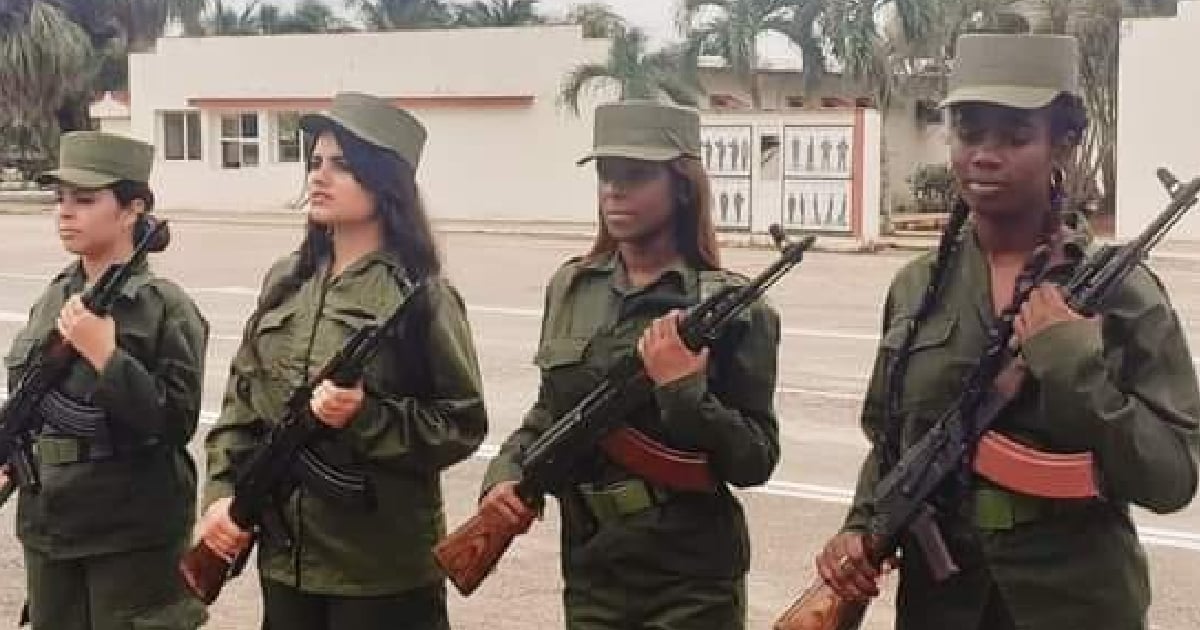
The Ministry of the Revolutionary Armed Forces (MINFAR) celebrated this Saturday on its social media the role of young Cuban women in the Voluntary Women's Military Service, highlighting their dedication and commitment to the defense of the country, in a message that reinforces the official propaganda on militarization in Cuba.
In a post on Facebook, the MINFAR stated that women in the military service “educate all combatants with their presence” and represent an “immense bastion” for the Revolution.
He also emphasized that his role goes beyond the symbolic: “When it comes to such a crucial task as the defense of the homeland, these young women take on an infinite dimension.”
The ministry made it clear that the purpose of these recruits is not limited to military training within the island, but that they would be prepared to fight "if necessary, in brother nations," aligning with the conflict-exporting doctrine that has characterized the regime.
To close the message, the MINFAR referenced a phrase from Vilma Espín, who stated that "let the enemies tremble of a people where every woman is a soldier of the Homeland," a declaration that reinforces the idea that military training remains a key pillar in youth indoctrination in Cuba.
The Women's Military Service in Cuba has been recently promoted as a "good option" for young women, according to the Cuban Women's Federation (FMC). The government-backed organization has advocated the idea that military service provides opportunities for training and professional development, although numerous accounts challenge this assertion.
One of the groups affected by this measure is the aspiring journalism students in Cuba. Starting from the 2024-2025 academic year, women who wish to study this major at Cuban universities will be required to complete one year of mandatory military service before beginning their studies, as reported by CiberCuba. This measure has sparked criticism on social media and among academic sectors, who see it as a strategy for indoctrination and control over future communicators.
Meanwhile, state media has circulated testimonies from young people who claim to be satisfied with their time in military service. A group of future journalists interviewed by state television stated that the experience had provided them with "discipline and values," although the coverage omitted any mention of the mandatory nature of the measure and the potential difficulties faced by those who refuse to comply, according to a report by CiberCuba.
In the same vein, a Cuban father defended his daughter's decision to join the military service, asserting that this experience "does not harm anyone, but rather benefits them." His testimony was shared on social media and reported by CiberCuba, although it did not address the allegations of abuses and pressures that have arisen in recent years regarding female military service on the island.
Frequently Asked Questions about Women's Military Service and Mandatory Service in Cuba
What is the Female Voluntary Military Service in Cuba and what is its purpose according to the regime?
The Volunteer Military Service for Women in Cuba is presented as a training tool for Cuban young women. According to the regime, it provides opportunities for professional training and development, and its purpose goes beyond the symbolic by preparing women for the defense of the homeland and even to fight in "brother nations." However, this measure is perceived as a strategy for indoctrination and control, particularly criticized by academic and civil sectors.
Why is Mandatory Military Service criticized in Cuba?
The Mandatory Military Service in Cuba is criticized for being seen as an oppressive and dangerous system for Cuban youth. Criticism intensifies due to the risks faced by young people, such as precarious living conditions, mistreatment, and situations that have led to suicides and deaths. Furthermore, the compulsory nature of the service is viewed as a measure of social and political control that destabilizes families, especially in vulnerable situations.
How does Mandatory Military Service affect aspiring journalism students in Cuba?
Starting from the 2024-2025 academic year, women who wish to study journalism in Cuba must complete a year of mandatory military service before beginning their studies. This measure has generated criticism, as it is seen as a strategy to indoctrinate and control future communicators. Despite official propaganda highlighting the educational value of the service, many question its real usefulness and the impact on freedom of expression.
What are the penalties for failing to comply with military service in Cuba?
Noncompliance with Military Service in Cuba can lead to severe penalties, including fines and potential criminal proceedings. Decree 103/2024 establishes fines ranging from 2,500 to 7,000 Cuban pesos for those who fail to register in the military registry or do not respond to summonses. Additionally, the parents or guardians of minors may be held responsible for their children’s infractions, which increases the pressure on families.
Filed under: