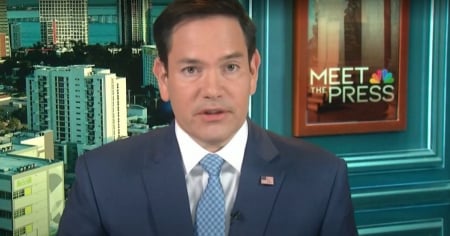
The Canadian Minister of Foreign Affairs, Mélanie Joly, delivered a strong message to the U.S. Secretary of State, Marco Rubio, during the G7 Foreign Ministers' Summit held in La Malbaie, Quebec.
"What I told the secretary is that Canada's sovereignty is not up for debate. Period. There is no discussion. There is no debate about it. There is no need to talk about it. [I told him:] 'You are here, respect us. Respect our sovereignty. You are in our country, respect our people.' Period," said the minister during a press conference following the meeting.
Joly's statements emerged in response to comments from the U.S. president, Donald Trump, who reiterated the idea that Canada could become the 51st state of the Union.
The Canadian minister made it clear that she would not allow those claims to affect the country's diplomatic agenda and that, in her words, "there was no discussion about it, nor any need to talk about that issue."
Rubio downplays the tension but acknowledges disagreement
For his part, Rubio acknowledged that there is a discrepancy between Trump's stance and that of the Canadian government, but he tried to downplay the matter, asserting that the G7 summit was not the appropriate forum to discuss a possible annexation of Canada to the United States.
"There is a disagreement between the president's stance and that of the Canadian government," Rubio acknowledged, according to CBC. "I don't think it's a mystery, and it wasn't a topic of conversation because it wasn't the purpose of this summit."
Trump insists on his vision for Canada
The U.S. president, for his part, reiterated his belief that Canada would function better as a state within the Union. During a conference at the White House, Trump stated, "We don’t need anything they have. As a state, it would be one of the great states."
Trump also referred to the border between the two countries, describing it as "an artificial line" that, in his view, "makes no sense."
Prime Minister Carney strongly rejects the idea
The Canadian Prime Minister, Mark Carney, was even more categorical in his rejection of Trump’s proposal. During a press conference, he called the idea "madness" and assured that Canada "will never, in any way, become part of the United States."
"The United States is not Canada," Carney emphasized. "We are a fundamentally different country."
Canada seeks to diversify its trade
Beyond the controversy, Joly emphasized that the Canadian government will continue to strengthen its trade with partners outside the United States. She highlighted the importance of reducing internal trade barriers between provinces and strengthening economic relationships with Europe and the United Kingdom. "We need to diversify our economy," she stated.
This stance arises in a context of trade tensions with Washington. Recently, Trump announced new tariffs against Canada, which has prompted trade retaliation from the Ottawa government.
The G7 and the War in Ukraine
During the summit, Joly also discussed the situation in Ukraine and expressed the G7's support for a ceasefire proposal put forward by the United States. According to her statements, the international community is closely monitoring Russia's response. "The ball is now in Russia's court," she noted.
Meanwhile, Trump stated that he has had "productive conversations" with Russian President, Vladimir Putin, and that there is "a good chance" that the war may come to an end.
The controversy surrounding Canadian sovereignty, coupled with trade and geopolitical challenges, marks a period of tension in the relationship between Ottawa and Washington. However, Joly reaffirmed that Canada will maintain its firm stance and continue to strengthen its international alliances.
Filed under: