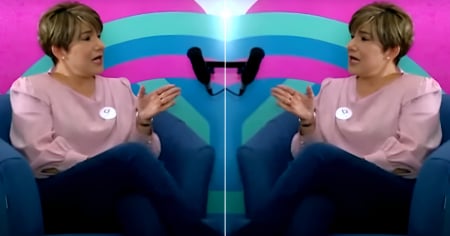
Lis Cuesta Peraza, National Director of Events at the Ministry of Culture of Cuba and wife of the ruler Miguel Díaz-Canel, addressed for the first time directly the criticisms and attacks she has received on social media since her emergence as a public figure.
In an interview with Alma Plus TV, the official responded with a speech that blended pedagogy, resilience and political loyalty, even going so far as to state that "even from the enemy, one can learn."
“At first, it hits you hard and you suffer because you are stigmatized, but you have to turn the page and move on,” Cuesta Peraza confessed, referring to the “hate speech” that, according to her, has circulated about her in the digital space. She stated that her strategy for dealing with such aggression has been patience: “I take it with forgiveness and harmony.”
Let's see how forgiveness and harmony are exercised by the "not first lady": In a Twitter thread from late May 2022, Cuesta Peraza claimed to have returned to social media "with several lessons learned."
"To those who identify as part of the revolutionary left and to the very lightweights, I invite you to deeply read the History of Cuba; there lies the value of true UNITY. To the pathological misogynists lurking here and to the enemies of the Revolution: I hate hate; I have NOTHING for you," declared the Twitter user after the mysterious reprimand.
However, in the interview this Sunday, she painted a different picture of herself and recounted that she has encountered people in real life who said unpleasant things about her on social media without knowing her: “When they meet me, they say: ‘Oh, I once…’. It’s no big deal. I never hold a grudge,” she stated.
She also did not mention the efforts of institutions and personalities of the regime to legitimize her figure, whether as an "researcher" or as a panelist on television. She also did not acknowledge that she has used her social media to ridicule and discredit civil society activists or demonstrators in popular protests.
According to Cuesta Peraza, we must differentiate between those who err out of ignorance and those who attack out of self-interest: "I feel sorry for those who do it out of mercenarism, but those who are confused should be forgiven."
His most striking reflection in this block was the following: “One can even learn from enemies. Behind a discourse tinged with hate or contempt, there may be a line, even imperceptible, that can be useful, that can teach you.”
The "not first lady" also insisted that criticism should not be dismissed because of its tone: "One cannot ignore what is being said, because you may indeed be wrong". However, her proposal was not to engage in public debate, but rather to privately discern what could be useful from a "poisoned critique".
The interview, at this point, became an exercise in the symbolic reconfiguration of a figure who has faced significant criticism since she was made public as Díaz-Canel's partner. Her public appearances, which are infrequent compared to first ladies in other contexts, have been the subject of mockery, memes, and disparagement.
Cuesta Peraza questioned the concept of first lady, asserting that "it is not only a bourgeois structure, but also a patriarchal one". She stated that she feels "very happy against that" and emphasized that her husband "has never intended for me to be behind or to hide." She defended her presence on social media and in public spaces as an achievement, not as a privilege.
In this context, she expressed her gratitude for the support she has received from influential women within the ideological apparatus of the regime, such as Dalia Soto del Valle (wife of the dictator Fidel Castro), Asela de Los Santos, and Mariela Castro, daughter of the retired general, Raúl Castro. She stated that these figures have “embraced” her and encouraged her to continue.
But the true aim of the interview was her attempt to reclaim the narrative about her persona. Cuesta Peraza sought to change her image from being a political figure targeted by attacks to that of a woman who overcomes, forgives, and even studies them.
And of course, he did so without addressing the structural causes that give rise to those discourses, nor questioning the censorship and repression that prevent civil society from freely criticizing the power of the regime.
In a system where public criticism of power is criminalized, Cuesta Peraza inverted the symbolic burden by portraying the "hatred" directed at her as unjust, individual, and emotional, while proposing a response rooted in patience, without acknowledging the social discontent that fuels those reactions.
"It is important to have an understanding perspective on this", he stated, as if the Cuban digital environment were not also characterized by censorship, surveillance, and fear. His speech was built upon an idea of moral superiority: those who criticize are mistaken; those who attack do so out of confusion or for money.
In that regard, Cuesta Peraza appealed to a concept of "sisterhood" from power, without allowing space for questions outside of her ideological framework. In her view, there are enemies, but also lessons: "one must always be willing to learn, even from that."
With the curious interview from the state media, Cuesta Peraza sought to reposition her image: from a discredited public figure to a voice of a resilient communist woman. From an object of ridicule to a subject of pedagogy. From a victim of hate speech to the protagonist of a narrative of learning. But, as is only logical, she did this from a fortified position, without leaving any cracks in the official narrative.
"Hasta del enemigo se aprende" is not a real self-criticism, but rather a phrase that softens dissent without acknowledging it, summarizing its strategy: to minimize conflict, absorb criticism, and maintain loyalty to the regime.
In short, the interview failed to humanize the regime's power; instead, it merely glossed it over, presenting it with a sensitive yet unyielding face. It did so by reminding activists and civil society that—even in the rhetoric of supposed learning and forgiveness—the power continues to speak only to itself.
Filed under: