In the context of International Women's Day, the Cuban regime paid tribute to Celia Sánchez Manduley, praising her "modesty," her role in the "background," and her dedication to fulfilling the dreams of Fidel Castro.
Gathered with women from across Cuba at the so-called Palace of the Revolution, the designated ruler, Miguel Díaz-Canel, quoted words from Celia Esther de los Desamparados Sánchez Manduley, stating that female figures gain significance to the extent that they explicitly renounce their protagonism in history.
Celia said: It's not about being a hero. What it's about is never stopping the fight. And I believe that is the conviction we can share and weave into our revolutionary sentiment here today,” emphasized Díaz-Canel in his speech, as reported by the National Television News (NTV).
In the event, which was also attended by the Secretary General of the Federation of Cuban Women, Teresa Amarelle Boué, and the spouse of the ruler, Lis Cuesta Peraza, to whom he publicly denied the title of “first lady”, the narrative consolidating the absolute male leadership within the so-called "revolution" was highlighted within the Cuban regime.
A narrative that high-ranking officials and leaders of the regime reproduce without shame, such as Dayli Sánchez Lemus, deputy director of the Office of Historical Affairs of the State Council, who, while recalling Sánchez Manduley, stated:
“She was a guerrilla all the time, she was a very modest woman who was involved in everything and hardly ever appeared. She was always in the background, taking care of the rear guard and logistical matters… Well, at the forefront too… Because she was always ahead to organize things, fulfilling and realizing Fidel's dreams…”.
The discourse of female subordination, which regime leaders have always highlighting the sweetness, love, and understanding of women, only reinforces the notion that the role of women in History is one of support and accompaniment, not of leadership or self-recognition.
“They are heroic women, they are women with a strength of soul, of spirit, with tremendous hearts… But I, quite simply, in the most modest way possible, can say that you are wonderful women, that Cuban women are wonderful women. Long live Cuban women!” concluded Díaz-Canel at the event.
This type of discourse reveals the macho structure that still defines the Cuban regime. While around the world March 8 is commemorated with calls for gender equity and women's empowerment, in Cuba the official apparatus celebrates its historical women by highlighting their selflessness, their "modesty," and their ability to be "in the background."
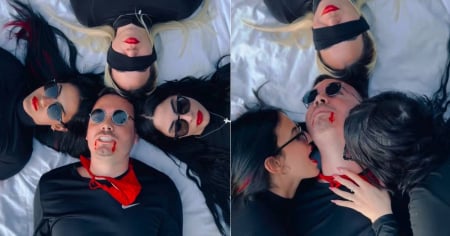
A model that perfectly aligns with the patriarchal structure imposed from power and leaves images such as that of "regret" from Mayelín Carrasco Álvarez, the mother who was arrested for protesting in the public square in the Granma locality of Río Cauto. Or the extravagant greeting from Sandro Castro, grandson of the dictator Fidel Castro.
The message conveyed is clear: women can be honored, but only if their role does not challenge the male hierarchy established by castrism. The "revolution" has been built upon the image of the all-powerful male leader, while the most prominent women in its history are remembered for their "silent sacrifice" and their supportive role.
Thus, the tribute to Sánchez Manduley on International Women's Day not only highlights the machismo of the official discourse but also perpetuates the idea that in Cuba, the ideal woman is one who remains in the background, dedicating her life to fulfilling the dreams of the men who hold power.
The official narrative and the cult of masculine personality
The so-called "Cuban Revolution" has built its history around male figures such as Castro, Ernesto "Che" Guevara, and Camilo Cienfuegos, presenting them as central heroes.
Women, although they actively participated, have been relegated to secondary roles in the official narrative. This approach perpetuates a patriarchal structure where leadership and prominence are primarily associated with men.
In her novel "I Was Never the First Lady," the writer Wendy Guerra explored how, from childhood, she perceived the heroes of the revolution as omnipresent deities, while female figures like Sánchez Manduley, secretary and alleged mistress of Fidel, were crucial yet less visible.
Guerra describes her work as a story of disillusionment and loss, reflecting the marginalization of women in the revolutionary narrative.
An example of the structural machismo of the Cuban regime is the constant reference to women as "brave, admirable, fighters," but without granting them a real space for decision-making.
The Cuban government boasts about its alleged gender equity, but the reality is that most high political and military positions remain in the hands of men. An article from CiberCuba had already warned that, in 2019, women held barely 14% of leadership positions in the Cuban government, despite representing more than 50% of the population.
Femicides, repression, and denial of gender violence
One of the most alarming aspects of institutionalized machismo in Cuba is the regime's refusal to acknowledge femicides as a real problem.
While feminist organizations and independent platforms have documented dozens of murders of women by their partners in recent years, Díaz-Canel recently claimed that "in Cuba there are no feminicides, but isolated incidents".
This denial reinforces the lack of effective policies to protect women and highlights the government's disinterest in addressing the issue seriously.
The marginalization of women is not only historical; it persists in contemporary Cuba, where blackouts, widespread shortages, extremely low wages, migratory exodus, and repression hit hard on mothers, grandmothers, sisters, and daughters.
The situation of Cuban political prisoners is yet another example of the regime's disregard for women who choose to speak out. Accounts detail how these women face inhumane conditions in prisons, lacking access to potable water, suffering physical and psychological abuse, and enduring prolonged isolation.
Organizations like Cubalex have reported that more than 100 women remain incarcerated for political reasons, many of whom participated in the protests on July 11, 2021.
These prisoners are facing inhumane conditions, such as lack of water and poor nutrition. Some have gone so far as to sign letters with their own blood demanding their freedom and that of other political prisoners.
In practice, Cuban women continue to suffer from discrimination, gender-based violence, and even political persecution. Recent cases have shown how feminist activists have been repressed by the regime, preventing them from leaving the country or imprisoning them for their critical positions.
The cult of personality and the exclusion of women
The message conveyed is clear: women can be honored, but only if their role does not challenge the male hierarchy established by Castroism.
The "revolution" has been built upon the image of the all-powerful male leader, while the most prominent women in its history are remembered for their "silent sacrifice" and their supportive role.
The cult of personality surrounding Fidel Castro and the other "heroes" of the Revolution has been crucial in perpetuating this patriarchal model. In every official commemoration, in every speech, and in every tribute, the message is the same: women may be recognized, but only in relation to their connections with male leaders.
Thus, the tribute to Celia Sánchez on International Women's Day not only exposes the machismo of the official discourse but also perpetuates the idea that in Cuba, the ideal woman is one who remains in the background, dedicating her life to fulfilling the dreams of the men in power.
Filed under: