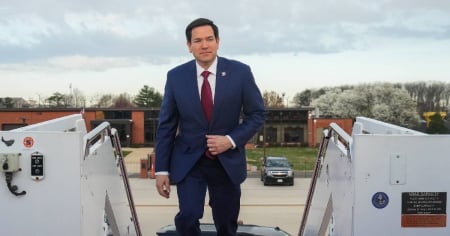
The United States Secretary of State, Marco Rubio, described the international medical missions organized by the Cuban regime as "an atrocious practice" for operating under conditions of labor exploitation.
However, he announced that he will evaluate on a case-by-case basis in the Caribbean, where several countries rely on these services, and acknowledged that there are places where Cuban specialists have "better working conditions."
During a press conference held in Jamaica, Rubio denounced that in many Cuban missions, doctors do not receive their salaries directly and even have their passports withheld to prevent them from fleeing.
"In many other parts of the world, doctors are not paid. The Cuban government is paid. Their passports are taken away. Basically, they operate as forced labor in many places," stated the U.S. official.
However, he emphasized that each country manages these programs differently, and due to the close relationships Washington has with Caribbean nations like Jamaica, he expressed a willingness to engage in dialogue with local governments to better understand how Cuban medical missions operate in each territory.
"Perhaps none of this applies to how things are managed here," he said, referring to Jamaica.
Rubio's statements come after the Caribbean Community (Caricom) openly questioned the U.S. sanctions against officials of governments that hire Cuban medical personnel under conditions deemed abusive.
Several Caribbean leaders advocate for medical cooperation with Cuba as an essential component of their healthcare systems. Jamaican Prime Minister Andrew Holness stated that his government is "very careful not to exploit Cuban doctors" and treats them in accordance with labor laws and international standards.
"We ensure that they are treated like any other worker and that our program complies with international laws," Holness stated, adding that the contribution of Cubans has been "of great help" due to the deficit of healthcare personnel in Jamaica.
Rubio also discussed the topic during meetings with other Caribbean leaders such as the Prime Minister of Barbados, Mia Mottley, and the Prime Minister of Trinidad and Tobago, Stuart Young. His agenda will continue this Thursday with visits to Guyana and Suriname.
One of the strongest endorsements of the Cuban medical program comes from the Prime Minister of Saint Vincent and the Grenadines, Ralph Gonsalves, who stated a few weeks ago that he would prefer to lose his U.S. visa rather than go without the support of Cuban doctors.
"If it is determined that I have to lose my visa, I will accept that. But I cannot let 60 hardworking and poor people who depend on Cuban doctors die," he stated.
Gonsalves sparked an intense debate about labor rights and professional exploitation by approving the Cuban state's decision to take a portion of the salaries of its health professionals, arguing that they received a "free education."
"That does not mean they are being exploited. They have free education. And if they go abroad, earning money with that education, it is not unreasonable for them to contribute something to the fund so that more people can be educated," he stated.
For his part, the Chancellor of Grenada, Joseph Andall, warned that his healthcare system would collapse without Cuban cooperation, and Jamaica's Minister of Foreign Affairs, Kamina Johnson Smith, claimed that over 400 Cuban professionals work in the Jamaican healthcare system.
Washington expands restrictions
Under the leadership of Marco Rubio, the State Department has announced new visa restrictions against foreign government officials who maintain agreements with Cuba under conditions deemed exploitative.
The measure is part of a broader policy to curb what Washington describes as the exportation of Cuban labor, which represents one of the main sources of income for the Havana regime.
"It's not about preventing medical assistance, but about ensuring that those professionals do not work under coercion," they argue from Washington.
Although Cuba claims that its medical brigades operate under fair and dignified bilateral agreements, human rights organizations, doctors, and the U.S. State Department itself have documented the conditions of semi-slavery faced by Cuban doctors abroad.
The practices include the retention of passports, strict surveillance, censorship, lack of labor guarantees, movement restrictions, and the confiscation of between 70% and 85% of professionals' salaries. Additionally, they face severe reprisals if they decide to leave the mission.
Frequently Asked Questions about Cuban Medical Missions and U.S. Policy.
Why does Marco Rubio describe Cuban medical missions as "an atrocious practice"?
Marco Rubio criticizes Cuban medical missions for operating under conditions of labor exploitation. According to his statements, doctors do not receive their salaries directly, their passports are withheld, and they work under coercive conditions, which he compares to forced labor. These practices have been denounced by human rights organizations and the U.S. Department of State.
What is the position of Caribbean leaders regarding Cuban medical cooperation?
Several Caribbean leaders defend medical cooperation with Cuba as essential for their health systems. For instance, the Prime Minister of St. Vincent and the Grenadines, Ralph Gonsalves, has stated that he would prefer to lose his U.S. visa rather than go without the help of Cuban doctors. Other leaders, such as the Prime Minister of Jamaica, assert that they comply with international labor standards when engaging with Cuban doctors.
What measures has the United States taken in response to Cuban medical missions?
The United States has imposed visa restrictions on officials from governments that hire Cuban medical personnel under conditions deemed exploitative. The policy aims to curb the export of Cuban labor and ensure that professionals are not working under coercion. These measures are part of a broader strategy by the Marco Rubio administration to hold the Cuban regime accountable for forced labor practices.
Filed under: