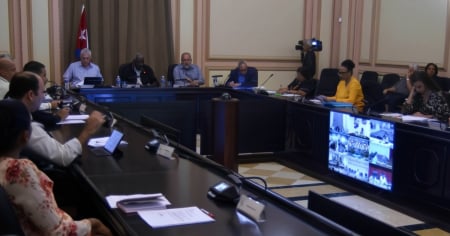
The President of the National Assembly of People's Power, Esteban Lazo Hernández, traveled to Moscow to lead the Second Session of the Commission for Cooperation between the Parliaments of Cuba and Russia, a meeting that highlights Havana's increasing dependence on its Eurasian ally.
The trip of Lazo takes place amidst a deep economic crisis and with limited financing sources. The objective is clear: to intensify ties with the Kremlin and pave the way for the future visit of Miguel Díaz-Canel.
During the meeting, held on Thursday at the headquarters of the State Duma, Lazo emphasized the strategic importance of the bilateral mechanism to “enhance cooperation” between both legislative bodies and as a tool to implement the agreements made by the leaders Miguel Díaz-Canel and Vladimir Putin.
"The goal is to achieve superior results for the benefit of both peoples," Lazo said. He reaffirmed the Cuban regime's intention to continue developing economic, commercial, financial, and scientific-technical collaboration with Moscow.
Prior to the parliamentary meeting, Lazo met on Wednesday with the Russian Foreign Minister, Serguéi Lavrov, who confirmed that the Cuban leader, Miguel Díaz-Canel, will participate in May in the celebrations for Victory Day in Moscow, having accepted an invitation from Putin himself.
Lavrov said that the visit of the president of the Cuban National Assembly represents a new chapter in the "strategic partnership" between the two governments.
"The visit of Esteban Lazo and recent exchanges reflect a moment of intense contacts at the highest level," emphasized the head of Russian diplomacy. He indicated that a new session of the Russian-Cuban Intergovernmental Commission for Economic and Scientific Cooperation is already being prepared, to be held in Havana.
A strategic alliance with new forms of dependency
Experts agree that the rhetoric of cooperation conceals a relationship of increasing subordination on the part of the Cuban regime, which seeks an economic lifeline from Russia in the face of the collapse of its internal model.
With insufficient remittances, stagnant tourism, and lacking productive support, Havana has offered preferential conditions to Russian companies, authorized the use of the ruble in commercial operations, and reinforced its diplomatic alignment with the Kremlin.
Since 2022, when Díaz-Canel traveled to Moscow to inaugurate a statue of Fidel Castro, Russia has increased its presence in key sectors of the Cuban economy, with investments in energy, transportation, agriculture, and tourism.
All of this takes place in an international context where the Cuban regime has refrained from condemning the Russian invasion of Ukraine and has supported Moscow's positions in multilateral forums.
The upcoming visit of Díaz-Canel to the Russian capital, coinciding with the 80th anniversary of the victory over fascism, will be an opportunity to once again showcase the closeness between both governments. It will also serve as a platform for new agreements at a time when the regime desperately needs external support due to internal social pressures and the structural collapse of its economy.
Frequently Asked Questions about the Collaboration between Cuba and Russia
What is the purpose of Esteban Lazo's trip to Russia?
The purpose of Esteban Lazo's trip to Russia is to strengthen ties with the Kremlin and to pave the way for a future visit from Díaz-Canel, seeking economic support amid the crisis Cuba is facing. The visit is part of the Second Session of the Commission for Collaboration between the Parliaments of Cuba and Russia.
How is Russia supporting Cuba in its economic and energy crisis?
Russia is supporting Cuba through loans, donations, and technical assistance. It has offered a loan of 65 million dollars to address the energy crisis, in addition to supplying spare parts and specialized equipment for the Cuban electrical sector. It has also restructured Cuba's debt to relieve the economic pressure on the island.
What are the implications of the alliance between Cuba and Russia for the region?
The alliance between Cuba and Russia strengthens Moscow's influence in Latin America and provides Cuba with political and economic support at a critical moment. This relationship aims to counteract the influence of the United States in the region and consolidate a strategic position for both countries on the international stage.
What role does oil play in the collaboration between Cuba and Russia?
Oil is a key component in the collaboration between Cuba and Russia. The Russian company Zarubezhneft collaborates with the Cuban CUPET in oil extraction at the Boca de Jaruco field. This project is crucial for reducing Cuba's dependence on crude oil imports and improving its internal production.
Filed under: