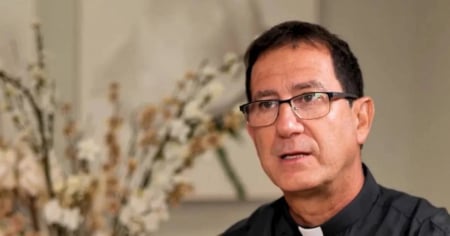
Father Alberto Reyes Pías (Camagüey, May 26, 1967) has granted an interview to CiberCuba through a questionnaire he agreed to answer in video format, despite the challenges posed by communication through this medium on the Island. In this remote conversation, lasting nearly 27 minutes, the parish priest of the Esmeralda area advocates for a peaceful transition in Cuba, urging the Diaz-Canel regime to step down and allow Cubans to reclaim their freedom and their country. He also discusses how to confront the fear of repression and learned helplessness, and admits that he fears a violent outbreak on the Island.
CiberCuba: You have pointed out that the regime maintains control in Cuba through fear and lies. How can that fear be eradicated? What role should the Catholic Church play in the process of overcoming fear?
Father Alberto: We cannot eliminate fear; we cannot stamp it out because fear is spontaneous, it is natural. As long as the government in Cuba remains a repressive government with power, there will be fear. So, what can we do to alleviate people's fear? Nothing. What can we do? Act in spite of fear. Resist peacefully. Protest peacefully despite the fear. This means not participating in things that support the government, even if I fear reprisals. It means expressing myself, speaking the truth in all environments despite the fear of potential consequences. But I believe that point is important. It is not about getting rid of our fear in order to act. Because, I repeat, fear is spontaneous, it is natural. And in that sense, we have no control over it. What we can do is act despite the fear.
The role of the Church in managing fear, I believe, starts with its ability to preach the truth, defend the truth, and declare the truth wherever it may be, grounded in the Gospel. Above all, it is about fostering a personal encounter with Jesus Christ that leads to an encounter with God the Father. Because when a person anchors their life in Christ, when they are convinced of God's presence in their life, they experience a strength, a capability that helps them break free from paralysis. This doesn't necessarily eliminate the feeling of fear—it might, but it doesn't always remove the sensation of fear, as I reiterate that fear is natural—but it does enable a person to overcome the paralysis induced by fear. It empowers the individual to face anything. In other words, a person experiences what the apostles felt when they were forbidden to speak about Jesus Christ. That assurance, that strength with which Peter proclaimed the need to obey God rather than men, regardless of the consequences. This can only be achieved when one has a profound assurance born from their experience with Jesus Christ. Therefore, I believe that when the Church promotes a personal encounter with Christ, it opens the door to personal freedom and the defense of social freedom.
The breakdown of the family as the pillar of society has turned Cuba into a matriarchal country where women, whether mothers or grandmothers, raise their children or grandchildren alone, almost always without male figures. As a result, girls and boys are brought up following feminine behavior patterns. However, in Cuba, women have proven to be remarkably brave. What explanation can you give for this national fear? Do you believe that the fear present on the streets is also felt within the Catholic Church?
Let's see, the fear in Cuba is quite understandable. Remember that this revolution began by imprisoning and executing individuals. In other words, the first message of this revolution is: "Those who oppose me will be imprisoned or executed." Honestly, if that doesn't instill fear, what else could? We have been generations indoctrinated in learned helplessness, convinced that nothing can be done here; people actually say it—this is something that can't be changed, nothing can be done. This is not true, but if one believes it, it becomes like the truth. On the other hand, the repression in Cuba is ongoing, brutal, and without limits. The government knows and is increasingly convinced that it has already lost this people. Therefore, it cannot afford any slip-ups with this populace; when the people take to the streets to protest and claim their rights, an entire mechanism of repression, detention, and imprisonment is immediately activated, and people feel very alone because Cuban civil society is a very defenseless society.
In Cuba, there is no rule of law. There are no laws to protect citizens. Given the learned helplessness, the vulnerability of Cuban society, where there is no one to defend you, and the repression that is very serious, systematic, and harsh, it is quite normal for this to generate fear. Therefore, I don’t want to be repetitive, but I have to reiterate that the fear within us, in generations, will not go away. The only thing we can do is train ourselves to learn how to defend what we want, to seek what we need, from fear, despite fear, overcoming fear, which will always be there.
Of course there is fear in the church, because the church is made up of the people—laity, priests, nuns, bishops—we are part of this community. We have experienced the same challenges as this people, we live through the same struggles, and simply entering the church does not make those fears disappear. What remains is the church, the gospel, the encounter with Jesus Christ—tools to confront our fears and grow in inner freedom.
Well, this is a process, a long and slow one, that each person must undertake; it is a personal journey. Therefore, is there fear in the Church? Yes, at all levels, though it might be lessened to the extent that individuals, from their experience of faith, engage in this process of inner freedom and work through their mechanisms to overcome and face their fears.
However, belonging to the Church does not automatically trigger that process. Each person must undertake a journey of inner freedom, for which the Church and the Gospel provide many tools.
You have acknowledged that change in Cuba will not come about through passive attitudes. With the route of emigration to the United States cut off, what attitudes do you think Cubans should adopt in order for Cuba to become a country where one can live and have future projects?
I believe that this process we call the Cuban revolution has given everything it could to this country and has shown for over 65 years that it has been incapable of developing a nation, of providing a life, a future for its citizens. It is unable to generate an environment of freedom, joy, peace, and satisfaction. History has demonstrated that they have failed as a system. They have failed, and the most honest thing they could do is relinquish power, to say, "Look, we couldn't do this; it was a failure, it failed." Cuba is not a developed country, Cuba is not a happy country, Cuba is not a free country, Cuba is not a country where people feel they have a present and a future. We should leave; that is the best and most honest thing they could do.
As long as they don't do it, I believe our attitude should be, on one hand, not to support anything that upholds this system, nor to attend anything, nor to support anything, nor to applaud anything that conveys the message that I endorse this system, because then we are helping this agony to continue. The other aspect is to cultivate that inner freedom and be able to express what we feel, what we want, what we long for, from our homes to society. Am I suggesting that this also includes peaceful demonstrations? Yes, I am indeed suggesting that this includes going out into the streets to protest in large numbers. I am saying this because it is our right, and it seems that without something like this, things will not change.
I am not in favor of violence; I would never support any violent act. But going out into the streets, en masse, to protest and demand our rights—that's what I want to convey as part of what we can do. Yes, I am saying this, I am affirming it, and I would be the first to join my people in a demonstration to demand a change in the system and the freedom we need
I would like you to evaluate the agreement to release 553 political prisoners, supposedly in light of the Jubilee, which, according to NGOs close to the families of the prisoners of conscience, has not gone as expected.
Well, regarding the release of political prisoners, or prisoners in general, we were aware that it was mostly about political prisoners, but the topic of prisoner release was discussed. It was framed not so much as a negotiation, but rather as a gesture of goodwill for the Jubilee. I believe that, in reality, behind this was the agreement to remove Cuba from the list of state sponsors of terrorism. In fact, once Cuba was re-included on that list, the releases were suspended. Therefore, I think this is essentially a maneuver by the government, which has utilized the religious element, the face of the church, and the excuse of the Jubilee, but fundamentally, I believe it’s all a political web at another level, with negotiations at a level that I suspect, but do not know. It's a negotiation at another level to exchange the freedom of prisoners for advantages that this government seeks and needs. Consequently, once Cuba was once again placed on the list of state sponsors of terrorism, the release of prisoners came to an end. Of course, one might wonder, well, if it was a gesture of goodwill for the Jubilee or if the Pope was behind this, what happened? Where did that go? The reality is that it was never that simple. There is a much deeper political game in which the Church has actually served as an excuse, not as a counterpart.
How is the Christian faith lived out in your parish? What answers do you have for the doubts of your parishioners, especially the younger ones?
Certainly, there are responses to political situations, but faith goes far beyond politics; faith is life, and it encompasses all of life. How is faith lived in my parish? By offering everything that faith can provide to children, teenagers, young people, couples, and the sick. There are countless things that one experiences beyond the political situation—values that shape how we build our lives, how we manage a marriage, the education of our children, family dynamics, and how we cope with the suffering that comes from illness, ailments, and the complicated situations of life. In other words, faith provides answers to all of life's circumstances, and in this, we grow.
What do you feel when you see those older people in Cuba rummaging through the trash looking for something to eat? Is there a way for Cubans to help them through their parish?
The fact that there are people who have to search for food in the garbage is, I believe, an indicator not only of the precariousness of life on the Island and the horrific need for basic necessities, but also of how this situation has come to affect a person's dignity. Everyone knows that searching for food in the trash is humiliating, it is deeply humiliating, and that is understood by the person doing it because they have no other choice. No one takes pride in rummaging through a dumpster. When someone resorts to doing that, it is because they can no longer cope, they have no other option, and that is very sad for a nation.
And there are certainly many ways to help. It would just require coordination, but at this moment, thank God, there are many ways to send food, to send medicine; there are many ways to help, but that certainly needs coordination.
You are one of the few Cuban priests who openly criticize the regime. In Nicaragua, there have been waves of arrests of priests. Are you not afraid that they will do the same to you? Are you prepared for martyrdom?
Let's see, I don't really think about martyrdom or anything that may happen, because my focus isn't there. My focus isn’t on what consequences my attitude might have. What do I tell myself? Well, first that you have to live one day at a time. I live one day at a time, I live my today, and I won’t suffer for something that hasn’t happened. I’m not going to exhaust my neurons worrying and forgetting the present over things that I don’t know if they will be in the future; since I don’t know, I live one day at a time.
What else can I tell myself? Let life pause for me.
What else can I say to myself? I want life to stop for me. I believe that what truly matters is being true to one's own conscience, and in that regard, there’s a piece of advice I give to people, and I always say: don't ask yourself and then answer yourself. You can ask yourself anything you want, but don’t ask and answer at the same time. What does this mean? So if I say or do this, and if this happens, then surely this will happen, or no, no, no, no. You can ask yourself whatever you want, but let life provide the answers. I want life to stop for me, to pause, because what’s really important to me is being faithful to my conscience. What’s truly important to me is that what I do makes sense.
This is what matters to me, and on the other hand, there's something I say and try to live deeply: the reality is that everything has a price. Speaking, telling the truth publicly, can come at a cost, but staying silent, witnessing reality and saying nothing, ignoring the needs of this people, the lack of freedom among this people, and turning away as if nothing is happening, that has a price—a devastating price, one that goes deep, affecting one's inner self and consciousness. So in my life, I never question where there is a price and where there isn't because everything has a price. What I wonder about in life is which price compensates me, which price I am willing to assume, which price I am prepared to pay. I am willing to pay whatever costs are necessary in order to be true to my conscience, in order to be faithful to what I believe God asks of me, in order to be faithful to the truth that Christ asks of me to defend in the Gospel.
Moreover, I grew up hearing that the church is the voice of those who have no voice. I grew up hearing that a priest must preach with the Gospel in one hand and a newspaper in the other, grounded in social reality. That's how I was raised. I grew up in the seminary listening to many priests say that the priesthood must be prophetic. The priest needs to learn to defend the truth. That’s how I was formed. That’s how I grew up in the seminary and in the church. I cannot now pretend that this is not in my DNA. I cannot now say that I do not have this within my soul. So, I try to be true to this. And if there are consequences, well, if they come, we will face them.
Despite the threats and acts of repudiation against him, he has decided to remain in Cuba. Why does he do it? Is he not afraid?
I am in Cuba, first of all because I love this place; I love this country, I love my people, I love my community. I have lived outside of Cuba twice. The first time was for four years when I went to study Theology in Italy, and the second time was for five years when I went to study Psychology in Madrid. It went very well for me. I enjoyed it greatly, but I always carried a profound feeling that this is not my site, this is not my place. Both experiences were extraordinary, very good, but at no moment did I feel the urge to say: I want to stay. Even in moments where you realize that you could have a very productive, very effective priestly ministry there, the feeling was always very deep: this is not my place, and besides that, I believe that someone has to stay with this people, someone has to accompany this people, someone has to sit and listen to the suffering of this people, someone has to raise their voice for this people, who have no voice. I have said it, I repeat it now, and I am honest when I say it: I feel like a voice crying out in the desert. Many times I feel like a drop of water in the ocean. I don't really believe that I am doing anything extraordinary. I think I am doing what I have to do, but that's precisely it, doing what I have to do, here, amidst this situation and with this people who need the shepherd to be here and accompany them from here.
I feel like a voice crying out in the desert. Many times, I feel like a drop of water in the ocean
Many of us dream of a peaceful transition to a Spanish-style system in Cuba, but high-ranking U.S. government officials do not rule out a surgical military intervention in Cuba, similar to what occurred in Syria in 2017, after the Al Assad regime attacked the civilian population with chemical weapons. How do you believe the transition to democracy on the Island should take place?
I too want, ask for, plead for, and desire a peaceful transition. It is the best thing that could happen to us. I believe that a transition must come. It has to come for many reasons. We are a country stuck, we are a country frozen in time. We are a country where the ruling system has nothing to offer other than clinging to power, with all the misery that has generated and repressing those who protest. In other words, this is not living. There is no present here, there is no future. Young people have been leaving in waves for many years. We are internationally recognized by international mechanisms as the oldest country in the region. We are a country with a high poverty rate. I believe that a transition must come. It is what is necessary.
I wish it could be peaceful. I don’t believe there should be an American military intervention. I don’t think that’s the solution either. But well, I’m a pastor; I’m not a politician, and I don’t know much about these things. I’m not sure. I wouldn’t want a violent transition because violent transitions always take a toll on the people. I fear it. I fear it because this government is leading this people to such a dead-end, to such exasperation and a difficult life, that I worry about a violent explosion. I fear it, I fear it, but I don’t want it. Therefore, once again, I take this opportunity to make a plea to the government of my country: Leave. Close this down already. Allow for a peaceful transition and let this people rebuild in peace without you. Leave now. Give up the power you have not known how to use and allow this people to be reborn into a different reality. Leave.
This government is leading this people to a point of deadlock, of exasperation, of difficult living conditions, that I fear a violent outbreak
Have you been able to convey that idea (of transition) to PCC officials in any contact you have had with them?
I have not been able to convey this idea of a transition, or any idea, to any member of the Communist Party. First of all, because they do not want to engage in dialogue with me. I can attest that many times when they have gone to complain about me to my bishop, the bishop's response has always been, "Talk to him, engage in dialogue with him," and their response has consistently been the same: "We have nothing to discuss with him; we have nothing to dialogue about with him." There was one occasion when I was summoned by State Security, actually to inform me that if I continued to express these ideas, I could be prosecuted under Cuban laws.
Well, that was the start, that threat, but then the conversation turned into a dialogue, and I believe that was good; at least for me, it was good. I was able to calmly express everything I thought, there was a dialogue, and I felt satisfied to have had this meeting, even if the motivation was a threat. But never again, never again, and I believe it’s necessary for us all to communicate. I think it’s important to have a national dialogue in Cuba; to call for a national dialogue where we can all be represented by someone so we can collectively seek a solution for this country, for the good of everyone, especially the people who are suffering. But also, for the benefit of those who govern us, because I am convinced that what they experience is not truly living either. Not because they lack material needs, or because they are unaffected by economic issues, but because I don’t believe they live in peace; I don’t think they have a serene and relaxed life.
I can imagine that they must be living with all the alarms going off. And that's not living, that's not living at all. I believe that a change in this country will benefit us all, the people, but also, also, those who govern us today.
Filed under: