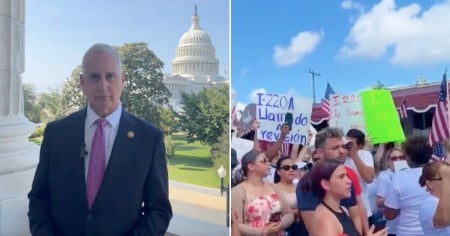
In a decision that has sparked significant controversy in South Florida, the government of the city of Doral unanimously approved a resolution to collaborate with the Immigration and Customs Enforcement (ICE), under the federal 287(g) program, which allows local law enforcement agencies to assume roles in enforcing federal immigration laws.
The measure sparked concerns among immigrant rights advocates, particularly given the city's demographic profile: 70% of its population is foreign-born, with a particularly significant Venezuelan community.
The approval of this agreement makes Doral one of more than 200 jurisdictions in Florida— the state with the most collaborations of this kind in the country— that have joined the program driven by the hardline federal immigration policies of the Trump administration.
A decision between legal pressure and social criticism
During the session that concluded with the vote, Deputy Mayor Maureen Porras explained that the decision was made following the recommendation of the city attorney, who interpreted that Doral is legally obligated to sign the agreement under a new state law approved in February, which strengthens cooperation between local and federal governments to combat illegal immigration.
"Our lawyer has interpreted the law to say that we have to sign this agreement," he assured Local 10.
Nonetheless, he acknowledged that there is legal confusion, as other cities like South Miami have challenged this alleged obligation in court, seeking a judicial order to clarify whether they are truly required to participate.
"We are closely monitoring that case. But as long as there is no clear judicial decision, we must act according to the legal guidance we currently have," added the deputy mayor.
Fear settles in the immigrant community
The resolution has been met with a mix of alarm and indignation from activists, lawyers, and members of the immigrant community, who claim that such agreements do not promote safety but rather fear.
"They do not have enough ICE agents to stop and carry out this mass deportation. They need help from the local police," said Juan Cuba from the Freedom Project in Miami.
The Venezuelan community in the municipality of Doral, also known as Little Venezuela or Doralzuela, is experiencing times of great uncertainty and fear due to the immigration policies of the Trump administration.
It pains us that the government is turning its back on us. "We did not come to commit crimes; we came to work, to build," said John, a Venezuelan immigrant who has been in the United States for nine years, where he runs a construction company and where his five-year-old daughter was born.
Between the law and the community
Although Vice Mayor Porras emphasized that the agreement will not be used to discriminate or violate the rights of residents, "we want to support our Police Department, but we also want to ensure that this contract is not used to discriminate against anyone based on their immigration status," she acknowledged that the anxiety is real.
"I know this worries a lot of people. That's why we need to put in a strong effort for community outreach," he said.
However, for those living in Doral without regular immigration status or with temporary permits, the message seems clear: the city that was once a refuge could now become an extension of the country's more aggressive immigration policies.
A wave of support and resistance in Florida
Doral is not alone in this decision. In recent months, cities such as Hialeah, Coral Gables, West Miami, and Miami Springs have also entered into similar agreements, citing similar reasons: to comply with state law, support police departments, and bolster "public safety."
In Hialeah, Mayor Esteban Bovo has tried to downplay the impact of the decision, assuring that "tomorrow morning everything will remain the same."
But for many activists, that normalcy is illusory. InOrlando, for example, the recent agreement signed between ICE and the Police Department sparked protests from community organizations, which criticized that the pact was signed without sufficient transparency or public consultation.
Meanwhile, the Florida Highway Patrol has announced that at least 1,400 state police officers will be sworn in as ICE liaison officers, consolidating an unprecedented state network for the enforcement of federal immigration policies.
Frequently Asked Questions about Doral's Collaboration with ICE and Immigration Policy in Florida
What does the Doral agreement with ICE under the 287(g) program entail?
The agreement between Doral and ICE allows local officials to be trained to enforce federal immigration laws. This means that Doral police officers, after receiving the appropriate training, will be able to question, arrest, and execute immigration orders, taking on roles that are typically reserved for federal agents.
What has been the reaction of the Doral community to the agreement with ICE?
The decision has sparked controversy and opposition among pro-immigrant activists and the local community, especially considering that 70% of the population in Doral was born abroad. Adelys Ferro, from the Venezuelan American Caucus, warned about the potential security risks this agreement could pose to the community.
How does Doral's decision fit into Florida's immigration policies?
The decision made by Doral aligns with Governor Ron DeSantis's immigration policy, which aims to strengthen the enforcement of immigration laws in the state. Florida has enacted laws that require cooperation between local and federal agencies in the detention and deportation of undocumented immigrants, and Doral is one of the cities that has chosen to collaborate with ICE under these guidelines.
What other municipalities in Florida have signed similar agreements with ICE?
In addition to Doral, other cities such as Hialeah, Coral Gables, West Miami, and Miami Springs have also signed agreements with ICE under the 287(g) program. These cities are part of a trend in Florida to strengthen cooperation with federal authorities to enforce stricter immigration laws.
What is the impact of the 287(g) program on the immigrant community in Florida?
The 287(g) program has raised concerns about potential racial discrimination and a decline in trust between immigrant communities and local authorities. There are fears that these measures could lead to unjustified persecution of immigrants and an increase in racial profiling, which impacts safety and social cohesion in the affected communities.
Filed under: