
Related videos:
In Santiago de Cuba, one of the most strategic provinces for the country's coffee production, only 65% of the agreed plan was met by the end of February.
This was acknowledged by the authorities during the Provincial Assembly of the XIII Congress of the ANAP, held last March, according to a report from the state-run newspaper Sierra Maestra in its printed version.
Despite the official calls to "push forward without pause," the reality remains one of scarcity, incomplete harvesting, unpaid wages, and coffee that, although it is present in the coffee plants, neither appears in the warehouses nor on the tables of households.
“It doesn’t even reach the warehouse. I have had to pay up to 40 pesos for a small cone, which is equivalent to half a cup from a small coffee maker,” laments Argelia Castellanos Jiménez, an octogenarian from Santiago who, with a pension of just 1,525 pesos, can only have a sip in the mornings “when it’s possible.”
The first secretary of the Party in the province, Beatriz Johnson Urrutia, urged during her speech to multiply efforts in the field: “We must drive it forward together, but without pauses and with our hands in the coffee plants, because the grain is there.”
Adalgenis González Cuevas, from the Agro-Food Bureau of ANAP, stated that the bulk of each harvest is in that sector, but the data is insufficient.
In this contest, around 4,000 tons of coffee were projected, with 575 designated for the arabica variety and the rest for robusta, making Tercer Frente the largest producer in the country with 2,000 tons agreed upon.
However, those who can be self-sufficient find in this option a remedy for the crisis. In Los Negros, a rural village in Contramaestre, the retired Epifanio Sapsim Borges, 75 years old, turned his backyard into a home coffee plantation.
"I sow and harvest the grain. Here, the pound costs up to 200 pesos," he assured. Adis Toro Fajardo, 85 years old, in the Patricio Lumumba neighborhood, also grows without chemicals or fertilizers: "I try to make my coffee as natural as possible," he explained.
Her daughters, grandchildren, and sisters enjoy her coffee, always taking a bit of the beans when they visit. However, beyond these domestic efforts, industrial production faces structural deficiencies.
Elieser Rodríguez Suárez, president of the UBPC Los Baños in Tercer Frente, has successfully implemented technological innovations with the support of the local Agroforestry Experimental Station.
"We are working on several systems associated with technologies that allow us a direct connection to research and development," he stated.
Nationally, the strategy presented in 2023 by the regime included seven actions to revive the sector, aiming to meet both domestic consumption and export needs.
However, according to Felipe Martínez Suárez, director of the experimental station, the drop in production is not due to a lack of coffee on the plants, but rather to a shortage of labor to harvest it.
The country lacks collectors, especially in mountainous areas, and there are no functional camps to accommodate mobilized individuals, as was done in the past.
Many students who previously participated in agricultural campaigns no longer do so, and the infrastructure inherited from the old "school to the countryside" plans is in ruins, as acknowledged by the state newspaper Sierra Maestra.
The joint venture BioCubaCafé S.A. has partnered with 14 agroforestry companies in Granma, Santiago, and Guantánamo, and plans to increase the value of premium organic coffee cans by 50%.
Its director, Michele Curto, stated that for every ton exported, another must be ensured for domestic consumption.
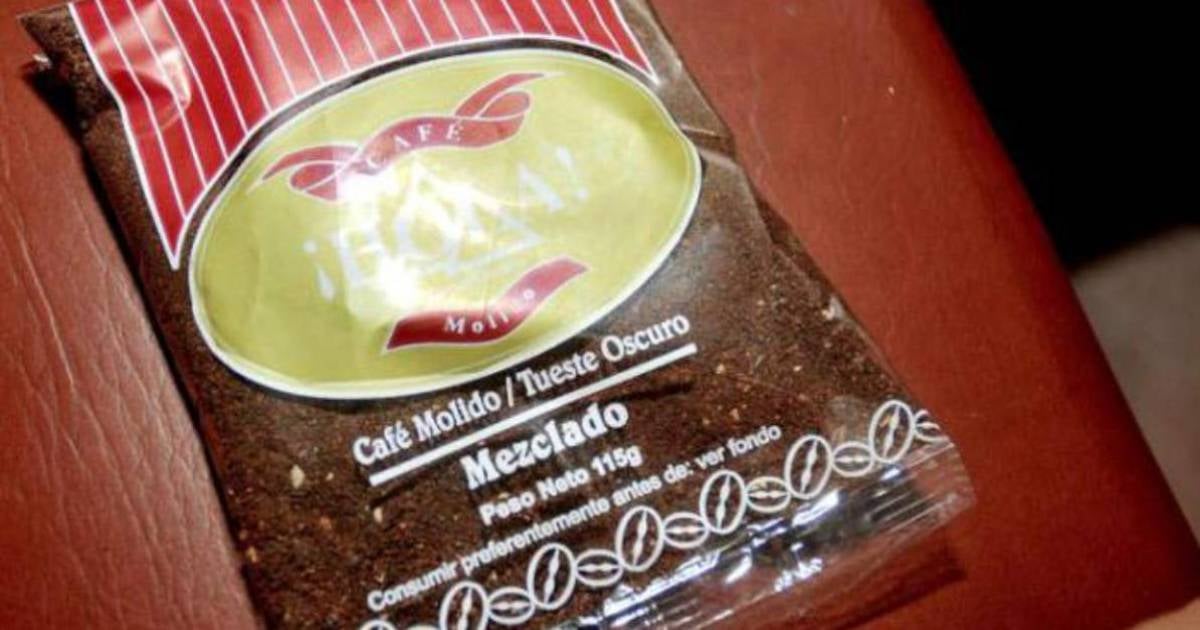
But in practice, that promise remains unfulfilled: coffee still hasn't reached the warehouses, and the famous ¡Hola! is also missing from the household supplies.
Pedro Manuel Cabrales, a producer at CPA Carlos Manuel de Céspedes, stated that they are 95% of the way to achieving their plan, with the goal of collecting one million cans.
In areas like San Luis, historically known for coffee production, coffee growers like Nidia Calunga, with 38 harvests under her belt, are reporting that there is a lack of fairness in compensation.
A can of sweet potato or any other crop exceeds the value of a can of coffee, and the time, effort, and sacrifice involved in maintaining a coffee plantation in the mountains are not taken into account.
In their case, the best price reached was 260 pesos for a can, which is insufficient to maintain a farm or support a family.
As if that weren't enough, the issues with the so-called "coffee mandates" persist: many producers have not received payment for what they delivered.
"And that means that, since we have to live, the product is sent to the informal market," confessed a farmer during the ANAP Assembly.
Others, speaking from anonymity, stated that the lack of timely payments leads to crop losses, as harvesting cannot be undertaken without available cash: “It's an open secret,” admitted one of them.
The attempt to bank the payment system has also not worked, as the coffee-growing areas are remote and lack basic connectivity.
The link between companies, officials, and producers remains weak, and the actors who should ensure the functioning of the production chain often are unaware of the real issues.
However, the ANAP concludes that the problem is multifaceted: economic, technical, logistical, and even social.
The state strategy aims to expand planted areas in flat and sub-mountain regions, granting more hectares to producers. However, enthusiasm is in short supply.
For now, the coffee bean is still not arriving, the people continue to wait, and the traditional small cup, which has become a symbol of Cuban identity, is now also a symbol of disappointment.
Frequently Asked Questions about the Coffee Crisis in Santiago de Cuba
What is the current state of coffee production in Santiago de Cuba?
The coffee production in Santiago de Cuba has been deficient, reaching only 65% of the agreed plan by the end of February. The shortage of labor for harvesting and structural problems have impacted production. Despite local efforts, such as cultivation in home gardens, industrial production faces significant challenges.
Why doesn't coffee reach the warehouses and tables of Cuban homes?
The coffee does not make it to the warehouses or to the tables of households due to a combination of a shortage of harvesters, lack of infrastructure, and issues in the payment chain to the producers. Many producers do not receive payment on time, forcing them to sell in the informal market.
What impact does the informal market have on coffee distribution in Cuba?
The informal market has grown significantly due to limitations in official distribution and high prices in state markets. This has led to an increase in the illicit trade of coffee, further complicating access to the product for the majority of the population.
What solutions does the Cuban regime propose to improve coffee production?
The Cuban regime has introduced strategies that include the expansion of cultivated areas and a focus on socialist cooperativism. However, these proposals face obstacles such as the lack of real incentives, shortages of supplies, and bureaucratic hurdles. The reality is that enthusiasm among producers is low.
Filed under: