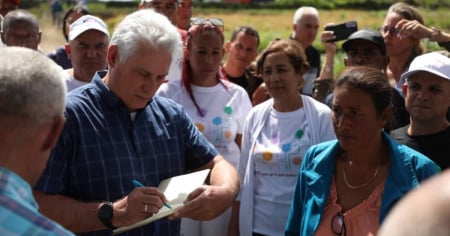
The Cuban leader, Miguel Díaz-Canel, visited the "Rogelio Rojas Tamayo" nursing home this Friday, located in the Colombia municipality, Las Tunas province, as part of a tour promoted by state media to showcase alleged improvements in the care of the elderly.
During the visit, the leader listened to testimonies from elderly individuals who claimed to receive "very good food" and "wonderful care," according to a report from Visión Tunera with words that gloss over the harsh reality faced by this demographic across the island.
"Here we receive good service... um... [I am] proud to be here. The food is quite good, the attention is wonderful," said an elderly man to the official media. For his part, the leader expressed his "satisfaction in seeing you well taken care of, something that you deserve at this stage of life, because you have done a lot for the country and the Revolution."
According to the report, the facility was renovated with an investment of two million Cuban pesos, aimed at refurbishing floors, walls, carpentry, and paint. However, beyond the public presentation, the living conditions of the elderly in Cuba are far from adequate.
Recent reports published by CiberCuba document how thousands of retirees and elderly individuals are surviving in extreme conditions, with laughable pensions, lack of access to medication and food, and in many cases, recycling trash to make ends meet.
While the regime invests fourteen times more in the tourism sector than in Public Health and Social Assistance, Cuban seniors are struggling with food shortages, the degradation of social assistance facilities, and the lack of an effective support network.
Cases like that of an elderly woman from Havana who asked for food assistance from an activist or retirees who beg to survive reveal the abandonment and hopelessness that characterize old age in Cuba.
Currently, the elderly are the only demographic group growing on the island, which exacerbates the demographic crisis and places greater pressure on a social system unable to meet their basic needs.
Far from being a model of progress, the government's propaganda visits aim to gloss over a structural crisis that particularly affects the most vulnerable sectors.
The brief staging in Las Tunas contrasts sharply with everyday reality: long lines to obtain subsidized food, crumbling housing, hospitals without resources, and a quality of life in rapid decline.
Díaz-Canel's words to the elderly from Tunera, delivered in a controlled environment, bear little resemblance to the hardships faced daily by thousands of elderly Cubans, who, after decades of hard work, confront the twilight of their lives in conditions of neglect and misery.
In this regard, the visit of the designated ruler Raúl Castro, one of the few privileged nonagenarians of the regime, fails to conceal the profound crisis affecting the elderly in Cuba, nor does it alleviate the growing social discontent due to the lack of effective public policies to protect those who need it most.
Filed under: