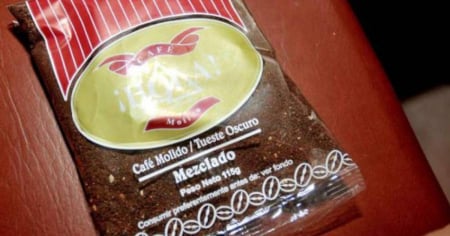
A Cuban resident in the Peralta neighborhood of Holguín shared on social media this Tuesday the arrival of coffee at her store, after five months of the regulated product's absence.
In a video posted on TikTok by the user @meli.cubanita0, the young woman stated: “this seems unbelievable, like, so many things have never come to the store all at once, but May 1st is coming and we have to be happy, so the coffee arrived, which hadn't been seen since last December, so come with me to get the coffee.”
Durante el recorrido, mostró el momento en que acudió a la bodega y explicó: “llegando a la bodega el muchacho estuvo apuntando lo que nos tocaba por la libreta, It was 4 bags of coffee at a cost of 44 pesos for all 4, after being out of stock for 5 months.”
Reactions: disbelief, criticism, and resignation
The video generated multiple reactions among Cubans both inside and outside the island. Some asked, "So, has no one been drinking coffee since December, darling?" while others questioned whether the delivered product could actually be called coffee. "The bad thing is that it's not even coffee, just peas and God knows what else," commented one user.
Several people pointed out that outside the state system, it is possible to buy coffee, but at unaffordable prices: “Of course you can, but outside, when it's not regulated by the government, it can cost up to 5 times more, and with their salaries, it's not enough. Those who buy outside do so because they receive extra money from abroad.”
The content creator herself responded to questions and explained: “No, I wish it were the case, but if they don’t pay you this month, it’s likely they won’t next month either, and when it does come, it will be what it is without considering what was missed in previous months.”
A structural crisis in coffee production
The scarcity reported by this young woman is part of a larger problem. In provinces like Santiago de Cuba, only 65% of the coffee plan projected until February of this year has been fulfilled, as authorities acknowledged in a meeting of the ANAP. Although the beans are available in the coffee plants, they do not reach the warehouses due to a lack of workforce, delayed payments, and logistical deficiencies.
The situation has forced many Cubans to pay exorbitant prices in the informal market. “Here, the pound costs up to 200 pesos,” said a producer interviewed in that area. Others, like retirees in rural areas, have chosen to grow and process the grain in their backyards.
Foreign initiatives and exportation
In parallel, the regime is trying to alleviate the crisis through international alliances. In Guantánamo, the Innova Café project aims to improve productive efficiency using renewable energy, with funding from the Andalusian Agency for International Cooperation. Part of the produced output will be allocated for export under the "fair trade" model.
Although these actions aim to revive the sector, the reality is that coffee continues to be scarce in the state distribution network. The timely arrival of the product just before May 1st seems more like an attempt to calm the frustrations of a population overwhelmed by the chronic shortage of basic goods than a real solution.
Frequently Asked Questions about the Shortage of Basic Goods in Cuba
Why has there been a shortage of coffee in Cuba?
The coffee shortage in Cuba is due to structural problems in production, such as a lack of workforce, delayed payments, and logistical deficiencies. Even though the beans are available on the coffee plants, they do not reach the warehouses because of these difficulties. Furthermore, the situation is exacerbated by the dependence on the state distribution system, which fails to adequately supply the population.
How does the shortage of products affect the Cuban population?
The scarcity of basic products in Cuba, such as coffee, rice, and hygiene items, severely impacts the quality of life of the population, forcing them to rely on the informal market where prices are exorbitant. Furthermore, the irregularity in distribution through the ration book increases uncertainty and discontent among citizens.
What measures is the Cuban government taking to address the supply crisis?
The Cuban government has attempted to alleviate the crisis through international alliances and projects such as Innova Café, which aims to improve productive efficiency by using renewable energies. However, these measures are insufficient, and shortages persist. The government acknowledges the crisis, but the proposed solutions, such as improving management and reducing subsidies, have not significantly improved the situation.
What alternatives do Cubans have in the face of food and basic product shortages?
In the face of scarcity, many Cubans turn to the informal market to acquire basic goods, although at very high prices. Others have chosen to grow their own food in backyards or small gardens. However, these alternatives are not feasible for everyone, and the majority of the population continues to face serious difficulties in accessing essential products.
Filed under: