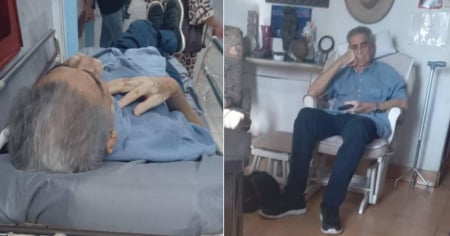
The name of the Cuban actor Samuel Claxton, a figure in film, television, and national theater for decades, is once again making headlines, this time not for a new performance, but for the public outcry seeking to assist him in his most vulnerable moment: at 82 years old, suffering from a serious health condition, without access to the basic medical supplies he needs to survive.
Due to this, activist Lino Tomasen, known as the Cuban Iron Man, recently visited the actor at his home, where he delivered food and a Bible as a gesture of support. The assistance, widely shared on social media, stands in stark contrast to the silence of the country’s cultural and health institutions.
“If you were one of those who enjoyed the performances of this great Cuban artist, now he needs a helping hand… any contribution will be appreciated,” Tomasen expressed in a video that has accumulated thousands of views.
Claxton, a victim of abandonment
Operated on for bladder cancer two years ago, Claxton has been living for a year with a percutaneous nephrostomy, a procedure that requires the continuous use of catheters and collection bags to drain urine. However, no official entity has guaranteed him the supply of these essential supplies. In Cuba, there has been a severe shortage of medicines for years.
In the midst of his deteriorating physical condition, the artist is forced to rely on donations and acts of solidarity to meet his basic needs. Despite his significant artistic legacy, his health situation remains overlooked by the state apparatus that has profited from his talent on screen and on stage for years.
The Price of Forgetting
The case of Claxton has sparked a wave of outrage on social media, where many citizens are condemning the lack of dignified care policies for older artists. In Cuba, as in so many other cases, artistic glory does not guarantee decent pensions, priority access to medications, or institutional support.
"In Cuba, glory does not guarantee dignity in old age," lament those who have followed the case.
Samuel Claxton was an essential part of generations of television and film productions, and his image is part of the cultural imagination of the country. Today, however, he lives surrounded by official silence and isolated gestures from citizens, while he awaits a medical probe that has not yet arrived at his home.
The drama of Samuel Claxton is not just that of a man, but of a nation that forgets those who once made it dream from a stage.
Frequently Asked Questions about Samuel Claxton's Situation and Support for Artists in Cuba
What health problems is Samuel Claxton facing and why does he need assistance?
Samuel Claxton faces serious health issues due to bladder carcinoma and lives with a percutaneous nephrostomy. He needs medical catheters and collection bags, supplies that are not provided by official institutions in Cuba, which forces him to rely on community solidarity to survive.
Why has Samuel Claxton's case generated outrage on social media?
The situation of Samuel Claxton has caused outrage because it highlights the neglect of the Cuban state towards its veteran artists. Despite his contribution to Cuban art, Claxton lives in precarious conditions without institutional support, which has been widely denounced on social media.
How has the aid for Samuel Claxton been organized?
Help for Samuel Claxton has primarily been organized through social media, where activists and citizens have called for solidarity. People like Lino Tomasen and Libia Batista have led initiatives to gather donations of feeding tubes and other necessary supplies for his care.
What is the response of the Cuban government to situations like that of Samuel Claxton?
The Cuban government has been criticized for its lack of action and support for retired artists. Often, posthumous tributes are the only form of recognition, while real and effective support during their lifetimes is practically nonexistent, according to complaints from citizens and artists.
Filed under: