The Minister of Labor and Social Security of Cuba, Marta Elena Feitó, denounced that several provinces in the country are not utilizing the budget allocated for the care of vulnerable individuals.
"It is inconsistent for there to be territories with such large unexecuted portions of this budget. There are even territories that, at this point in the year, have 0% execution," stated Feitó at the Council of Ministers held this Monday at the Palace of the Revolution.
The minister expressed regret that, despite the serious social situation facing the country, these funds remain unused. “We could be caring for the elderly, for children, and doing many social initiatives that have a positive impact, and we are truly not doing that,” she emphasized.
The Prime Minister, Manuel Marrero, reacted with surprise to Feitó's statements and proposed a thorough review of the reasons for the non-execution of that budget in the territories.
“I believe this is a topic we need to analyze differently. Why isn't that being executed? Why are the financial resources designed to assist these individuals not being used? Is it a lack of sensitivity, a lack of humanism?” Marrero asked.
The Cuban government did not specify which provinces have committed this serious breach, nor what concrete measures will be taken to reverse this situation. For now, the priority of the Council of Ministers is, by order of Díaz-Canel, the search for foreign currency.
Increase in homelessness amid the social crisis
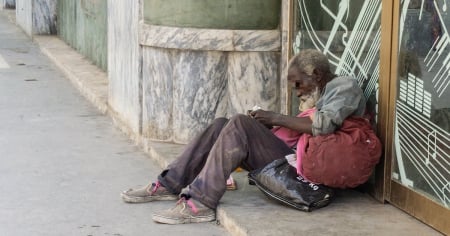
This official recognition occurs in a context where poverty and indigence are visibly increasing in the country, especially in cities like Santiago de Cuba, Havana, and Holguín.
In April, the regime acknowledged a rise in the number of homeless individuals in Santiago de Cuba, although it attributed the causes to family neglect and the tightening of the United States embargo.
The provincial director of Labor and Social Security, Ernesto González Ojea, acknowledged that “the current economic context” limits access to essential goods, but he held families accountable for neglecting their vulnerable members, pointing out that many fail to comply with the provisions of the new Family Code.
The authorities have promoted social assistance centers in that area. However, citizen and independent media criticisms point to the root of the problem being the internal economic crisis, the ineffectiveness of public policies, and the state neglect.
Retirees and seniors are the most affected sector in the current crisis. A pension of 1,500 pesos is equivalent to the price of one liter of oil in the Cuban market.
Many Cuban elders are becoming more frequently involved in scenes of begging or take to the streets to sell any product to survive.
Meanwhile, the budget that could alleviate some part of this reality remains unexecuted in several provinces. The lack of institutional action and the indifference of the authorities exacerbate a social crisis that threatens to overflow before the gaze of the central government.
Frequently Asked Questions about the Non-Execution of the Social Budget in Cuba
Why is the budget for social welfare not being implemented in Cuba?
The Minister of Labor and Social Security of Cuba, Marta Elena Feitó, has denounced that several provinces are not executing the budget allocated to assist vulnerable individuals. This happens despite the critical situation the country is facing, which could be alleviated if these funds were utilized. The Prime Minister, Manuel Marrero, has indicated that a thorough review will be conducted to understand the causes of this non-execution.
What are the consequences of not executing the social budget in Cuba?
The non-execution of the budget allocated for social care in Cuba has serious consequences for the most vulnerable sectors of the population, such as the elderly and children. The lack of utilization of these resources contributes to the rise of poverty, begging, and the social crisis in the country. Citizens' criticisms point to the ineffectiveness of public policies and state neglect as the main causes of this issue.
What has the Cuban government said about the rise of homelessness in the country?
The Cuban government has acknowledged an increase in homelessness, particularly in cities like Santiago de Cuba, Havana, and Holguín. However, it has attributed this phenomenon to family neglect and the tightening of the U.S. embargo. Despite this, critics point out that the root of the problem lies in the internal economic crisis and the ineffectiveness of public policies.
What measures has the Cuban government taken to address the social crisis and homelessness?
The government has implemented several social care centers and the Family Care System (SAF), which provides basic food and cultural activities, among other services. However, critics point out that these measures are insufficient and do not address the structural causes of the social crisis. The lack of execution of the social budget and the lack of state protection continue to be significant issues.
Filed under: