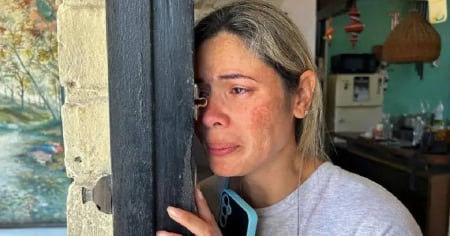
A Cuban woman identified as @miricubana1 on TikTok announced on that social network her decision to return to Cuba after struggling to adapt to life in the United States. The young woman claims she will take advantage of the program promoted by Donald Trump, which offers one thousand dollars and a plane ticket to immigrants who decide to return voluntarily to their home countries.
"After several months of me making my first videos saying that I was going to Cuba, the moment has arrived; now I'm really going in a few days," she affirmed in her video. "I will be showing you videos on the plane, me on the plane, at the airport, etc.," she added.
The Cuban explicitly mentioned the self-deportation program: “You must have seen the law where Trump is giving $1,000 and the plane ticket. I’m going to leave, I’m going to self-deport that way. In fact, I already entered the application and did everything I needed to do.”
"I didn't adapt to this country," he insisted. "People say this is the wonder of the world and all, but I don't see the wonder. Especially if you are far from your family. This is a factory for old people; here you work, pay, and practically never visit family. This country is really tough."
"I am not going to continue forcing my life to be unhappy, living in depression, longing for the land of wonders. I'm returning in a few days... It's not cowardice, it's that I haven't adapted, I don't feel well, things haven't gone well for me, and I want to leave. This country is not for me," she concluded in her message.
The post generated a wave of comments on TikTok, where messages of support, criticism, and reflections on the migration experience intertwined.
"Brave decision, not all of us adapt," wrote a user. Another person noted: "Where you feel happy is where you should be; in reality, our homeland is Cuba." Someone else commented: "Not even for 10 thousand would I go back, not even to gain momentum."
Other users, however, expressed skepticism: "Later, make a video too if you regret it or what you will do in Cuba to survive." Meanwhile, one user commented: "I hope you don't regret it when you get there."
One of the most controversial comments was: “How good that you are going to starve,” to which the Cuban responded with a second video in a firm tone but without losing her composure.
"My response to you is going to be the most polite in the world," she said at the beginning of the new video. "I am 32 years old, and I have been in this country for a year and a half. I came here when I was 31. I have never gone hungry, never, never, never. I remember there were days when, as a child, I had to eat white rice, but I would eat it with such happiness."
"What good is it to have delicacies and an empty heart? What good is it to possess everything and not feel complete, not feel happy, not feel at ease?" she wondered.
And he concluded with a straightforward statement: “I might go eat plain rice with an egg, but happily, with my family, with my children. So, rice and eggs, but I’m not going to feel lonely, I’m not going to cry alone at night. I don’t know how to explain that to you because maybe you don’t have the brains to understand it. Kisses and blessings.”
This second video also generated a wave of reactions. Many users praised her for her way of responding and for prioritizing her emotional and family well-being. “Great response, it turned out perfect,” commented one user. Another wrote: “I prefer an egg with love than a chicken with pain.”
Others added: “Criticism is becoming increasingly common, be happy wherever you want”; “I completely understand you, we only live once”; “Only you know what you're experiencing, each person is a different world.”
The case of @miricubana1 is situated within a broader context of Cubans who have chosen to return to the island in recent months. In March, Lisandra Acevedo, another Cuban in Miami, also announced her return to Cuba with her daughter, citing a lack of employment and housing. “I'm going back to Cuba with my daughter, not because I want to, but because I don't have any alternatives,” she said at the time.
His case was followed by new videos where he reflected on his decision, which at one point he considered reversing, but ultimately he returned. “Here I am, in Cuba, for a few days now, but I just managed to connect”, he said from the island in April.
The self-deportation proposal was announced by Trump on May 5, and has been described by authorities as “a dignified exit” for immigrants in irregular situations. In exchange for registering on the CBP Home app and voluntarily leaving the country, the plan offers one thousand dollars and a plane ticket.
However, another Cuban in the U.S. publicly rejected the offer, deeming it insufficient. Immigration attorneys warn that opting for this option may have long-term legal consequences, including penalties of up to 20 years without being able to re-enter the United States.
Meanwhile, cases like @miricubana1's continue to spark debate on social media about the emotional cost of migration, the pressure to adapt in a new country, and each person's right to make the decision they believe is best for their life.
Frequently asked questions about self-deportation and Cuban immigration in the United States
What is the self-deportation program promoted by Donald Trump?
The self-deportation program is an initiative that offers one thousand dollars and a plane ticket to immigrants who choose to return voluntarily to their countries of origin. This program was announced by Trump and aims to reduce the costs associated with traditional deportations. However, accepting this option may result in long-term legal consequences, such as penalties that prevent re-entry into the United States for several years.
What are the reasons why some Cubans decide to return to Cuba from the United States?
Many Cubans return to Cuba due to difficulties adjusting to life in the United States and for emotional and family reasons. The distance from their loved ones, the challenge of adapting to a new environment, and unmet expectations regarding job opportunities and quality of life are common factors that motivate this decision.
What challenges do Cubans face when they decide to self-deport?
Cubans who choose self-deportation may face severe immigration penalties that could prevent them from returning to the United States for up to 20 years. Additionally, they must consider the emotional and economic implications of returning to a country where the situation is precarious. It is important for them to consult with immigration lawyers before making this decision.
How are Trump's immigration measures perceived among Cubans in the United States?
Trump's immigration measures generate divided opinions among Cubans in the United States. While some believe these policies are necessary to maintain order, others view them as harmful to immigrants and the Cuban people, as they do not directly impact the Cuban government but rather its citizens.
Filed under: