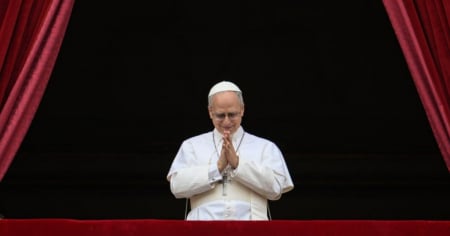
The newly elected Pope Leon XIV spoke this Saturday about the challenges humanity faces regarding artificial intelligence.
In his first address to the College of Cardinals, the Supreme Pontiff justified his choice of name by explaining that “Pope Leo XIII, with the historic encyclical Rerum novarum, addressed the social question in the context of the first great industrial revolution,” according to Vatican News.
Similarly, "today, the Church offers everyone its treasure of social doctrine in response to another industrial revolution and the development of artificial intelligence," he added.
The Bishop of Rome thanked the cardinals in his first official speech for the papal responsibility, which he referred to as "this yoke (…) much greater than my strength, as it would be for anyone."
He also recalled the legacy of his predecessor in areas where it seems he will maintain a continuity, such as concern for the poor and synodality.
Robert Francis Prevost, 69 years old, was elected this week as the 267th Pope of the Catholic Church. A member of the Order of St. Augustine, he is the first American Pope and also holds Peruvian citizenship after having lived in that country for several years.
Former Cardinal Prevost has had a direct connection with Cuba, a country he visited several times before his appointment as Supreme Pontiff.
Recently, a photo of him in Havana alongside the late dissident Harold Cepero Escalante in front of the Cathedral of Havana surfaced on social media, capturing a moment of Christian fellowship that takes on new meaning today.
Cepero Escalante, a member of the Christian Liberation Movement, died at the age of 32 in Granma while he was in a car with Oswaldo Payá. The event was labeled as an "accident" by the government, but family members, friends, and a 2015 report from the Human Rights Foundation attribute it to a deliberate action by the regime.
Precisely, following the election of the new Pope, Raúl Castro and Miguel Díaz-Canel sent congratulatory messages, eager to present an image of harmony and continuity in relations with the Vatican.
Frequently Asked Questions about Pope Leo XIV and Artificial Intelligence
Why does Pope Leo XIV consider artificial intelligence a challenge for humanity?
In his first speech before the College of Cardinals, Pope Leo XIV emphasized that artificial intelligence represents a challenge similar to that faced by humanity during the first industrial revolution. The Church offers its social doctrine as a response to this new industrial revolution and the development of artificial intelligence, suggesting that it is necessary to address the potential ethical and social impacts this technology may have on society.
What is Pope Leo XIV's relationship with Cuba?
Pope Leo XIV, formerly Robert Francis Prevost, has visited Cuba several times, which has strengthened his connection to the island. He has shared significant moments with the Cuban Church and has met important figures such as the dissident Harold Cepero. These experiences have allowed him to gain a close understanding of the country's reality and its social and political challenges.
How has the Cuban government reacted to the election of Pope Leo XIV?
After the election of Pope Leo XIV, the Cuban government, led by Raúl Castro and Miguel Díaz-Canel, sent congratulatory messages to the new Pontiff. They expressed their desire to strengthen relations with the Holy See and promote dialogue and peace, despite the political and social crisis the island is experiencing. This gesture aims to project an image of harmony and continuity in bilateral relations.
What does the election of Pope Leo XIV symbolize for the Catholic Church?
The election of Pope Leon XIV is significant for the Catholic Church for several reasons. He is the first Pope born in the United States, which reinforces the international and multicultural dimension of his papacy. Furthermore, his election represents a moderate continuity of the path initiated by Pope Francis, with a focus on social justice, inclusion, and intercultural dialogue.
Filed under: