The Russian leader, Vladimir Putin, proposed this Sunday to hold direct talks with Ukraine in Istanbul on May 15, just hours after Kiev and European leaders called for an unconditional ceasefire for 30 days starting Monday.
We are determined to hold serious negotiations (...) to eliminate the root causes of the conflict," said Putin to reporters at a press conference in the Kremlin.
"We do not rule out that during these conversations we may agree on a new ceasefire," he added, without directly addressing the call made by the leaders of Ukraine and other countries for a ceasefire to begin on Monday.
The advisor to the Russian president, Yuri Ushakov, stated to the press that Russia will be represented in the negotiations in Istanbul by a delegation, the members of which will be announced later.
"We will send a delegation," was the response to the question of who will attend the peace negotiations.
In his appearance, Putin stated that he had made "repeated initiatives" to cease fire, but Kiev has "sabotaged" them, without acknowledging the Kremlin's own violations of the proposed truce.
He also stated that his decision to maintain "serious" negotiations with Ukraine is driven by a need to "eliminate the root causes of the conflict."
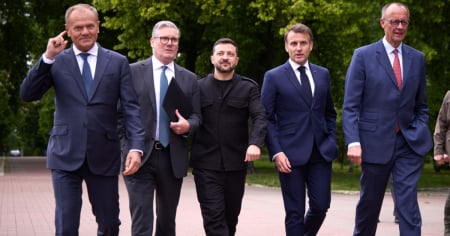
The leaders of four major European countries threatened to increase pressure on Putin, if he does not agree to an unconditional 30-day ceasefire in Ukraine.
France, the United Kingdom, Germany, and Poland stated that their proposal for a ceasefire starting Monday, May 12, had the support of U.S. President Donald Trump, whom they had informed by phone earlier in the day.
The Kremlin spokesperson, Dmitry Peskov, told CNN on Saturday that Moscow would have to consider the proposal. On the same day, Peskov reiterated that Russia was willing to hold peace talks with Ukraine "without preconditions" and accused Kiev of blocking them.
The three-day unilateral ceasefire declared by Russia on the occasion of the 80th anniversary of the victory over Nazi Germany expired this Saturday, and Ukraine claimed that Russian forces violated it repeatedly.
In March, the United States proposed an immediate and limited truce of 30 days, which Ukraine accepted, but the Kremlin has resisted accepting the terms.
Frequently asked questions about the peace negotiations between Russia and Ukraine
What does Vladimir Putin propose in the peace talks with Ukraine?
Vladimir Putin proposes to hold direct and serious talks with Ukraine to address the root causes of the conflict. These discussions are scheduled for May 15 in Istanbul. Putin has also mentioned the possibility of agreeing to a new ceasefire during these negotiations.
What is the United States' stance on the conflict in Ukraine?
The United States, under the administration of Donald Trump, has proposed a total and immediate ceasefire lasting 30 days, which Ukraine has accepted. Trump has emphasized that this conflict should have never started and advocates for a ceasefire in strategic sectors as a path towards lasting peace.
Why do peace negotiations in Ukraine depend on Russia's response?
Negotiations depend on Russia because, although Ukraine has accepted a ceasefire proposed by the United States, Putin has shown resistance to accepting the conditions, such as halting the shipment of weapons to Ukraine by the West.
What role do European leaders play in the peace process in Ukraine?
The leaders of France, the United Kingdom, Germany, and Poland have threatened to increase pressure on Putin if he does not agree to an unconditional 30-day ceasefire. These European leaders support the ceasefire proposal to move toward peace and have been in communication with U.S. President Donald Trump to coordinate actions.
Filed under: