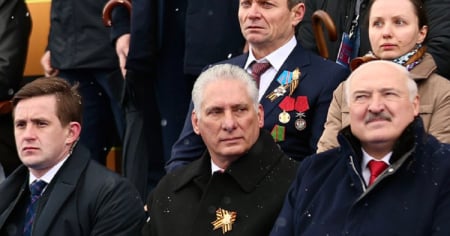
The Cuban leader, Miguel Díaz-Canel Bermúdez, accompanied by his wife, the "No First Lady" Lis Cuesta, paid tribute on Monday to the victims of the Leningrad siege during World War II, at a ceremony held at the Piskaryovskoye Memorial Cemetery in St. Petersburg.
The event is part of his most recent official visit to Russia, at the invitation of President Vladimir Putin, on the occasion of the Victory Day commemoration.
During the ceremony, the leader laid a floral tribute at the monument to the Motherland and recalled the sacrifice of over 490,000 civilians and combatants buried in 186 mass graves after enduring the Nazi siege for 900 days.
The Presidency of Cuba and Díaz-Canel highlighted on social media the emotional nature of the tribute and the "friendship" between the two nations.
"We returned to the memorial cemetery in St. Petersburg, the resting place of 490,000 sons of the Hero City that resisted 900 days of Nazi #Blockade without surrendering. #Cuba has great friends here. Together we evaluated projects and toured historical sites of interest for cooperation," the leader wrote on X.
Upon his arrival in St. Petersburg, Díaz-Canel also held a meeting with the local governor, Alexander Beglov, reaffirming the historical ties between the two nations and recalling the visit of dictator Fidel Castro to the city in 1963, then known as Leningrad.
The Cuban Foreign Ministry described the meeting as "fruitful" and framed it within a series of activities aimed at strengthening bilateral cooperation.
The visit of the Cuban leader is part of a continuous policy of rapprochement between Havana and Moscow. In November 2024, Díaz-Canel met with the president of the Russian state oil company Zarubezhneft to enhance energy cooperation, a critical issue for Cuba amid its fuel crisis and prolonged blackouts.
In April 2025, Russian Deputy Prime Minister Dmitri Chernishenko visited Havana to strengthen the "strategic alliance," amid the international isolation both governments face.
However, this approach has sparked criticism both within and outside the island due to Havana's increasing dependence on Moscow, especially at a time when Russia is facing severe international sanctions for its invasion of Ukraine.
During a previous visit in May 2024, Díaz-Canel expressed his support for Putin and condemned the sanctions imposed on Russia, despite reports from Cuban families about the irregular recruitment of young people to fight in the Ukrainian conflict.
The alliance has also manifested in the military arena. In June 2024, Russian warships, including a frigate and a submarine, docked at the port of Havana, during a visit described as a "friendship", which raised concerns in Washington due to its geopolitical symbolism.
Although Díaz-Canel's tribute at the Piskaryovskoye Cemetery aims to project an image of historical respect and brotherhood between nations, it cannot be separated from the political context surrounding it.
The continuous visits of the Cuban leader to Russia, the energy agreements, expressions of support for Moscow in international forums, and military collaboration have been interpreted by analysts as a consolidation of an asymmetric relationship that provides political and economic breathing room to Havana in exchange for increasingly costly diplomatic loyalty.
In the midst of one of the deepest crises in its recent history, the Cuban government appears to have chosen Russia as its main strategic ally, even if that means aligning itself with a power under intense international scrutiny.
Frequently Asked Questions about Díaz-Canel's Visit to Russia and Cuba-Russia Relations
What was the purpose of Díaz-Canel's visit to Russia in May 2025?
The purpose of Díaz-Canel's visit to Russia was to pay tribute to the victims of the Leningrad siege and strengthen the ties between Cuba and Russia. The visit included a ceremony at the Piskaryovskoye Memorial Cemetery and meetings with Russian leaders to discuss cooperation projects in strategic sectors such as biotechnology, energy, and artificial intelligence.
Why are the relations between Cuba and Russia important for both countries?
The relationship between Cuba and Russia is crucial due to cooperation in strategic sectors such as energy, tourism, and defense. For Cuba, Russia represents a strategic ally amidst its economic crisis and international isolation. Meanwhile, for Russia, Cuba is an important partner in Latin America that helps expand its geopolitical influence in the region.
What criticisms does the rapprochement between Cuba and Russia face?
The approach between Cuba and Russia faces criticism due to Havana's increasing dependence on Moscow. Furthermore, the alliance occurs in a context where Russia faces international sanctions for the invasion of Ukraine. This relationship has been interpreted as a consolidation of an asymmetrical bond that provides political and economic benefits to Cuba in exchange for diplomatic support towards Russia.
What cooperation projects are being assessed between Cuba and Russia?
Cuba and Russia are assessing cooperation projects in biotechnology, energy, and artificial intelligence. These projects are part of an agenda aimed at strengthening bilateral cooperation in key areas for the development of the island, in an effort to overcome the economic challenges facing Cuba.
Filed under: