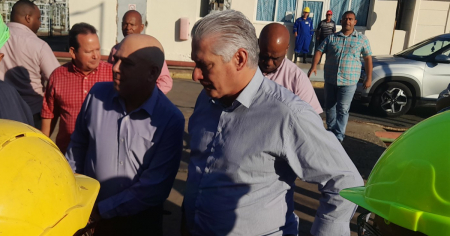
The ruling Miguel Díaz-Canel once again referred to the Cuban youth who are leading peaceful demonstrations on the island as "antisocials," thus resuming the stigmatizing and repressive language that the regime has historically used to discredit any form of protest.
In a conversation with a hundred young people during episode 30 of the podcast "Desde La Presidencia" about the events of August 1994, following the social uprising known as the Maleconazo, the president asserted that there was "external manipulation" behind those protests and that the demonstrators "do not represent the true revolutionary people."
He resorted to the same rhetorical resource to label the protesters as “criminals” and “antisocial” in order to delegitimize the social protest.
During the program, in light of the fallen in combat of Cuba's National Hero, José Martí, it was stated that the discontented youth "were far from Martí's thought" and that they needed to be "transformed."
"It was a criminal act; imperialism used those antisocial elements, but they are our antisocial elements. They are the ones we need to transform, individuals who are far removed from Martí's ideals, and that is why we must return to Martí," said Díaz-Canel, who referenced the incident to suggest reading Cintio Vitier's essay "Martí in the Current Hour of Cuba."
He also referred to the Maleconazo as a mere "protest that he thought would bring down the revolution."
He also recommended the essay published by intellectual Cintio Vitier in September of that same year, in which he warned that those who take to the sea or raise their voice against the system "are also one of us," but have been driven to disillusionment.
The president's words come as the country's crisis worsens, especially following the recent announcements of the collapse of the national electrical system, one of the main reasons for public discontent on the island.
The Cuban regime has repressed dozens of peaceful protests against blackouts in recent years and has imprisoned over 1,000 people following the demonstrations in July 2021.
Frequently Asked Questions about Díaz-Canel's Statements and the Situation in Cuba
Why does Díaz-Canel label the young protesters as "antisocial"?
Díaz-Canel uses the term "antisocial" to discredit young Cubans who protest peacefully, claiming they are manipulated by external influences and do not represent the "true revolutionary people." This type of language aims to stigmatize and delegitimize protests against the regime.
What reasons do young Cubans have to protest?
The protests of Cuban youth are motivated by the economic crisis, power outages, and lack of freedoms. The collapse of the electricity system and the scarcity of basic goods have exacerbated social discontent, leading young people to demand changes and improvements in their living conditions.
How does Díaz-Canel justify the repression of protests in Cuba?
Díaz-Canel justifies the repression of protests by labeling them as "criminal acts" instigated by imperialism. He claims that the protesters are far from Marti's ideals and that they must be "transformed," using these statements to justify the use of force and to delegitimize popular discontent.
What impact does Díaz-Canel's speech have on social discontent in Cuba?
Díaz-Canel's speech, which stigmatizes the demonstrators and evades internal responsibilities, increases social discontent. Citizens perceive a disconnect between the government's words and the reality they face, which fuels protests and criticism, especially on social media.
Filed under: