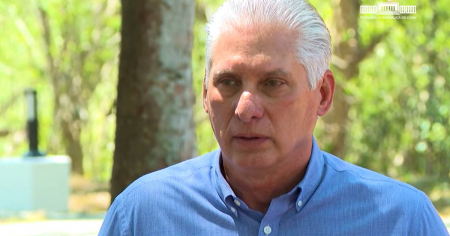
In the midst of one of the worst energy crises of recent decades, the Cuban leader Miguel Díaz-Canel acknowledged the severity of the electrical collapse affecting millions of citizens, but again blamed the United States embargo for the situation.
"Yes, as Alfredo López Valdés said yesterday, the situation of the electrical system is serious, but not impossible to overcome. Although its recovery may take time due to its complexity and the effects of the blockade imposed by the U.S. on access to resources, we are working hard, and we will achieve it," he said on X.
The message quickly generated outrage on social media, where citizens, exhausted after weeks of blackouts sometimes lasting over 24 consecutive hours, responded with criticism and skepticism.
"It will take time; will we be alive by then?" wondered a resident in Matanzas, while another Cuban abroad sarcastically added, "Do you have any idea how long resistance and endurance last? 3 days, 15, a lifetime?"
"You do not explain why the Russian credit from 2016 was not executed to install 4 new thermal units. Nor do you explain why for years resources were not dedicated to the SEN but were instead allocated to tourism," said another user.
The director of the Electric Union (UNE), Alfredo López Valdés, confirmed on Wednesday during the Round Table that "the situation of the electrical system is serious", citing outdated infrastructure, a lack of fuel, and the inability to rotate circuits due to the excessive duration of power outages.
The executive explained that five generating units are under repair, and that once they are ready, they would only contribute 500 MW to a clearly collapsed system. Although there are 1,000 MW available in distributed generation, the lack of diesel prevents them from being operational.
While the government announced a three-year energy recovery plan, millions of Cubans are living in darkness, without clear information, without refrigeration for their food, and lacking minimal conditions for rest.
In rural areas and low-income neighborhoods, prolonged power outages have already exceeded 30 hours without service, affecting the elderly, children, and chronic patients.
On social media, a retiree challenged Díaz-Canel: "It's unfortunate that the occasion wasn't taken advantage of from the Presidency for self-criticism regarding so much deferred maintenance, for not prioritizing it at the right moment, and for not preventing the current situation."
However, instead of taking responsibility for the mismanagement of resources, the lack of planning, and structural corruption, the authorities insist on solely blaming the United States embargo.
The First Deputy Minister of Energy and Mines, Argelio Jesús Abad Vigoa, stated that "the power outages are a consequence of the criminal American blockade against Cuba. This is not a cliché, it's not something fictional, it's not rhetoric."
He even claimed that "the authorities also suffer from power outages," a statement that was widely rejected by users, who point out the privileges of high-ranking officials, shielded from the hardships faced by the general population.
"The people are suffering while you enjoy luxuries that many don't even know exist. Don't you feel ashamed to take the former first lady around the world?" said a netizen.
"The whole country is collapsed, the people do not care about the efforts, the people care about the life we no longer have down here, you do not, you have the privilege that power grants you," wrote an elderly man on Facebook.
Meanwhile, Díaz-Canel's promise that "we will succeed" rings hollow for those who sleep among mosquitoes, without ventilation, cook with charcoal or firewood, and watch their food spoil due to a lack of refrigeration.
For many, the issue is not the time it will take to resolve the crisis, but the lack of political will to change a model that has proven to be unviable.
As another young person on the Internet said: "It is very naïve to still believe in the promises of Díaz-Canel, who has shown that he does not have what it takes to resolve the severe total crisis that Cuba has been in since the beginning of his term."
Meanwhile, the people continue to wait not only for light but for real answers.
Frequently Asked Questions About the Energy Crisis in Cuba
What is the current situation of the electrical system in Cuba?
The electrical system in Cuba is collapsed, with prolonged blackouts affecting millions of citizens due to outdated infrastructure, lack of fuel, and ineffective government management. The situation is critical and it is expected that the crisis will continue, with blackouts lasting over 24 hours in some regions.
What measures has the Cuban government announced to address the energy crisis?
The Cuban government has announced a three-year energy recovery plan, which includes the repair of generating units and the installation of photovoltaic solar parks. However, these measures have proven to be insufficient to address the underlying problem, and the population continues to endure prolonged blackouts with no effective short-term solutions.
What factors does the Cuban government attribute to the energy crisis?
The Cuban government, through figures like Miguel Díaz-Canel and the Deputy Minister of Energy and Mines, attributes the energy crisis primarily to the United States embargo, labeling it a "criminal blockade." However, many citizens and experts criticize this stance, pointing out poor internal management, lack of planning, and corruption as significant causes of the crisis.
How is the energy crisis affecting the lives of Cubans?
The energy crisis severely impacts daily life in Cuba, leaving the population without electricity for over 30 hours in some cases. This causes interruptions in the supply of drinking water, food preservation, and everyday activities such as cooking. The lack of electricity has also forced the suspension of work and school activities, increasing frustration and social discontent.
Filed under: