
Related videos:
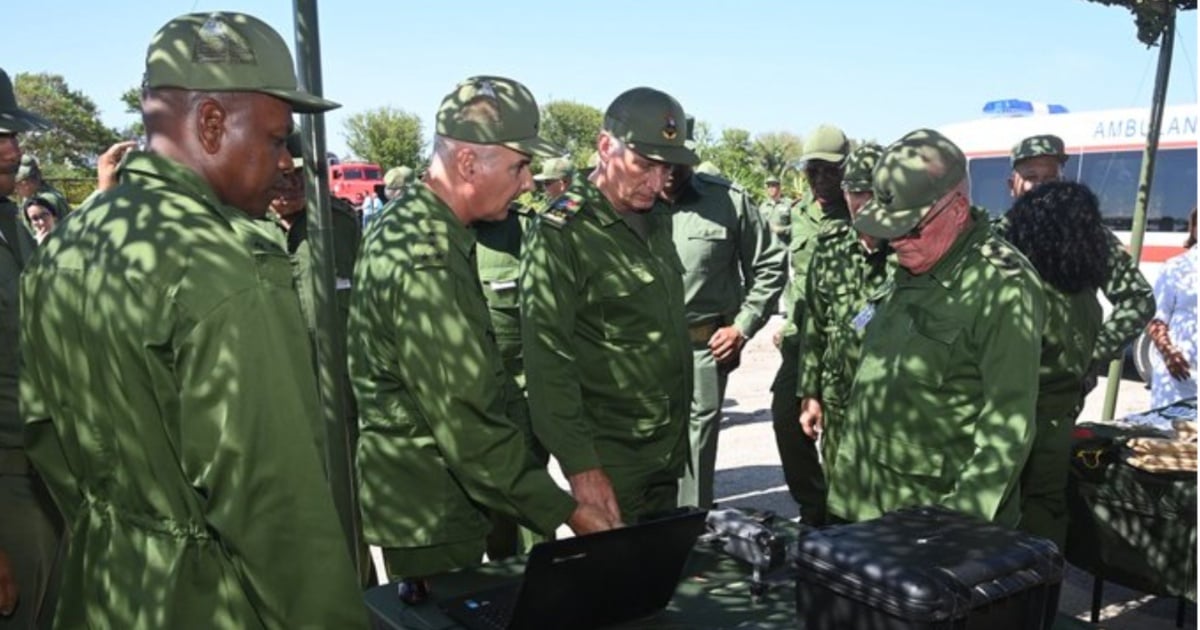
The Cuban leader Miguel Díaz-Canel Bermúdez appeared in military attire this Saturday, a day after the massive protests that took place on Friday in Bayamo and Cienfuegos, where the population voiced their concerns about the ongoing blackouts and food shortages.
The social media of the Presidency of Cuba published images of the regime's representative during the event Meteoro 2025, which the Government typically conducts to "assess" the status of compliance with the measures outlined in disaster risk reduction plans, as well as the forces and resources allocated for rescue and salvaging operations.
The images, however, focused on Díaz-Canel
In previous instances, the ruler has also resorted to military clothing to threaten the population when protests have erupted and to show "control" over the events.
On this occasion, he is presented at the Advanced Mobile Communications Center, responsible for information concealment and processing, but also alongside the head of the Engineering Department of MINFAR.
During the early hours of this Friday, May 24, new popular protests were reported in several cities in Cuba: Bayamo, in Granma province; Cienfuegos; and Ciego de Ávila. The demands, once again driven by prolonged blackouts and the critical shortage situation, were spread through various videos shared on social media.
The recent protests are part of a growing wave of demonstrations in the eastern part of the country, documented in recent days in cities like Santiago de Cuba, where residents from neighborhoods such as Micro 9 took to the streets to demand better living conditions.
The shouts of "We want food!" and "Down with the dictatorship!" have become common in the audiovisual recordings shared by citizens on social media.
In the context of these events, Díaz-Canel has again labeled the young Cubans participating in peaceful demonstrations on the island as "antisocial," thus resuming the stigmatizing and repressive language that the regime has historically used to discredit any form of protest.
The ruler justifies the repression of protests by labeling them as "criminal acts" instigated by "imperialism." He claims that the demonstrators are far from Marti's ideology and must be "transformed," using these statements to justify the use of force and delegitimize popular discontent.
Frequently asked questions about the recent protests and the regime's response in Cuba
Why have recent protests occurred in Cuba?
The protests in Cuba have primarily been motivated by prolonged blackouts and shortages of food and water. In cities like Bayamo, Ciego de Ávila, and Cienfuegos, the population has taken to the streets to demand solutions to these issues that severely impact daily life. These demonstrations reflect a growing public discontent with the regime's inability to resolve the energy and supply crisis that the country is suffering.
How has the Cuban regime responded to these protests?
The Cuban regime has responded to the protests with repression and propaganda campaigns. A strong military and police presence has been deployed to contain the demonstrations, and internet outages have been reported to hinder communication and the spread of information. Furthermore, the government has downplayed public discontent by labeling the protests as "criminal acts" instigated by external enemies, while attempting to project an image of calm and control.
What does Díaz-Canel's appearance in military attire after the protests symbolize?
Díaz-Canel's appearance in military attire symbolizes a strategy of intimidation and control. Although he does not hold military ranks, the use of military clothing in his public appearances following episodes of social discontent aims to convey a message of authority and readiness to use force to suppress protests. This tactic has been used previously by the regime as a means to deter popular discontent.
What is the current situation in the cities where protests have taken place?
The situation in cities like Bayamo and Cienfuegos remains tense and characterized by repression. Although the regime has tried to project an image of normalcy, testimonies and videos from citizens reveal a reality of discontent and unmet demands. Issues of blackouts and shortages persist, and the population continues to call for improvements in their living conditions.
Filed under: