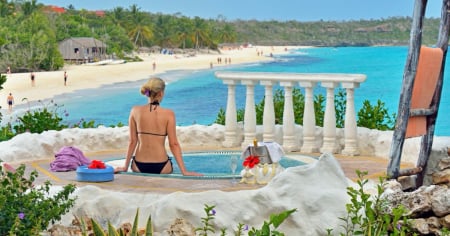
While the Cuban economy is experiencing one of its worst crises in decades, characterized by daily blackouts, rampant inflation, and shortages of food and medicine, the Cuban government is intensifying its efforts to present tourism as a national lifeline.
This Tuesday, the official program Mesa Redonda served as a platform for an extensive monologue about the benefits of the tourism sector, reported by the state media Cubadebate in an article titled “Tourism in Cuba: How does it impact the economy and the quality of life of the population?”.
More than a critical analysis, the article presents itself as a propaganda operation, in which high-ranking officials of the regime—including representatives from the Ministry of Economy, the National Institute of Hydraulic Resources (INRH), and the Gran Caribe Hotel Group—listed the supposed benefits of tourism, omitting the deep contradictions of the model and the unequal impact it has had on the daily lives of Cubans.
Susset Rosales Vázquez from the Ministry of Economy stated that tourism “allows for funding priorities in other sectors such as health, education, and infrastructure.”
However, what most Cubans experience is a collapsed healthcare system, schools lacking basic resources, and entire neighborhoods without stable access to clean drinking water, while luxurious hotel complexes flourish in strategic tourist hotspots.
The data presented by the government shows that over 300 million dollars have been invested annually in hydraulic infrastructure related to tourism. However, far from benefiting the entire population equally, these projects prioritize tourist areas such as Guardalavaca, Cayo Largo, or Santa Lucía, where paradoxically, the residents continue to rely on water trucks to receive water.
The official discourse also emphasizes that tourism fosters productive linkages and supports both state and non-state economic actors. However, much of the Cuban private sector—when not suffocated by arbitrary regulations—barely benefits from these opportunities.
Meanwhile, companies like Fruta Selecta, connected to the state apparatus, are responsible for supplying the hotels, ensuring the state monopoly over earnings in foreign currency.
Although there is talk of "diversification" and "local development," the truth is that tourism has created a parallel economy where access to dollars, services, and food is directly dependent on contact with foreign visitors. This has deepened the inequality between those who work in the tourism sector and those who live outside its benefits.
The government discourse relies on quotes about the "warmth of the Cuban people" to justify its structural dependence on tourism, while concealing the fact that hotels have electricity while the population endures blackouts of up to 20 hours a day.
The million-dollar investments in hotels and resorts that remain empty for most of the year stand in stark contrast to the precarious situation faced by the average citizen, as well as the insufficient investment in key areas such as housing construction, electrical energy, Public Health, and Education.
Filed under: