
Related videos:
A recent post on social media by Pedro Jorge Velázquez, a Cuban state journalist known as “El Necio de Cuba”, once again highlighted the deep contradictions that permeate the regime's discourse, even from within its most loyal ranks.
In a lengthy statement published on their , the spokesperson urged the Communist Party of Cuba and the Government to intervene in ETECSA's pricing strategy, following the wave of criticism generated by the new data packages in dollars announced by the state-owned company.
"In just a few hours since the measure was announced, it is highly UNPOPULAR. I cannot recall another measure that has generated such an instantaneous and widespread level of dissatisfaction, even among those most committed to the Cuban government and the socialist process. Analyze the impact and listen to the citizens who are expressing themselves. If the measure goes against the interests and needs of the people, it goes against the Revolution," pointed out El Necio.
In this context, the government spokesperson stated that "ETECSA will have no choice but to rectify this commercial strategy and seek a balance between the business need to generate revenue in dollars and the public's need for connection to communicate, study, work, stay informed amid so many outages, and also to be entertained."
What is curious –and revealing– about the case is not only that the measure has been condemned even by openly officialist sectors, but also that Velázquez seems to deliberately ignore who truly holds power in Cuba.
I believe that the leadership of the Party and the Government must advise the executives of ETECSA to rectify as soon as possible and find a middle ground in their strategy: to extend the consumption in CUP which is currently limited to 6GB, as this is very little for the needs of the majority of the Cuban population who cannot afford the extra packages that have been announced,” proposed the communicator.
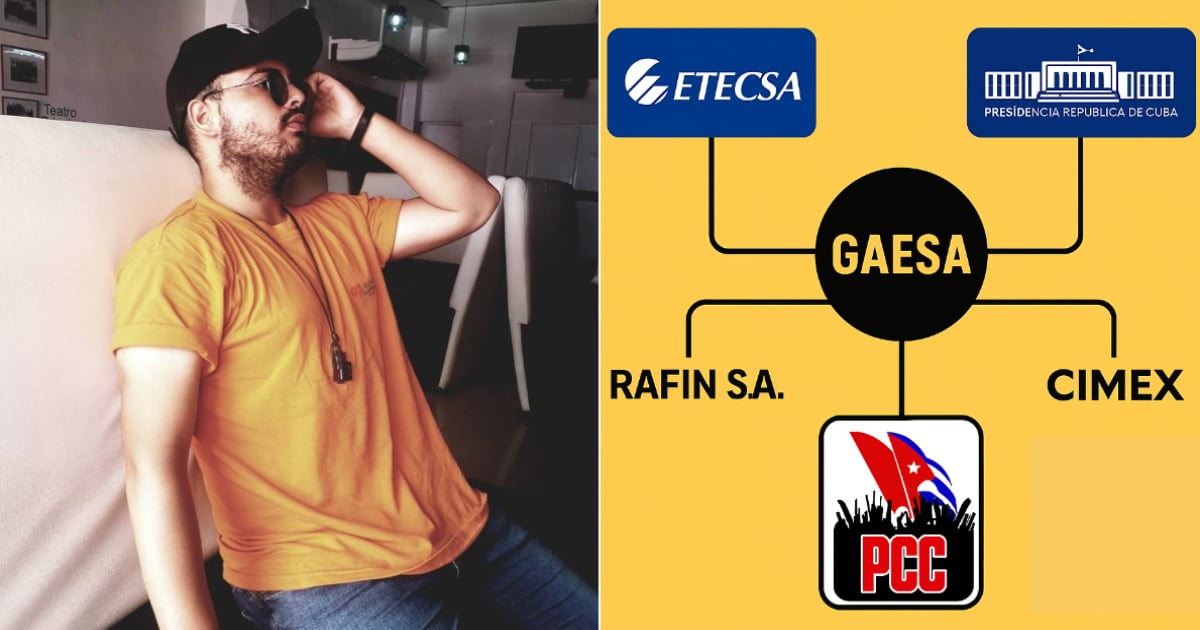
His statement revealed his ignorance—whether genuine or feigned—of the actual structure of economic power in Cuba: both ETECSA, as well as the Party and the Government itself, serve the interests of the military conglomerate GAESA (Business Administration Group S.A.), the true center of economic and political power on the island.
ETECSA: State enterprise or appendage of GAESA?
ETECSA is presented as a state-owned corporation, but since RAFIN S.A. acquired 27% of its shares in 2011 –a move that effectively removed Telecom Italia from the equation–, its control has been in the hands of entities connected to the Cuban military establishment.
RAFIN S.A., a shadowy financial entity whose name has been linked to “Raúl y Fidel Investments,” maintains operational and capital connections with CIMEX and FINCIMEX, two entities that are indeed directly integrated with GAESA.
The control of this consortium over key sectors of the Cuban economy – tourism, trade, finance, and telecommunications – is complete and is exercised with discretion, without public accountability or institutional checks and balances.
The Party, the Government… And the owners of power?
El Necio's complaint is not so much a criticism as it is a plea to his own superiors. Asking the Party and the Government to "make ETECSA reconsider" is like demanding that a reflection alter the face of its owner.
In Cuba, the Party and the Government are not autonomous powers, but rather ideological and administrative arms of the military, economic, and political command structure embodied by GAESA.
In other words, there is no one above ETECSA who is not part of the same mechanism that dictated the criticized measure.
A protest that confirms the discontent (and confusion)
The most revealing aspect of the text from El Necio isn't its call for sensitivity or to "seek a balance" with the people, but the tacit acknowledgment that even within the Fidelista bloc, there is a perception of weariness, deafness, and the authoritarianism with which governance is carried out.
"If the measure goes against the people, it goes against the Revolution," he wrote. But in Cuba, the Revolution is no longer that propagandistic myth of "the power of the people": it is a network of oligarchic power disguised as socialist discourse.
The real question is not whether ETECSA will reconsider. The question is whether any of its true owners are willing to forgo profits in exchange for preventing a social upheaval.
Attacks of honesty and blind loyalties
This episode is not the first in which Velázquez engages in what some have called "controlled honesty attacks": moments when he gently criticizes the system, but never breaks away from his role as a disciplined spokesperson for the regime.
He has done it before in relation to blackouts, unpopular measures, or social scandals, always adopting a tone of paternal concern that quickly reverts to the path of obedience.
As noted in an article published in CiberCuba in December 2024: "The official journalist Pedro Jorge Velázquez seems to be not only stubborn but also blind".
The criticism that El Necio made at that time, related to the lifestyle of Sandro Castro and the elite of power, did not lead to an ideological break, but rather another return to the fold. Velázquez himself has defended the legacy of Che Guevara, while the heirs of the "revolution of the humble" enjoy Mercedes Benz, private jets, and luxury homes.
From Mariela Castro and her lavish parties in Miramar, to Antonio Castro yachting in the Mediterranean or the trips of Marrero's children and Díaz-Canel's stepson across Europe, the examples of double standards and the extravagant lifestyles of the regime's elite are countless.
And all of them, systematically, ignored by the moderate criticism of "El Necio," which prefers to focus on the effects and never on the causes.
Meanwhile, millions of Cubans lacking stable access to the internet, electricity, or basic food must listen to spokespeople like Velázquez asking for sensitivity from those who have condemned them to scarcity and repression.
"The Fool" should open his eyes, not only to see the harm caused by the regime he defends but also to recognize that his role as a loyal critic only serves to mask authoritarianism with a veneer of dialogue. A dialogue that does not exist, because those who lead it live like kings and govern like a caste, not as public servants.
Filed under: