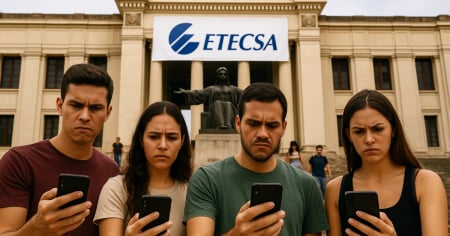
Lidia Esther Hidalgo Rodríguez, Commercial Vice President of ETECSA, confirmed this Friday during the official regime's Mesa Redonda program that nearly half of the users will be affected by the new package of measures that severely restricts the use of the Cuban peso (CUP) for mobile top-ups and instead promotes data packages in US dollars.
In a television appearance, the woman assured the regime spokesperson Randy Alonso that the decision was made based on a "study" of the consumption patterns of the population.
More than 50% of our population consumes approximately that value which is related to the offers we are making available and which are increasingly at a more affordable price and also offer more data in the plans we are introducing," said the executive, referring to the alleged benefits of the measure.
Hidalgo Rodríguez emphasized that the limit of 360 CUP over a period of 30 days applies specifically to the national top-ups made through local applications.
"There are customers who only want to enjoy data and make a combination and additionally, there is an offer for 360 pesos that includes a total of 6 GB, along with a bit more SMS and minutes than the other offers we have available in that capacity," he said.
For the other "half" of the population, with "different needs," plans for extra data at very high prices are offered. For 3 GB, one must pay 3,360 CUP; for 7 GB, around 6,720 CUP; and for 15 GB, 11,760 CUP. Another package of offers has prices in dollars and will be topped up from abroad.
In his justification, Hidalgo referred to the urgency of financing to "develop the country", but the true reason lies in his insistence that internet traffic in Cuba has increased. The regime takes advantage of the rise in data consumption to bring dollars into the country.
"We understand the importance of the internet today. We use it for everything, from work to relationships with friends and family. Traffic today has nearly quadrupled. Seventy-five percent of internet traffic in Cuba relies on mobile services. Consumption patterns have shifted in recent years towards streaming platforms and gaming platforms; this is considered normal behavior," commented Tania Velázquez, president of ETECSA, during the Round Table discussion.
"All of this requires a sustainability model, even if the currency of payment is in CUP. At the same time, the income in foreign currency that has supported the services has decreased. Since December, some measures have been announced to recover ETECSA's exports," he specified.
The officials from the communications monopoly praised that despite the limit of 6G for 360 Cuban pesos on national recharges, platforms like WhatsApp or Telegram allow for "an efficient use of data": "With just 1 GB, up to a million text messages can be sent, thus maintaining active communication," without mentioning how much would be spent on video calls, one of the most commonly used methods by Cubans to communicate with their emigrated relatives.
Regarding educational and labor needs, they stated that 300 MB of national browsing is included, along with free access to platforms such as ToDUS, the Nauta email service with 50 MB per mailbox, and other educational tools that "do not consume data," as if they were the only ones required by students.
The dollarization of ETECSA services primarily affects Cubans who do not have access to foreign currency. The new data plans in dollars offer options such as 4 GB for 10 USD, making internet access a privilege for those who receive remittances from abroad.
This measure deepens economic inequality and limits connectivity for a large segment of the population, consolidating a monetary duality in an essential service.
The justification provided by the company has been perceived as a mockery by many users, who believe that the quality of service has not improved despite the high rates and ongoing restrictions.
Frequently Asked Questions about the ETECSA Rate Hike in Cuba
What changes has ETECSA announced regarding mobile top-ups in Cuba?
ETECSA has limited recharges in Cuban pesos (CUP) to a maximum of 360 over a 30-day period, which forces users to purchase larger data packages in United States dollars (USD). This measure has faced criticism for excluding those who do not have access to foreign currency.
How do the new ETECSA rates affect Cuban users?
The new rates mean that Cubans without access to dollars can only purchase a 6 GB package for 360 CUP per month, which is insufficient for daily internet needs. This exacerbates inequality and limits connectivity for a large part of the population.
Why has ETECSA decided to dollarize part of its services?
According to ETECSA, dollarization aims to "develop and sustain" the telecommunications service network in Cuba. However, this justification has been widely criticized, as the quality of service has not improved and many believe that the measure is a mockery that increases economic inequality.
What reactions has ETECSA's decision provoked among the Cuban population?
The decision by ETECSA has sparked a wave of outrage and criticism both on social media and in digital media, even on official platforms like Cubadebate. Users believe that this measure is "armed robbery" and a further step towards economic exclusion.
What options do Cubans who do not receive remittances have to access the internet?
For Cubans without access to remittances, connectivity options are severely limited. They can only purchase a 6 GB package in CUP, while the more affordable plans are in dollars, leaving them either out of the system or with minimal connectivity.
Filed under: