
Related videos:
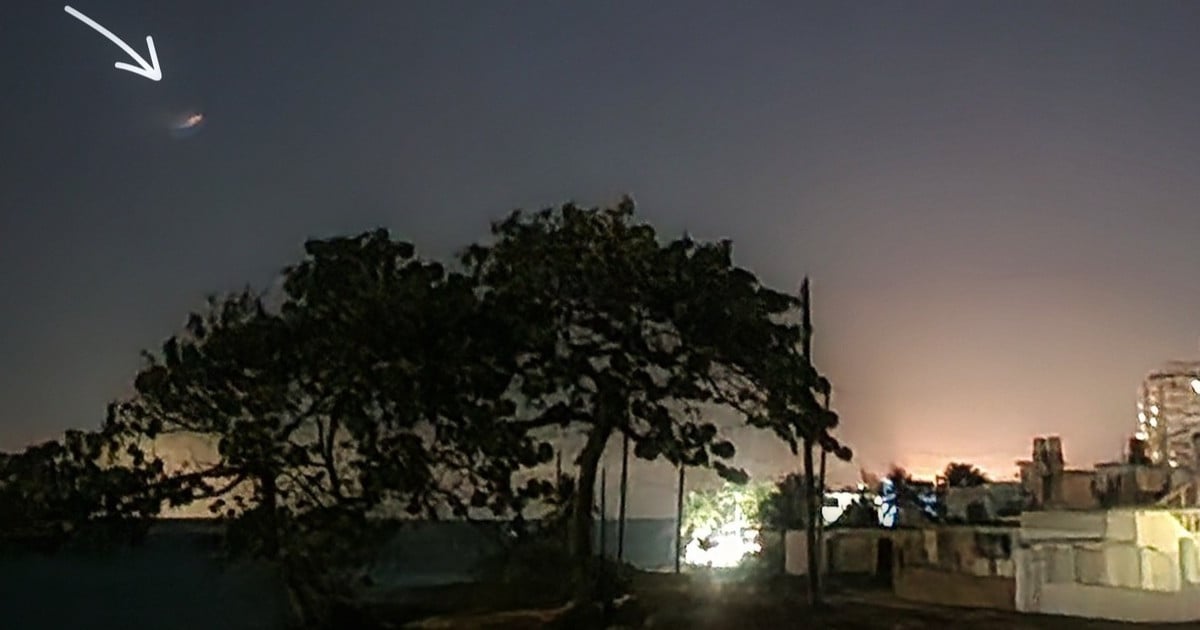
The sky over Matanzas was illuminated again on Tuesday night with the passage of the Falcon 9 rocket, launched by the American company SpaceX from Launch Complex 40 at Cape Canaveral, Florida.
Cuban meteorologist Henry Delgado Manzor shared a photograph of the event on Facebook and described the weather conditions that enabled the observation of the phenomenon.
"The weather conditions were favorable for observation, due to the low cloud cover over the city of Matanzas. The sighting of the light from the trail was between moderate and regular," he wrote.
This launch, which took place at 9:17 PM, is part of a new mission to place 28 Starlink satellites in low Earth orbit, aiming to expand satellite internet coverage in various regions of the world.
Although the visual impact in Cuba was not significant, it was enough to rekindle the enthusiasm of many sky watchers and astronomy enthusiasts on the Island.
This has not been an isolated incident. In recent weeks, the Falcon 9 has been spotted several times from Cuba.
On May 1st, Delgado Manzor reported another sighting from Varadero, also including a photograph.
On that occasion, the launch took place at 9:51 PM, with the same type of payload: 28 Starlink satellites.
"Aerospace enthusiasts in the Caribbean region are already on the lookout and eagerly await each launch to observe and report on the passage of SpaceX's rocket," specified the expert on Facebook.
The recent activity is part of a highly intense period for SpaceX, the company led by Elon Musk, which has successfully carried out several Falcon 9 launches, some with less than 48 hours apart.
On April 22, the Bandwagon-3 mission was carried out, whose visibility from Cuba was remarkable due to a combination of clear skies and widespread power outages in various regions of the country.
On that dark night, the rocket's passage left a glowing trail that was visible from Pinar del Río to Guantánamo, sparking numerous comments and photographs on social media.
According to meteorologist Ariel Maturell, the Bandwagon-3 mission is part of SpaceX's Smallsat Rideshare program, designed to provide launches for small satellites from multiple clients in a single flight, thereby reducing the cost of access to space.
The current Bandwagon series—which includes the missions carried out in April and May—follows Bandwagon-1 (April 2024) and Bandwagon-2 (December of the same year), and continues to expand the company's shared launch capacity.
Unlike the latest flights of the colossal Starship rocket, which experienced explosions shortly after takeoff from Texas, the Falcon 9 maintains its reputation for reliability and efficiency, boasting a high number of successful missions.
Its launch frequency and the intensity of its wake have made it an increasingly familiar sight in the skies of the Caribbean.
In a context where weather conditions and public interest align, SpaceX launches have become social and visual phenomena in Cuba, where citizen reports on social media multiply with each new sighting of the Falcon 9 on the horizon.
For many, it's not just an astronomical phenomenon, but a bright window into the technological future and a reminder of how much the sky can change even in the midst of darkness.
Frequently asked questions about Falcon 9 rocket launches and their visibility from Cuba
Why is the Falcon 9 rocket visible from Cuba?
The Falcon 9 rocket is visible from Cuba due to favorable weather conditions, such as clear skies and low cloud cover, which allow for the observation of the glowing trail generated by the rocket during its launch from Cape Canaveral, Florida. These sightings have captured the attention of astronomy enthusiasts and the aerospace industry in the Caribbean region.
What is the purpose of the Falcon 9 launches that have been seen from Cuba?
The main objective of these launches is to place Starlink satellites into low Earth orbit to expand satellite internet coverage. SpaceX aims to improve internet access in various regions of the world, providing an alternative to traditional terrestrial networks through its rideshare program, which enables multiple clients to share a single launch to reduce costs.
How has the Cuban government reacted to Starlink technology?
The Cuban government has taken a critical and restrictive stance towards Starlink technology, viewing it as a threat to its control over telecommunications on the island. The General Customs has confiscated Starlink equipment on the grounds of violating current regulations and has warned that its use without official authorization is illegal, thereby reinforcing the state monopoly on internet access.
Why does SpaceX use the Falcon 9 rocket for its missions?
SpaceX uses the Falcon 9 rocket due to its reputation for reliability and efficiency, with a high number of successful missions. Unlike other launches that have encountered failures, Falcon 9 has proven to be a robust and efficient launch vehicle, making it a preferred choice for satellite deployment missions and rideshare programs.
Filed under: