
Related videos:
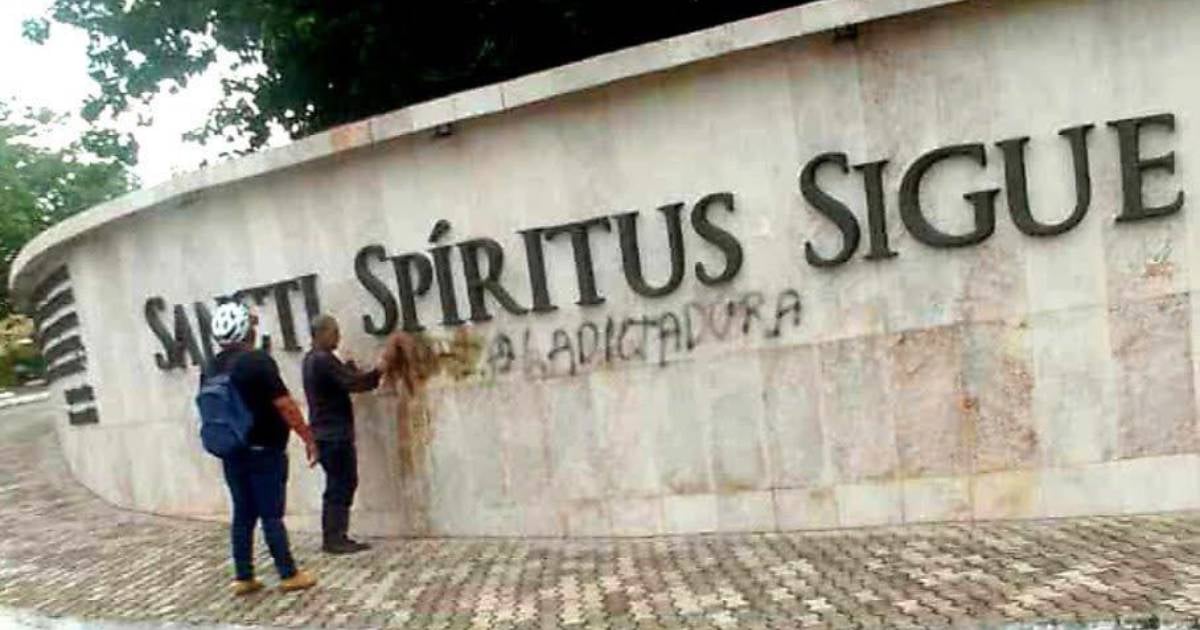
A sign with the phrase “Down with the dictatorship” appeared this Tuesday in one of the busiest areas of Sancti Spíritus, causing a major stir on social media and among passersby who witnessed the scene before it was removed by agents of the Ministry of the Interior (Minint).
The message was painted in black letters on an emblematic wall located precisely at the intersection of Carretera Central and Avenida de los Mártires (Marcos García), across from the provincial headquarters of the Ministry of Science, Technology, and Environment (CITMA) and the "José Martí" University.
The graffiti was placed beneath a bronze inscription that reads: “Sancti Spíritus continues the march,” a famous phrase uttered by the mambí general from Sancti Spíritus, Serafín Sánchez, as he died in battle, which added a symbolically defiant tone to the act.
On social media, users like Clandestinos Sancti Spíritus and the activist known as Lara Crofs celebrated the action with posts showcasing local pride.
A few minutes after its appearance, the sign was covered by two alleged agents of the Minint, as shown in images shared on digital platforms.
The speed at which the authorities intervened reflects the regime's sensitivity to public displays of dissent.
The journalist Wilfredo Cancio Isla, upon sharing the event, questioned whether this act responds to the popular discontent generated by the recent technological restrictions imposed by ETECSA, or to the growing frustration caused by power outages, the economic crisis, and the scarcity of basic goods affecting the city.
"Signal of discontent with ETECSA's recent measures? Or extreme fatigue and civic indignation? Or a liberating cocktail with all the explosive ingredients of the profound crisis of shortages in Cuban society?" questioned Cancio Isla in a post on his Facebook page.
Although the sign was quickly removed, the message was captured in dozens of photos and videos that went viral rapidly. For many, it represents a symbolic act of resistance amid a climate of repression, constant surveillance, and growing social discontent.
The emergence of these antigovernment expressions, which are becoming increasingly frequent in various regions of Cuba, has been notable: recently, posters appeared in Santiago de Cuba demanding the release of political prisoner José Daniel Ferrer.
Frequently Asked Questions about Anti-Government Protests in Cuba
What prompted the appearance of the sign "Down with the dictatorship" in Sancti Spíritus?
The sign "Down with the dictatorship" appeared as a manifestation of discontent and symbolic resistance against the repression and shortages experienced in Cuba. Among the possible motivations are the discomfort generated by the recent technological restrictions imposed by ETECSA and the growing frustration over blackouts and the economic crisis.
Why did the Cuban authorities react quickly to the sign in Sancti Spíritus?
The speed with which the Cuban authorities intervened to remove the sign reflects the regime's sensitivity to any public display of dissent. These acts of protest are seen as a threat by the government, which responds with surveillance and repression to prevent discontent from spreading.
How has popular discontent manifested in other regions of Cuba?
The popular discontent in Cuba has been expressed through anti-government posters and protests in various regions of the country. Recent examples include posters in Santiago de Cuba demanding the release of political prisoners and protests in Granma against blackouts and shortages of basic resources. These actions reflect the growing frustration of the population with the regime.
What role do social media play in the protests in Cuba?
Social media is a key tool for disseminating and highlighting protests in Cuba. Despite the internet restrictions imposed by the government, citizens use these platforms to share images and videos of demonstrations, which helps to break the information blockade and mobilize more people to join the protests.
What is the Cuban government's response to the demonstrations of discontent?
The response of the Cuban government to the expressions of discontent has been repression and criminalization of the protesters. The authorities deploy security operations to prevent protests and detain activists and citizens, while the official discourse discredits the protesters as "antisocial" or "criminals."
Filed under: