The Cuban government on Thursday condemned the United States' decision to partially restrict the entry of Cuban citizens into its territory as "racist" and harmful, in a list that includes Cuba alongside seven other nations, including Venezuela.
The Minister of Foreign Affairs of Cuba, Bruno Rodríguez, denounced on the social media platform X that the “new entry ban to #USA for nationals of several countries has a racist background supported by anti-Cuban politicians.”
Rodríguez also warned that the measure “harms contact between Cuban families”, referring to the 1.5 to 2.5 million Cubans and descendants of Cubans who, according to various studies, reside in the U.S.
Lastly, he emphasized that the new restriction "damages personal, professional, academic, and cultural exchanges between both countries."
Strong citizen reaction: "Since when do you care about the Cuban family?"
The chancellor's post on X sparked a deluge of critical comments from internet users, many of whom expressed their outrage over the mention of family separation.
"Since when do you care about the Cuban family? You who have separated it from the very first day. Assassins, you are very scared; your time is short. Down with the dictatorship!” questioned a citizen.
“You and your government have promoted this. You continue to subject the people to inhumane conditions. Should I detail them for you?”, pointed out another.
“Who started the division of families? The biggest HDGP our country has seen, the Piedra. Now that they're in trouble, they need the stateless, worms, dissidents, ex-Cubans, etc. Go to hell... for your little car. HDGP,” exclaimed a third outraged individual, who blamed Fidel Castro for the beginning of family separation.
Another comment concluded: "Blah blah, it's you who have messed things up for 70 years, always draining dollars from the exile."
The new executive order from the U.S.
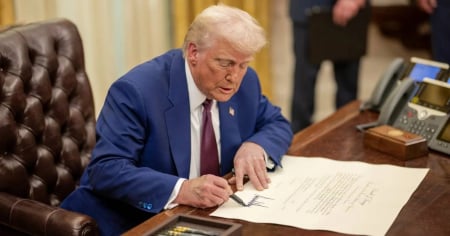
The President of the United States, Donald Trump, signed an executive order on Wednesday prohibiting citizens from 12 countries from entering the U.S., and imposing partial restrictions on seven others, including Cuba.
The order, which will take effect on June 9, completely prohibits the entry of citizens from Afghanistan, Myanmar, Chad, the Republic of Congo, Equatorial Guinea, Eritrea, Haiti, Iran, Libya, Somalia, Sudan, and Yemen.
It also imposes restrictions on nationals from Burundi, Cuba, Laos, Sierra Leone, Togo, Turkmenistan, and Venezuela, under the argument of "risks to national security."
Regarding the Cuban case, the official text states that the island "is a state sponsor of terrorism. The Government of Cuba does not cooperate or share sufficient information regarding law enforcement with the United States. Historically, Cuba has refused to accept the return of its deportable nationals."
It is also noted that "according to the Visa Overstay Report, Cuba had an overstay rate of 7.69% for B-1/B-2 visas and an overstay rate of 18.75% for F, M, and J visas."
"Therefore, the entry of Cuban citizens into the United States as immigrants and non-immigrants under the visa categories B-1, B-2, B-1/B-2, F, M, and J is suspended," adds the presidential order.
It is emphasized that "consular officials must reduce the validity of any other non-immigrant visa issued to Cuban citizens to the extent permitted by law."
The White House clarified that the partial restrictions allow for certain exceptions for lawful permanent residents in the U.S., individuals with valid visas, visa applicants in specific categories, and individuals whose entry is deemed to be in the national interest.
According to government officials, the proclamation was expedited after the antisemitic attack that occurred on Sunday in Boulder, Colorado, although it was already under evaluation prior to that.
Filed under: