A Cuban doctor living in Chile has sparked a new debate on social media after posting a video on TikTok contrasting the ease of access to infant formula in the South American country with the dramatic situation faced by families in Cuba. His testimony, recorded while buying formula for his newborn daughter, has received a wave of reactions, both of support and indignation.
"The most beautiful thing about this country is that all these products are attainable with your salary; there are options for every budget," says the doctor known as El Dr Mulato (@eldrmulato), while showcasing the wide range of infant formulas available at a pharmacy in Chile. The Cuban emphasizes that, although his wife has attempted to maintain exclusive breastfeeding, it has been necessary to supplement with formula, an option that, in his words, is feasible in Chile thanks to the healthcare system and the purchasing power of the average citizen.
It also emphasizes that the Chilean Ministry of Health offers fortified Purita milk through public programs, in case the family cannot afford the food.
"Meanwhile, in Cuba, with a minimum wage of $5, you can't buy anything. The government provides nothing, only hunger, misery, communism, and phrases like 'Homeland or death.' That doesn’t feed newborns," he laments.
Reactions on social media: support, recommendations, and political debate
The video received dozens of comments. Some Chilean users validated their testimony: “Only Cubans know what life is like in their country,” wrote one user. Others shared experiences about the most effective formulas or their effects on babies. Criticism of the Cuban system and ideological references also emerged: “Communism destroys countries” and “the joke is on itself.”
There were even those who recalled that it was a leftist president, Salvador Allende, who promoted free milk programs in Chile, which sparked debates about the ideological nuances in both systems.
This is not the first time that Dr. Mulato has made an impact on social media with his comparisons between Cuba and Chile. In April, he shared his experience in a public hospital in Chile, highlighting the dignified conditions of the medical environment compared to the hospital shortcomings in Cuba. A month later, he documented the benefits received after the birth of his daughter, as part of the state program Chile Crece Contigo: from cradle to hygiene and clothing items, all free of charge.
He has also published videos showcasing the abundance of bread in Chilean supermarkets, contrasting with the extreme rationing on the island: “2025 and they are still giving one bread per person in Cuba,” he said at the time.
Cuba: absent milk, present corruption
Meanwhile, the situation in Cuba regarding infant formula is becoming increasingly critical. In May, Spanish YouTuber Juanjo Dalmau documented a Cuban father's struggle to obtain milk for his daughter, unsuccessful in multiple stores. They eventually managed to buy a bag for 200 pesos at a Mipyme, more of an exception than a rule. The ordeal was captured in a viral video.
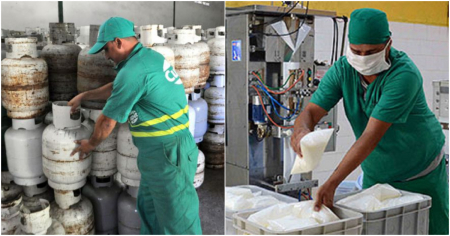
In early June, five individuals were arrested in Havana for stealing 197 bags of powdered milk intended for infants. The product was being sold illegally for 1,650 pesos per pound, an amount beyond the reach of most Cuban families. Corruption, according to reports, involved state workers and external receivers.
Additionally, the Cuban government has been widely criticized for offering chocolate mixes without milk or sugar, and even cola syrup as a substitute for milk for children. Mothers have expressed their frustration on social media regarding these nutritionally deficient alternatives.
Structural inequality: dollarization as a barrier
Another aspect of the problem is the partial dollarization of commerce. Although sales of powdered milk have been reported in MLC stores like the one at 3rd and 70th in Havana, the prices in foreign currency—up to $8.75 per bag—are out of reach for those who only receive income in Cuban pesos. This situation has generated controversy and discontent among the population.
According to a report from UNICEF, at least 9% of Cuban children suffer from severe food insecurity, a situation that is worsened by shortages, ineffective rationing, and the lack of nutritionally viable substitutes.
The publication of El Dr Mulato is not just a mere outlet. It is part of a growing phenomenon of Cubans in exile who, armed with evidence, reveal the gap between their new realities and the lives they left behind. In a context where official data is scarce and state propaganda insists on a triumphalist narrative, videos and citizen testimonies have become a key channel for documenting and denouncing the deep crisis that Cuba is experiencing.
Frequently asked questions about the food and social situation in Cuba
Why is it difficult to access infant formula in Cuba?
The difficulty in accessing infant formula in Cuba is due to a combination of basic product shortages, rampant inflation, and distribution problems. The price of powdered milk is so high that it approaches the monthly minimum wage, making it an unattainable commodity for many Cuban families. Moreover, corruption and the black market exacerbate the situation, further limiting access to this essential product.
How does the milk shortage affect children in Cuba?
The shortage of milk severely impacts children's nutrition, as many children lack access to this essential food. The lack of milk is causing health problems among children, especially those with special needs, due to the deficiency of appropriate nutrients. The situation is critical for children aged 2 to 6 years, who are not receiving enough milk because of insufficient inventory and poor distribution management.
What solutions has the Cuban government proposed for the milk crisis?
The Cuban government has implemented makeshift solutions, such as replacing powdered milk with liquid milk of questionable quality and limited distribution to the youngest children. However, these measures have not resolved the milk supply crisis and have not provided structural solutions to ensure access to this essential product.
How does the situation regarding access to basic goods in Cuba compare to that in other countries?
Compared to other countries, the situation in Cuba is extremely precarious. While in countries like Chile one can access a variety of basic products with the average salary, in Cuba access to essential products such as milk and bread is severely limited, forcing families to resort to the black market at exorbitant prices. The contrast is evident in testimonies from Cubans abroad who highlight the ease of access to products in other nations versus the scarcity on the island.
Filed under: