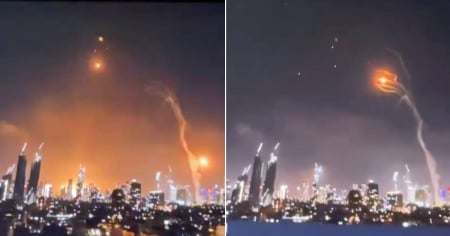
Several videos published by media outlets show the impact of Iranian missiles in Tel Aviv, Israel, this Friday, in a dramatic escalation of the conflict in the Middle East.
A spokesperson for the Israeli police stated that the bombing caused significant material damage and left hundreds of people displaced, adding that bomb disposal experts were working to secure the impact sites.
The Israel Defense Forces (IDF) confirmed that another wave of missiles had been launched toward Israel late last night. "The attack is ongoing. Dozens of additional missiles were launched toward the State of Israel," said an IDF spokesperson.
The attacks resulted in multiple injuries in various parts of the country. According to the Israeli emergency service Magen David Adom, five people were treated for injuries in the Dan region: one in moderate condition and four with minor injuries.
Iranian state media described the missile launch as the beginning of Tehran's "crushing response" to the Israeli attacks that occurred earlier this Friday.
The prime minister of that country, Benjamin Netanyahu, said at a press conference that they are going through "one of the best military operations in history, the High Line operation."
The objective of Israel's military operation, he clarified, is to "eliminate this threat from the Islamic regime, both the nuclear threat and the threat of ballistic missiles to Israel."
"While we achieve our goals, we are also clearing the way for you to reach your goal, which is freedom. Over the last 24 hours, we have removed military commanders, nuclear scientists, the most significant enrichment facility of the Islamic regime, and a large part of its ballistic missile arsenal. More is on the way. The regime does not know what has hit them, nor do they know what will hit them. The nation of Iran and the nation of Israel have been true friends since the days of Cyrus the Great," he stated.
Israel launched devastating attacks against the heart of the nuclear and military structure of Iran, deploying fighter jets and drones previously introduced into the country to assault key facilities and kill high-ranking generals and scientists, a bombardment deemed necessary before its adversary could come closer to developing atomic weapons.
Sources from the United States Department of Defense confirmed that the country is assisting Israel in the interception of Iranian missiles.
Although the type of support was not specified, it is known that in previous offensives, the U.S. has deployed combat aircraft and defense systems from naval destroyers in the region.
Iran retaliated and launched dozens of ballistic missiles against Israel, where explosions erupted in the skies over Jerusalem and Tel Aviv, shaking the buildings below.
"We will not allow them to escape unharmed from this great crime they have committed," said Iran's Supreme Leader, Ayatollah Ali Khamenei, in a recorded message in which he promised revenge. The Iranian ambassador to the UN stated that 78 people died and more than 320 were injured in the Israeli attacks.
Frequently Asked Questions about the Conflict Between Israel and Iran in 2025
What triggered Iran's recent attack on Israel?
The attack by Iran on Israel was in response to Israeli bombings of Iranian nuclear facilities and military targets. Israel carried out these attacks to counter what it perceives as an existential threat from Iran, eliminating high-ranking military leaders and Iranian nuclear scientists. This action was part of a larger operation called "High Line," aimed at dismantling Iran's nuclear and ballistic capabilities.
What has been Israel's response to the Iranian missile attacks?
Israel has responded with more airstrikes against key targets in Iran. The Israel Defense Forces (IDF) have confirmed the launch of a series of attacks aimed at neutralizing the Iranian threat, including the destruction of nuclear facilities and the removal of key figures within the Iranian regime. Prime Minister Netanyahu has stated that the operation will continue until the threat is completely neutralized.
What is the role of the United States in this conflict between Israel and Iran?
The United States is assisting Israel in intercepting Iranian missiles. Although Secretary of State Marco Rubio has denied direct involvement in the Israeli attacks, the Department of Defense has confirmed its support in Israel's defense. Moreover, the United States has mobilized military assets in the region to protect its interests and personnel, and has urged for the maintenance of open diplomatic channels with Iran.
What consequences has this conflict had on the international community?
The conflict has generated global concern over a possible regional escalation. Countries such as Russia, China, Oman, and Saudi Arabia have expressed their worry, while some have condemned the Israeli attacks. The price of oil has risen significantly due to fears of a global energy crisis. The international community is urging restraint to avoid a larger-scale war in the Middle East.
Filed under: