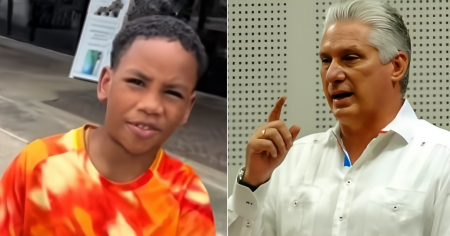
The Cuban leader Miguel Díaz-Canel spoke out this Friday against the airstrike launched by Israel on Iranian territory, which took place in the early hours of the morning and has generated a wave of international reactions due to the risk of an escalation in the Middle East.
From his account on the social network X, Díaz-Canel stated: "We strongly condemn the attacks carried out by Israel against the Islamic Republic of Iran, which irresponsibly escalate tensions in the Middle East and endanger peace and international and regional security with unpredictable consequences."
He also called for “an end to the barbarism and for respect for International Law,” in a message that adds to the chorus of criticism expressed by governments allied with Iran and other international actors concerned about the geopolitical impact of the attack.
What are the relations between Cuba and Iran like?
The relations between Cuba and Iran have notably strengthened in recent years, under a bilateral agenda marked by strategic cooperation and ideological affinities.
In December 2023, Miguel Díaz-Canel made an official visit to Tehran, where he was received by the Iranian Supreme Leader, Ali Khamenei, and sealed several agreements in sectors such as energy, health, and technology.
During that trip, the Cuban leader expressed his interest in "setting higher collaboration goals" with Iran and praised the relationship as a continuation of the alliance forged during the time of Fidel Castro.
That political alignment has been reaffirmed by both regimes in the face of international pressure, especially from democratic governments that question their repressive practices.
Cuba and Iran share a model of authoritarian control over society and information, as well as common positions in international forums where they oppose the Western liberal order.
Beyond the economic agreements, the alliance is sustained within a framework of mutual support in the face of international sanctions, isolation, and condemnation for human rights violations.
What does the United States government say about Israel's attack on Iran?
The U.S. Secretary of State, Marco Rubio, denied any involvement of his country in the Israeli military operation.
Israel took unilateral measures against Iran. “We did not participate in attacks against Iran, and our top priority is to protect U.S. forces in the region,” Rubio stated in an official statement.
He added that the Donald Trump administration has maintained contact with its partners in the area and taken measures to safeguard its personnel.
Rubio also emphasized that Israel views this action as "necessary for its own defense" and warned that "Iran must not attack American interests or personnel."
Key facts following the attack
The Israeli air offensive took place around 03:30 (local time in Tehran), targeting military and nuclear facilities. Among the confirmed casualties is the commander-in-chief of the Iranian Revolutionary Guard, Hossein Salamí, along with at least six nuclear scientists.
The Israeli Prime Minister, Benjamín Netanyahu, described the operation as "successful" and assured that it will continue until the Iranian threat is eliminated. In response, Iran's Supreme Leader, Alí Jamenei, vowed retaliation and stated that Israel "must prepare for severe punishment."
The Natanz nuclear plant was damaged, although the International Atomic Energy Agency (IAEA) confirmed that no increases in radiation levels have been recorded. The facilities in Fordow, Isfahan, and Bushehr were not affected.
The attack triggered a significant
The United States convened an urgent meeting of the National Security Council and reiterated from the Pentagon that it did not participate in or provide assistance for the Israeli offensive.
Frequently asked questions about Díaz-Canel's statements and Cuba's international relations
Why did Díaz-Canel condemn Israel's attack on Iran?
Miguel Díaz-Canel condemned Israel's attack on Iran, arguing that it increases tension in the Middle East and jeopardizes international peace and security. This stance aligns with Cuba's policy of supporting Iran, with which it maintains close relations and shares a strategic collaboration agenda. Additionally, both countries oppose the international sanctions imposed primarily by the United States.
What are the relations like between Cuba and Iran?
The relationship between Cuba and Iran has strengthened in recent years, based on strategic cooperation and ideological affinities. Both countries have signed agreements in sectors such as energy, health, and technology, and share a common stance in international forums against the Western liberal order. This alliance is not only economic but also rests on mutual support in the face of international sanctions and external pressures.
What stance has the United States taken regarding Israel's attack on Iran?
The United States, represented by Secretary of State Marco Rubio, denied any involvement in Israel's attack on Iran. Rubio stated that the action was unilateral on Israel's part and that Washington's priority is to protect its military personnel in the region. This stance aims to distance the United States from the escalation of the conflict while maintaining its focus on safeguarding its interests in the area.
What impact has Israel's attack on Iran had on the global economy?
The attack by Israel on Iran has triggered a significant increase in oil prices, with hikes of up to 13%. This rise reflects fears of a global energy crisis, as the conflict in the Middle East may impact oil supply and international economic stability.
Filed under: