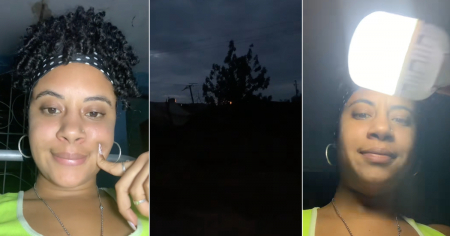
A Cuban in the United States posted a video on TikTok, reacting strongly to those who defend the idea that “there is food, work, and money in Cuba.” The creator of the video, identified as Robelcasa (@robelcasa), shared his passionate reflection after seeing another piece of content on the platform with thousands of comments supporting that narrative.
"I just saw a video of a young man saying that there is everything in Cuba, that what it takes is to work," he says in the first few seconds. From abroad, where he claims to have been for seven years, he refutes that view and launches a direct denunciation of the situation on the island: "What is there in Cuba? There's not even toothpaste. There are no factories, no water, no electricity, no dignity."
Throughout the video, recorded outside a gym in the U.S., he recalls how even before emigrating, there were already hygiene crises, blackouts, and food shortages. “Now you have to send even cumin just to be able to cook,” he states. “If you don’t have a family member who can send you food from abroad, you have nothing.”
Robelcasa also describes the deterioration of the healthcare system, the shutdown of workplaces, and the decline of private businesses due to the lack of electricity: “They take it away for 24 hours and then give it back for two. What does an electric plant like that solve?”. And he concludes: “The problem in Cuba won't be solved by this video either.”
"In Cuba, there is nothing": massive support on social media
His testimony quickly received hundreds of supportive reactions. Several users confirmed that the description matches their daily experiences. “That’s all true,” commented one internet user. “You’re absolutely right, things get worse every day,” wrote another. There were also more intense comments: “They have nothing, it’s a Cuban holocaust,” or “Cuba is living under a murderous dictatorship.”
Other users rejected the positive narrative of the original video that prompted Robelcasa's reaction, considering it a distortion of reality and a mockery for those who experience it daily.
The precariousness described from the island
The testimony of Robelcasa resonates with other recent stories that have portrayed life in Cuba from various angles. In Villa Clara, a family documented how they wash their clothes with an old Soviet washing machine while battling power outages and cooking with improvised heating elements on a homemade stove, stating that “we have to make the most of the time we have with electricity”.
The routine of a Cuban mother has also become visible as she starts her day without water or electricity, making coffee with charcoal and caring for her child with the help of a rechargeable fan sent to her from abroad, in a video where she naturally shows "what it's like to wake up living in Cuba".
In Matanzas, another young Cuban shared how he had to transport water in a wheelbarrow to his partner's grandparents' house, after several days without a drop of the liquid, describing the ordeal in one sentence: “This is not living”.
From abroad, a mother delivered a heartfelt message against the regime after seeing her daughter struggle on the island, tearfully stating that “my daughter is the one suffering because of the communists”.
Even foreign visitors have captured this reality. Some Spanish YouTubers, after their visit to Havana, described it as “a prison with a blue sky and beautiful cars”, after recounting blackouts, hunger, and surveillance in the humble areas of the capital.
As the wave of testimonies grows from all fronts—those from within, those from outside, those who have left, and those who visit—the message is repeating: in Cuba, there isn’t everything. There is a deep crisis that refuses to go away. And those who experience it are no longer willing to remain silent.
Frequently Asked Questions about the Current Situation in Cuba
Is it true that in Cuba "there is everything"?
Despite some testimonies claiming that certain products are available in Cuba, the reality is that the majority of Cubans face a severe shortage of basic products such as food, medicine, and hygiene items. This situation is compounded by the economic crisis and the limitations of the distribution system on the island.
How does the lack of electricity affect daily life in Cuba?
The frequent blackouts in Cuba have a devastating impact on everyday life. Electricity is intermittent, forcing families to constantly adjust their daily routines, affecting everything from meal preparation to healthcare. People must adapt to the lack of basic services, leading to exhaustion and frustration.
What do Cubans say about the economic and social situation on the island?
Many Cubans describe the situation on the island as unsustainable, with a lack of basic resources, constant blackouts, and widespread deterioration of public services. Hopelessness and discouragement are common among the population, which faces daily challenges to survive in an increasingly precarious environment.
How does precariousness manifest in infrastructure and services in Cuba?
The infrastructure in Cuba is severely deteriorated. Families are facing challenges in accessing basic services such as drinking water and electricity. The streets are in poor condition, and the buildings urgently need repairs. Furthermore, the scarcity of resources has led to a decline in the quality of life and an increase in insecurity.
What impact do testimonies from Cubans abroad have on the perception of the situation in Cuba?
The testimonies of Cubans abroad, such as that of Robelcasa, strengthen the perception that the situation in Cuba is critical and contradicts official narratives. These accounts, shared on social media, have sparked a debate about the Cuban reality and have helped to highlight the difficulties faced by the population on the island.
Filed under: