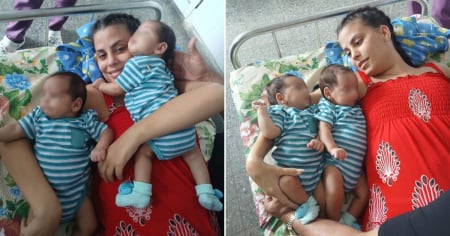
A Cuban woman identified as Lizzmaria, a TikTok user under the name @lizzmaria.la.cuba, shared a video that candidly and lovingly portrays the start of an ordinary day in Cuba: without water, without electricity, with a child sleeping next to a rechargeable fan, and a charcoal coffee maker as the only resource to begin the morning.
In the video, Lizzmaria does not complain. She speaks sweetly, as if telling a friend about her experiences, and shows without filters the inside of her home: the washing machine filled with unwashed clothes, a kitchen waiting to be cleaned, the coffee maker that only works when heated over coals. "This is what it’s like to wake up living in Cuba, my loves," she says while preparing coffee with almost ritual precision, measuring the sugar and carefully adjusting the aluminum lid to prevent spills.
"As you can understand, there is no electricity," she adds while setting the coffee pot on an improvised stove. She recounts everything without bravado, and perhaps that's why it is so moving: because she doesn’t aim to evoke emotion, only to show what is.
A testimony that summarizes the daily ordeal
What might seem exceptional to others is just routine for Lizzmaria. The lack of electricity, the need to use charcoal, the scarcity of water, or the reliance on small acts of solidarity, like the rechargeable fan a friend sent her—none of this she presents as a complaint, but rather as part of another day. And therein lies her value: in demonstrating how extraordinary the ordinary has become in the lives of so many Cuban families.
A story that is not only yours
What Lizzmaria is experiencing is not an exception. Many Cubans on the island share snippets of their daily lives on social media, showing charcoal stoves lit with plastic due to a lack of fuel, children who can't sleep because of the heat, or empty refrigerators where only scraps are kept "just in case."
User testimonials like @una.cubana.de.el and @anita.cubanita64 on TikTok have documented similar situations. There is fatigue, yes, but also humor, ingenuity, tenderness, and an enormous capacity for resilience. "With dark circles like a raccoon," one of them said while showing her pots stained black from coal soot, while the other recounted how she had to take her son to a hospital, where there were no basic supplies.
It's not viral, it's real
At the time of this note, Lizz's video has not become a trending topic, but it says more than many statistics or speeches. It reflects what life is like on an island where basics—water, electricity, gas—are becoming increasingly uncertain, yet life continues on. That's why it matters. Because it is genuine.
And because in every spoonful of sugar that Lizzmaria adds to her coffee, there’s a clear message, even if she doesn’t say it: this is what we have... and still, we carry on.
Frequently Asked Questions about the Energy and Social Crisis in Cuba
What are the main problems that Cuban families face in their daily lives?
Families in Cuba face a daily crisis marked by the lack of electricity, water, and basic resources. Blackouts are frequent and prolonged, making it difficult to cook food and preserve it, as well as to use essential appliances. Additionally, the fuel shortage forces many families to resort to using coal stoves, increasing the effort required to perform basic household tasks.
How do Cuban mothers adapt to the energy crisis to care for their children?
Cuban mothers have demonstrated great resilience and creativity in adapting to difficult conditions. They use charcoal stoves for cooking, prepare food manually without mixers or proper refrigeration, and find ways to protect their children from mosquitoes amid prolonged blackouts. Despite the adversities, their dedication and love for their children are evident in every effort they make.
What impact does the lack of electricity have on the daily lives of Cubans?
The lack of electricity severely affects the quality of life in Cuba. In addition to complicating the preparation and preservation of food, blackouts limit access to basic services, hinder restful sleep due to heat and lack of ventilation, and impact health and well-being, especially in homes with children and the elderly. The precarious economic situation further exacerbates these difficulties, creating an atmosphere of constant uncertainty and stress.
What solutions does the Cuban government propose in response to the energy crisis?
The Cuban government has announced measures to improve the electric system, such as the synchronization of power plants and the introduction of new energy generating units. However, these efforts have not been sufficient to address the chronic issues of electricity supply. The lack of fuel and breakdowns in the plants remain significant challenges, leaving many areas of the country with constant service interruptions.
Filed under: