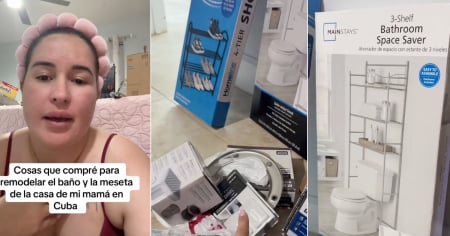
A Cuban mother living in the United States has sparked a wave of reactions on social media after sharing a video on TikTok, where she delivers a heartfelt message against the ruler Miguel Díaz-Canel and the Cuban regime, holding them responsible for the suffering on the island.
I'm resigned to his life, to all the filthy communists, says the woman (@lachinagonzalez97gmail.c), clearly affected, through screams and tears. Her indignation comes shortly after the recent imposition of new measures and tariffs that worsen the situation in Cuba, particularly the so-called tarifazo from ETECSA, which has generated widespread rejection both inside and outside the country.
The outburst from this mother was preceded by another video where she denounces the living conditions on the island through a critical rap: “Living under communism that has lasted for years and harms families so much,” she sings, while calling on the people to raise their voices.
Her cry did not go unheard, and many users joined her message with phrases like “I also feel resigned” or “that is the sentiment of all Cubans.” The comments express a mix of support, anger, and frustration: from those encouraging her not to remain silent, to those pointing out that it is Cubans abroad who are financially supporting the country.
The comments on social media came quickly and turned into a massive display of support for the Cuban mother. Many echoed her words as if they were a collective slogan. Phrases such as “I too resign myself to the mother of all communists” and “I resign myself in Díaz-Canel's heart” were repeated emphatically. Others were even more explicit: “those people wouldn’t pay for the damage they've done even if you killed them” or “65 years of crimes, depression, and prisons.”
From exile, many Cubans expressed that the pain of that mother is the same as what they feel when they see their families suffering on the island. Comments such as “nobody knows what I suffer because of that situation,” “Cuba hurts us,” or “my daughter is also there, and I can't take it anymore” were common. One person wrote: “that video reflects the feelings of many Cubans,” while another said: “my love, I'm with you. It hurts me just the same.”
The outrage over the current situation was also evident: “they are squeezing the people,” “Cubans are without food, without medicine, without power, and without a future,” or “it’s a silent genocide.” Some voices directly targeted the government: “Díaz-Canel is a bastard,” “down with the dictatorship,” “the regime thrives on the money of those who left,” “that dictatorship won’t fall because Cubans don’t take to the streets.”
There were also critical reflections on the role of those who still do not protest within the island: “everyone there has to take to the streets,” “he who remains silent, consents,” “if we don't all go out, we will never be free.” Others expressed resignation: “this has been the same since 1959,” “we've been like this for 65 years,” or even bitter irony: “we will cry while they march on July 26.”
Amidst it all, a shared feeling of anger and helplessness prevailed, but also a sense of unity in suffering. "I understand you so well, I think the same," "I join in your pain, which is also mine," "your daughter is like mine," "your words are mine," read through hundreds of reactions. The video, unfiltered and unmade-up, became a harsh mirror of the despair that affects millions of Cubans both on the island and abroad.
The context of these citizen expressions is marked by the profound economic crisis affecting the island. Recently, the state telecommunications monopoly, ETECSA, announced that it will limit national top-ups to only 360 pesos per month, forcing users to resort to expensive packages in dollars. The official justifications, centered on alleged international fraud, have been broadly rejected by the population.
The video of this Cuban mother resonates with the feelings of many citizens who see in her pain a representation of the entire country. “My daughter is suffering in Cuba because of those communist bastards,” she states through tears. For many, this phrase reflects a shared reality: the desperation of thousands of families torn apart by migration, poverty, and repression.
Frequently Asked Questions about the Crisis in Cuba and the Citizen Protests
Why does the Cuban mother in the viral video blame the Cuban regime for her daughter's situation?
The Cuban mother blames the regime for the harsh economic and social conditions her daughter faces on the island, which she directly attributes to the policies of Cuba's socialist government. Her outrage was fueled by recent economic measures, such as the increase in ETECSA fees, which exacerbate the situation for Cuban citizens.
What is ETECSA's "tarifazo" and why has it generated so much backlash?
The "tarifazo" of ETECSA refers to the new policies of the Cuban state telecommunications company, which limit national top-ups to 360 pesos per month and force users to pay expensive packages in dollars. This measure has been criticized as an attempt to economically blackmail Cubans abroad and a form of economic repression against those living on the island.
How have Cubans in exile reacted to the problems on the island?
Cubans in exile have expressed a mix of support, anger, and helplessness regarding the situation on the island. Many share the pain and frustration of seeing their family members suffer, and some have proposed measures such as suspending remittances to Cuba in protest against the regime. However, there is an ongoing debate about the impact of these actions on the families who remain on the island.
What problems do Cuban mothers face due to the energy crisis?
Cuban mothers face numerous challenges due to the energy crisis, such as prolonged blackouts that impact their ability to cook, refrigerate food, and rest adequately. These conditions worsen daily life, especially in households with children, the elderly, or ill individuals. Many mothers, as seen in the testimonies, resort to makeshift methods to care for their children amidst these difficulties.
Filed under: