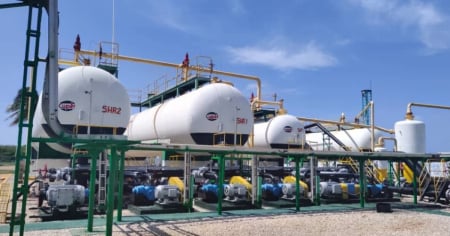
In one of the most critical moments for the Cuban electrical system, with daily blackouts, a crisis in generation, and chronic fuel shortages, the National Television News once again resorted to the regime's usual tactic to try to calm popular uncertainty: the promise that this time they will indeed find oil.
The report from NTV - crafted by the official spokesperson for energy matters, Bernardo Espinoza - announced a supposed intensification of geological studies with support from the People's Republic of China, to identify potential areas of interest for the exploration of oil and gas on land.
Under the umbrella of a supposed “geology aligned with the country’s priorities,” Espinosa explained that cutting-edge geochemical maps are being developed to detect chemical anomalies across the national territory in search of new deposits. The project, he affirmed, “is unprecedented” and has the full support of the Chinese government.
According to the words of the interviewed specialists, these studies will help detect everything from concentrations of mineral elements to potential pockets of hydrocarbons, and will even have an impact on agriculture and the environment.
But the central promise is clear: it is about finding oil to sustain the national electricity generation, one of the most vulnerable Achilles' heels of the country.
However, this type of announcement is not new. The Cuban regime has been selling energy expectations that never materialize for over two decades.
Just reviewing the press files reveals a pattern: during each wave of blackouts, when social tensions escalate, the government responds not with immediate solutions, but with spectacular announcements about imminent oil discoveries, revolutionary technologies, or "strategic" international agreements that are supposedly going to solve the energy dependency. The result is always the same: nothing changes.
In 2018, for example, the participation of the Chinese company Gran Muralla in drilling new wells in Matanzas was heavily promoted, featuring advanced techniques that would allow for oil extraction from both land and offshore areas.
The promise was clear: to increase national production and reduce imports. Today, six years later, that production remains stagnant and Cuba imports more than 70% of the fuel it consumes.
At the beginning of 2024, the focus was on the drilling of new wells in the northern area of Matanzas. More recently, in January 2025, there was again talk of five new exploratory wells in Varadero. None of these announcements have resulted in a noticeable improvement in the country's energy capacity.
This repetitive cycle of energy promises has a clear objective: to construct a narrative that shifts the blame for power outages onto external or situational factors, while simultaneously projecting a supposed national capacity to reverse the crisis with its own resources, sovereignly and in partnership with "friendly" foreign powers. In practice, it is recycled propaganda.
The geological narrative serves an ideological function: the notion that the Cuban subsoil conceals a potential wealth that just needs time and science to be harnessed. However, this idea has been repeated since the 1990s, without any corresponding results.
At times, it was promised that Cuban oil was comparable to that of the Gulf of Mexico; at other times, it was claimed that new techniques would multiply production. The reality is that the country produces barely a third of the crude it consumes, and that crude is of low quality and difficult to process.
In this equation, China emerges as the ideal partner in official rhetoric: advanced technology, political backing, and grandiose speeches. However, agreements with Beijing rarely translate into substantial investments or effective technology transfer.
Beyond a few drilling rigs or occasional technical assistance, there are no visible results that justify the rhetoric of "total support." In fact, many of the energy initiatives announced with China have faded into oblivion after making headlines for just a day.
The Cuban population, which suffers firsthand from the effects of blackouts, has learned to read between the lines. Whenever a "new potential deposit" is announced, what usually follows is not light, but more darkness. Blackouts do not vanish with words, nor with geochemical maps, nor with promises of energy sovereignty.
What the country needs is not another story about the oil hidden underground, but rather transparency, efficient management, and a genuine willingness to change a failed energy model. Until that happens, oil will remain, for Cubans, not a resource, but a tale. A Chinese Tale.
Filed under: